
Introduction
Once upon a time, digital transformation was synonymous with…
Digital transformation was all about doing things much faster: faster tools, faster launches, faster growth. But along the way, clients began to ask a different question. The question was not “How fast are you?” but rather “Can I trust you?”
This change has been the main factor in changing everything. It is no longer data privacy that only needs to be checked off from the list of legal requirements or the responsibility of IT. It has become the very basis of contemporary digital transformation. The reason is that, no matter how innovative your product may be, if users do not feel safe sharing their data, then your growth will eventually come to a halt.
Why Data Privacy Should Be the Center of Digital Transformation?
The majority of companies are not deliberately ignoring data privacy. Most of the time, it gets deprioritized while different teams focus on feature launches, tool integration, or cloud migration. Privacy becomes something that they “will deal with later”.
The trouble with that “later” is that it almost never shows itself.
In the current digital economy, data is at the core of everything. Marketing platforms track customer behavior. Products gather usage data. Collaboration tools keep users’ private conversations. Transformation changes the entire business. If privacy is not part of the new business model, then the business will fall apart in a short time.
Customers become hesitant. Regulators get involved. Trust is gradually being lost.
That is the reason why data privacy is no longer a side issue. It is the heart of a digitally transformed business that can sustain itself.
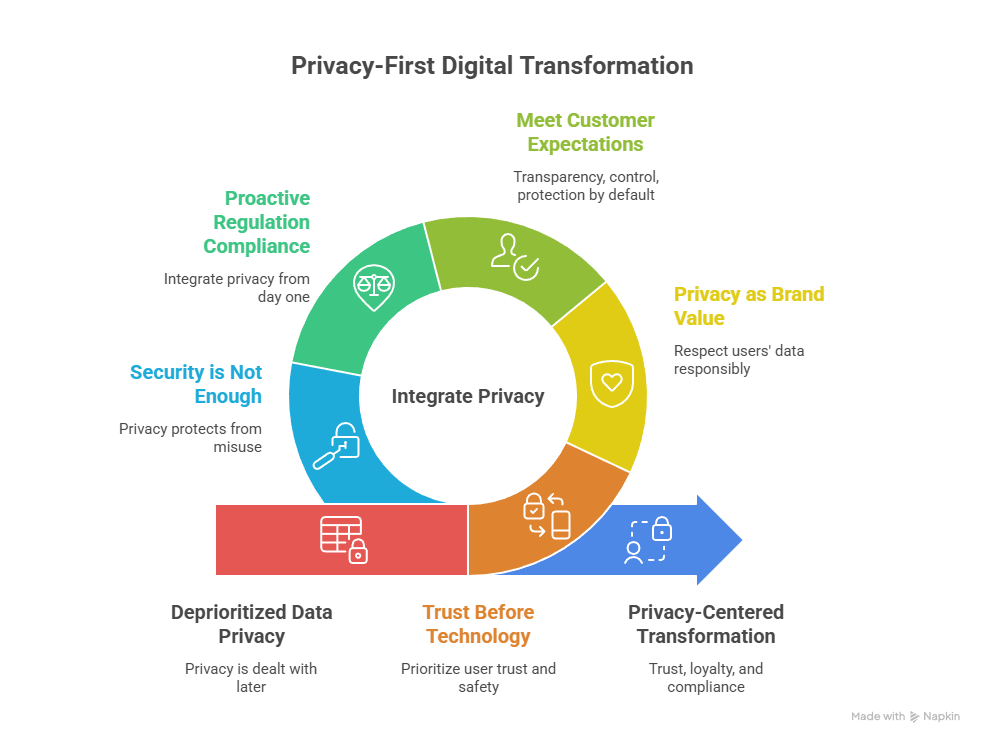
Trust Before Technology
Why should we hide the truth from ourselves? Consumers are technologically illiterate with regard to the inner workings of your company. They could not care less if you use microservices or monoliths. What they do care about is whether their information is safe with you.
Giving away data, emails, credit card info, work files, and personal preferences is a trust move on people’s part. One time, if that trust is broken, regaining it will be extremely difficult.
Most of the time, digital transformation concentrates initially on the instruments, leaving the users to come later. However, the successful enterprises do the opposite. They create privacy-first systems where security is not taken for granted but is there naturally. When trust is placed before technology, then customer onboarding becomes less difficult, and loyalty is maintained for a longer period of time.
Privacy As Brand Value
Data privacy is beyond being only a compliance issue. It is a brand statement now. People opt for companies that they feel handle their data in the most responsible way.
Imagine a brand that very clearly explains the data it collects, the reasons for collection, and control options for users. It sends a resounding message: “We respect you.”
Respect leads to confidence. Confidence results in longer relationships. And it’s those long-term relationships that digital transformation is actually about.
Brands that consider privacy as one of their values do not need to?
During times of crisis over-explain themselves, as they already have gained credit.
Customer Expectations Changed
A decade ago, users would impulsively click “Accept”; that era is over. Major breaches, always-on news, and general awareness have brought behavioral changes.
Currently, customers require:
- Transparency rather than a hidden clause
- Control instead of assumptions
- Protection by default, rather than if requested
When digital platforms disregard these requirements, then the points of friction appear silently. People can still subscribe, but they will not fully interact. They will be reluctant to upload data, limit usage, or seek alternatives.
Privacy-centered transformation helps to get rid of that doubt and replace it with trust.
Regulation Reality
Let us have a look at the other side of the story. The regulations, such as GDPR, CCPA, along with other regulations, are not slowing down; they are amplifying. Moreover, the regulations are not only targeting big enterprises anymore.
But here is the important observation:
Companies that handle compliance as a last-minute problem always have difficulties. Those who integrate privacy in their systems from day one are able to adjust without any problems.
Privacy, being the centerpiece of digital transformation, makes compliance a byproduct rather than a burden. Team members have freedom from the constant legal risk firefighting and can focus on user experience improvements instead.
Security is Not Enough
Several companies consider security and privacy as one thing. They are interconnected, but not equal.
Security keeps the attackers away from the protected parts of the system. Privacy is about protecting people from misuse, overreach, and lack of control.
You can implement very powerful security measures and still lose user trust if the way their data is used remains unclear or they feel it is excessive. Proper digital transformation does not tilt the scale in favor of either. It both protects and respects data.
This change of thinking is vital. Privacy is not merely the stopping of hackers; it is giving due respect to the user’s wishes.
Designing with Privacy in Mind
A privacy-centered change in the way business is done starts from the very first step, the design stage. Not from the release. Not from the feedback. Right at the beginning.
This involves:
- Only collecting data that is absolutely necessary.
- Making permissions clear and giving the user the option to adjust them
- Using simple language to explain how data is being used
- Allowing users to be fully aware of their own data
Where a lot of teams stumble is that they conceal privacy deep within the settings. Privacy, however, should be there for everyone to see. When users are informed about how their data is being used, their anxiety lessens, and their engagement grows.
This is the point where well-planned UX meets moral obligation.
Internal Culture Shift
Digital transformation is not only about new technologies. The main point is the employees. Also, privacy should be part of the internal culture, not only the external communication.
Understanding the importance of privacy by the teams changes decision-making in a very natural way. Product managers, before deciding on adding unnecessary tracking, stop and think once more. Marketers concentrate on consent-based data. Developers put their efforts into creating systems that help users to be less exposed by default.
This common mentality not only lessens the company’s risk but also does not slow down the innovation process. Actually, in most cases, it speeds up as teams create with confidence instead of being afraid.
Long-term Growth Protection
Short-term growth is still possible without having good privacy practices in place. But long-term growth is out of the question.
Each data breach, misuse incident, or unclear policy is a little step away from trust. In the end, acquiring new customers becomes more costly. Customer retention lowers. Reputation gets damaged.
A privacy-focused digital transformation is the best way to keep growth sustainable. It works like a firm base from where upscaling does not mean bringing disorder or risk. Such businesses are the ones that do not lose their cool when tech advances; instead, they adjust.
Collaboration Needs Privacy
The contemporary way of working is collaborative. Teams are sharing files, messages, plans, and even their most sensitive talks via digital platforms daily. Without strong privacy principles, collaboration tools would be more of a threat than a help.
This is the reason why the introduction of platforms for digital collaboration has to be done with privacy as the main infrastructure, rather than a feature that can be added on. Productivity, as a result, goes up naturally when teams have confidence in the environment they are working in.
Privacy doesn’t put the brakes on teamwork. On the contrary, it helps turn collaboration into a long-term practice.
Need A Reliable Partner for Future-Proof Digital Transformation?
In the era where data is the fuel for decisions, personalization, and growth, privacy is the thing that holds the whole structure stable.
As companies shift their focus towards data privacy in the process of their digital transformation, they are not simply keeping away from risk; they are gaining trust, loyalty, and relevance in the long run. Customers get the feeling that they are being respected, teams get the feeling that they are strong, and growth gets the feeling that it is safe.
Colladome enables modern teams to support this privacy-first approach without losing the freedom to collaborate, create, and innovate in secure and transparent digital environments. The future of transformation is not only digital, but it is also dependable.