Mastering Your Web Development Technology Stack: A Strategic Guide for Business Leaders
In today’s fast-paced digital landscape, the strategic decision of choosing the right web development technology stack directly dictates your business’s trajectory. Many leaders grapple with technology choices that inadvertently hinder growth, compromise operational efficiency, and limit future scalability. A misstep here can lead to significant financial drain and missed market opportunities. This guide empowers you to navigate these complex decisions with clarity, transforming potential pitfalls into pathways for success. By making informed, strategic choices, businesses can accelerate innovation, achieve unparalleled efficiency, and secure a lasting competitive advantage in their respective markets.
The Hidden Costs of a Mismatched Technology Stack
Founders, CXOs, and decision-makers frequently grapple with the profound business pain points stemming from a misaligned web development technology stack. Opting for generic or outdated solutions, often seen as cost-savers initially, inevitably leads to significant long-term repercussions. These include escalating maintenance costs, as the system struggles to adapt to evolving business needs, contributing to substantial tech debt impact. Performance bottlenecks become common, resulting in slow performance and poor user experiences, directly impacting customer retention and conversion rates.
Furthermore, a poorly chosen stack inherently introduces scalability limitations, hindering growth as the business expands. Critical security vulnerabilities emerge, exposing sensitive data and eroding customer trust. Attracting and retaining top-tier development talent becomes a formidable custom software development challenge, as skilled professionals are disinclined to work with obsolete technologies. Ultimately, these issues translate into tangible business consequences: decreased revenue, crippled operational efficiency, and a severe reduction in market responsiveness, making it impossible to pivot or innovate effectively. The initial “savings” are dwarfed by the strategic costs of an unsuitable foundation.
Strategic Tech Stack Selection: Your Foundation for Digital Growth
In today’s dynamic digital landscape, the fundamental solution to achieving sustainable business objectives lies in strategically choosing the right web development technology stack. This critical decision forms the bedrock for all your digital initiatives, addressing core challenges related to performance, security, and adaptability. A meticulously selected stack provides a robust, scalable, and secure foundation essential for developing impactful custom software and web development projects.
Its effectiveness extends beyond mere functionality, driving innovation and significantly improving user experience. By investing in future-proof technology choices, businesses can drastically reduce long-term maintenance costs and enable rapid adaptation to evolving market demands. The tangible business outcomes include enhanced competitive advantage, improved operational agility, and sustainable growth, allowing enterprises to thrive in an increasingly digital-first world. This strategic approach ensures your digital platforms are not just built, but engineered for enduring success.
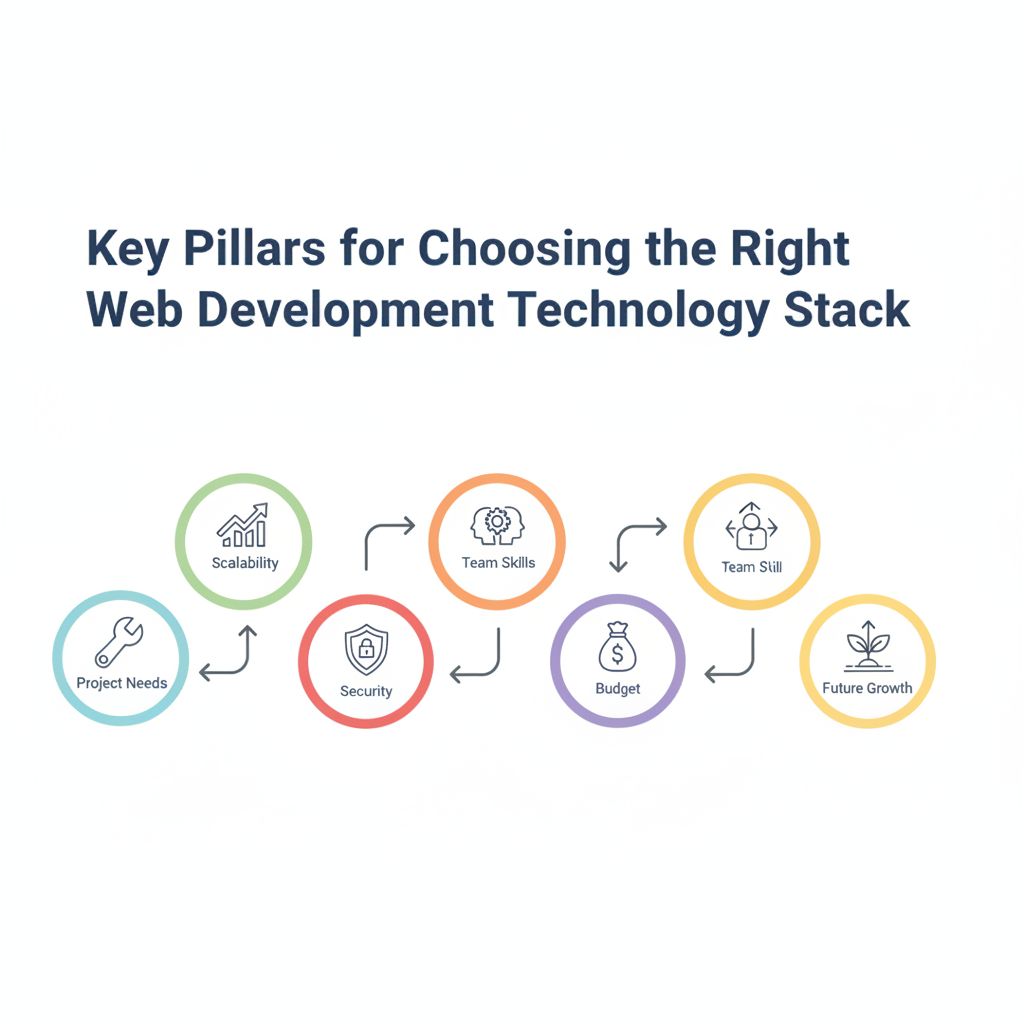
Key Pillars for Choosing the Right Web Development Technology Stack
- Project Scope & Requirements: Relying on generic solutions often leads to misaligned functionality and wasted resources, failing to meet specific business objectives. To counter this, conduct a thorough analysis to define precise project scope, user stories, and functional requirements. This informed approach enables the selection of an optimal technology stack that aligns perfectly with unique needs. The outcome is efficient development, precise functionality, and avoidance of costly reworks, delivering a solution that truly serves its purpose.
- Scalability & Performance: An inadequately chosen stack can quickly become a bottleneck as user traffic or data volume grows, leading to slow load times and poor user experience. The solution involves prioritizing technologies known for their ability to scale horizontally and handle high demands, such as robust backend development frameworks and efficient databases. This ensures the platform can grow with your business. The outcome is seamless expansion, superior performance under load, and support for future business growth without requiring a complete re-platforming.
- Team Expertise & Ecosystem: Adopting a technology stack unfamiliar to your current development team can lead to talent gaps, slower development cycles, and increased hiring costs. The strategic solution is to leverage your team’s existing skill sets or choose custom software development frameworks with robust community support and ample talent availability. This approach facilitates quicker adoption and efficient problem-solving. The outcome is accelerated development, minimized onboarding time, reduced recruitment expenses, and a more productive and confident development team.
- Security & Compliance: Neglecting security considerations in web development can result in severe data breaches, reputational damage, and hefty regulatory fines. To mitigate this, prioritize an optimal technology stack selection that incorporates strong security features, regular updates, and compliance with industry standards and data privacy regulations. The critical outcome is the protection of sensitive assets, maintenance of user trust, ensured legal adherence, and mitigation of significant financial and reputational risks for the business.
- Maintenance & Future-Proofing: Choosing obscure or poorly supported technologies can lead to high maintenance costs, difficulty finding skilled developers, and rapid obsolescence. The solution is to opt for an optimal technology stack selection with active communities, clear roadmaps, and long-term support. Considering open-source options often provides greater flexibility and sustainability. The outcome is ensured long-term viability of the application, reduced total cost of ownership, and easier updates and feature enhancements as business needs evolve.
Aligning Technology with Business Objectives
Defining Core Business Goals
Clearly articulating business objectives – whether market entry, operational efficiency, or enhanced customer engagement – directly informs your technology stack choices. This ensures every component, from database to user interface, actively supports strategic outcomes. A robust foundation guarantees that your digital transformation efforts are purpose-driven, maximizing ROI and business impact.
Impact on Time-to-Market
Adopting agile and efficient software development methodologies and technologies is crucial for competitive advantage. By streamlining development cycles, businesses can launch new products or features faster, capture emerging market share, and respond dynamically to industry shifts. This proactive approach ensures sustained revenue growth and strengthens market positioning.
Future-Proofing for Innovation
Selecting a flexible technology stack is paramount for long-term relevance. It must facilitate seamless AI integration, machine learning, and other emerging technologies. This forward-thinking strategy ensures your enterprise solutions remain adaptable, scalable, and capable of leveraging future innovations, securing sustained growth and competitive edge.
Technical Considerations for Optimal Performance
Scalability and Growth Potential
The chosen web application development stack must inherently support anticipated user growth and increasing data volumes without compromising performance. This is non-negotiable for enterprise solutions, where consistent availability and speed directly impact customer satisfaction and operational efficiency, safeguarding revenue streams and supporting business expansion.
Security and Data Integrity
Robust security features are critical within any tech stack to protect sensitive business and customer data. Implementing advanced measures fosters trust, ensures regulatory compliance, and mitigates financial risks associated with breaches. Prioritizing data privacy is fundamental for maintaining brand reputation and avoiding costly disruptions.
Maintainability and Support Ecosystem
A well-documented, widely supported technology stack significantly reduces long-term maintenance overhead. It ensures access to a broad talent pool for ongoing custom software development and swift issue resolution. This ecosystem stability translates to lower operational costs and greater efficiency, protecting your technology investment.
Financial and Resource Management
Understanding Total Cost of Ownership (TCO)
Beyond initial software development, a comprehensive TCO evaluation must include licensing, infrastructure, and ongoing maintenance costs. Disregarding these can lead to unexpected budget overruns. A holistic view ensures financial predictability, optimizing resource allocation and maximizing the long-term ROI of your technology investments.
Leveraging Existing Team Expertise
Aligning the chosen tech stack with your current team’s skills is a strategic imperative. This approach accelerates development timelines, significantly reduces training costs, and improves project efficiency for custom web development initiatives. Maximizing internal capabilities ensures smoother adoption and faster realization of business benefits.
Open-Source vs. Proprietary Solutions
The choice between open-source frameworks and proprietary platforms carries distinct financial and flexibility implications. Open-source can offer cost savings and community support, while proprietary solutions may provide dedicated vendor support and integrated features. Strategic decision-making here impacts budget, control, and future scalability for enterprise solutions.
Driving Growth Through Digital Transformation
Embracing AI for Operational Excellence
AI integration streamlines processes, automates repetitive tasks, and provides predictive insights, directly translating into significant operational efficiencies and cost savings. For enterprise solutions, this means optimized resource utilization, reduced human error, and enhanced decision-making, ultimately boosting profitability and competitive advantage.
Enhancing Customer Experience with Custom Software
Custom software development enables personalized customer journeys, improves engagement, and fosters loyalty through superior digital experiences. By tailoring solutions to specific customer needs, businesses can significantly boost satisfaction, increase retention, and ultimately drive higher revenue and market share in a competitive landscape.
Accelerating Market Reach with Web Applications
Robust web application development is pivotal for expanding market access and supporting diverse business models. It facilitates global scalability, enabling rapid growth and securing a competitive advantage in the digital economy. A well-executed web application acts as a powerful revenue driver and a cornerstone of your digital presence.
Data-Driven Decision Making for Revenue Growth
Strategic digital transformation, powered by advanced analytics and AI, empowers businesses to extract actionable insights from vast datasets. This capability optimizes marketing strategies, refines product offerings, and enhances operational efficiency, leading directly to increased revenue, improved profitability, and a stronger competitive position in the market.
| Criteria | Legacy Stack (e.g., LAMP, Older .NET) | Modern Stack (e.g., MEAN/MERN, JAMstack, Serverless) | Business Impact |
|---|---|---|---|
| Development Speed | Slower iteration cycles due to monolithic architecture, complex dependencies, and manual deployment processes. | Faster development with modular components, reusable APIs, and efficient CI/CD pipelines, enabling rapid prototyping and deployment. | Quicker time-to-market for new features and products, allowing businesses to respond swiftly to market demands and gain a competitive edge. |
| Scalability | Primarily vertical scaling, often hitting performance ceilings and requiring significant effort for horizontal expansion. | Designed for horizontal scaling with microservices and serverless architectures, effortlessly handling traffic spikes and growth. Essential for scalable applications. | Ensures applications can grow seamlessly with user demand without performance bottlenecks, preventing downtime and supporting exponential business growth. |
| Maintenance Costs | Higher operational costs due to complex legacy codebases, manual updates, and the need for specialized, often scarce, expertise. | Lower costs through modularity, automated testing, active open-source communities, and easier debugging. Supports efficient custom software development. | Reduces long-term operational overhead, freeing up budget for innovation and strategic investments rather than reactive fixes. |
| Security | More susceptible to known vulnerabilities if not consistently updated, with patching often being a complex and risky process. | Enhanced security with regular updates, robust frameworks, built-in features, and isolated microservices architectures. Crucial for building trust in modern platforms. | Stronger protection against cyber threats, safeguarding sensitive data and ensuring customer trust and regulatory compliance. |
| Talent Availability | Shrinking pool of developers with expertise in older technologies, leading to higher recruitment costs and slower project execution. | Vast and growing global talent pool, making it easier and more cost-effective to find skilled developers for modern stacks. | Ensures project continuity, faster hiring, and access to cutting-edge expertise, supporting the growth of growing businesses. |
| Innovation Potential | Limited by technological constraints, making it difficult and costly to integrate new features or emerging technologies like AI/ML. | High potential for innovation due to flexible architecture, API-first approach, and seamless integration with AI/ML, IoT, and other advanced tech. | Enables rapid adoption of new technologies and business models, driving competitive advantage and ensuring the business is future-proofed. |
| Cloud Integration | Challenging and often requires significant refactoring to migrate, as they are not inherently cloud-native. | Cloud-native by design, offering seamless integration with public cloud services (AWS, Azure, GCP) and serverless options for optimal resource utilization. Leverages cloud DevOps services. | Unlocks benefits like cost efficiency, global distribution, and enhanced disaster recovery, boosting operational flexibility and resilience. Essential for choosing the best cloud service provider. |
Real-World Impact: How Strategic Tech Stacks Drive Business Success
Choosing the right web development technology stack is a strategic imperative for business success, enabling innovation, scalability, and measurable outcomes. Consider these impactful scenarios:
- E-commerce Platform Scaling: A rapidly growing online retailer needed a scalable custom solution for peak traffic and AI-driven personalization. Adopting a modern, cloud-native e-commerce stack achieved 99.9% uptime, reduced operational costs by 15%, and saw a 20% increase in conversion rates through AI personalization.
- Enterprise Operational Efficiency: A manufacturing firm aimed to digitize processes and integrate disparate systems. A carefully selected enterprise software development stack enabled seamless data flow and automated key workflows. This resulted in a 30% improvement in operational efficiency and faster decision-making, leveraging ERP solutions.
- Innovative SaaS Product Launch: A startup launching a cutting-edge SaaS product required complex data processing and real-time analytics. Their choice of a high-performance, flexible tech stack facilitated rapid iteration, secure data handling, and easy integration of machine learning models, securing early investor interest and market adoption.
These examples highlight how strategic technology choices are fundamental to achieving ambitious business goals and fostering sustainable growth.
Businesses exploring custom software development solutions often face complex choices, from selecting the right technology stack to integrating advanced capabilities like AI. Similarly, decision-makers evaluating their next digital transformation initiative understand the critical need for robust, scalable platforms. Navigating these paths successfully requires more than just technical skill; it demands strategic foresight and a deep understanding of evolving market needs. Partnering with a trusted expert can bridge this gap, ensuring your vision translates into a high-performing digital product that drives efficiency and competitive advantage. We help enterprises and SMEs unlock their potential through tailored, future-proof solutions.
Empowering Your Digital Future with Strategic Tech Choices
In today’s rapidly evolving digital landscape, choosing the right web development technology stack is not merely a technical detail but a foundational strategic decision that profoundly impacts your business’s future. A well-selected stack ensures your digital platform is inherently scalable, capable of handling increased user loads and future expansions without costly overhauls. It drives operational efficiency by streamlining development processes and reducing maintenance overhead, allowing your teams to innovate faster. Furthermore, it provides a significant competitive advantage, enabling quicker market entry, superior user experiences, and robust security. By prioritizing this critical choice, businesses can build resilient, high-performing digital solutions that truly align with their long-term goals. If your organization is ready to transform its digital presence and ensure sustained growth, consider a strategic consultation to explore how a tailored web development technology stack can unlock your full potential.