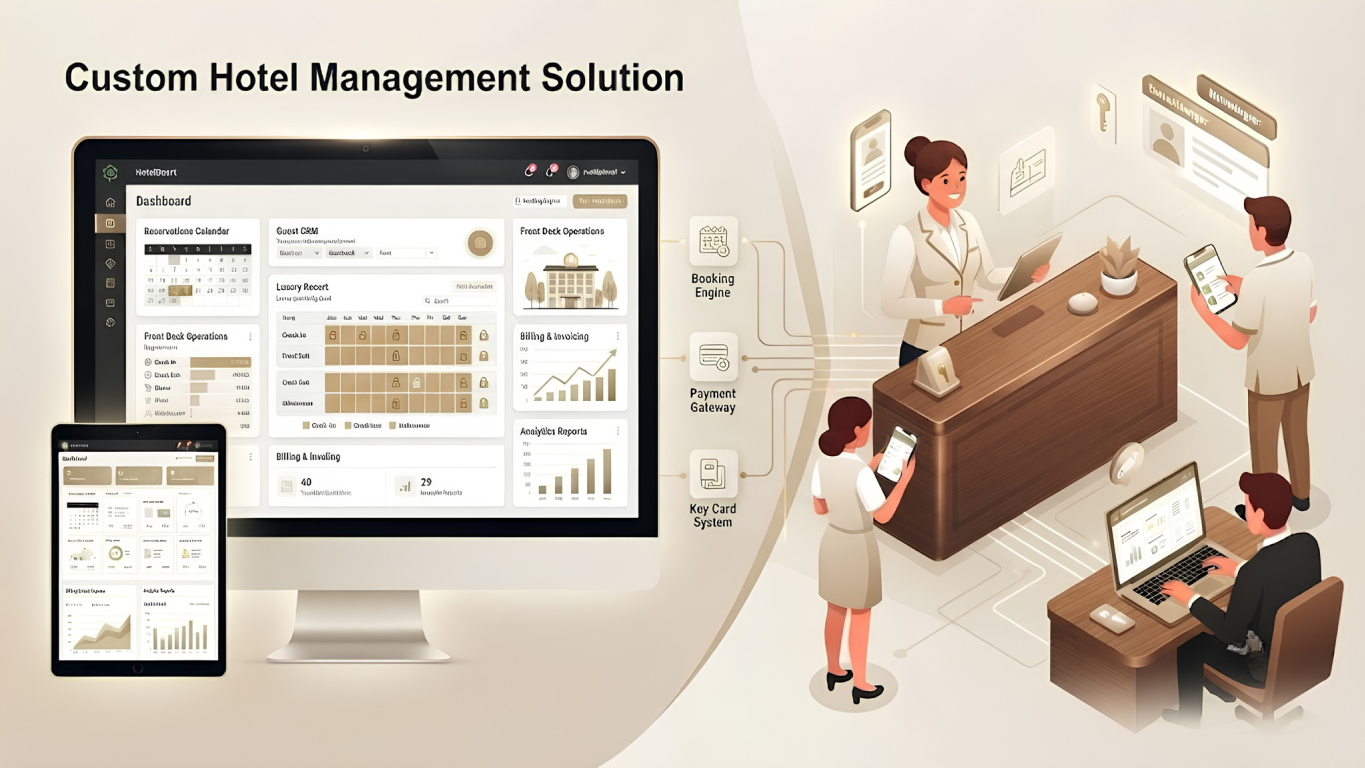

Running a modern hotel involves much more than accepting reservations and assigning rooms. Hotel teams have to manage bookings, room availability, guest information, billing, housekeeping, staff coordination, payments, reports, and customer communication at the same time. When these activities are handled through spreadsheets, separate applications, or manual processes, errors can quickly affect both operational efficiency and the guest experience.
This is where custom hotel management software for hotels can make a significant difference.
Unlike a standard system that provides the same features to every property, custom hotel management software can be designed around the actual workflow of a hotel, resort, serviced apartment, hostel, or multi-property hospitality business. The software can bring important operations together in one centralized platform while allowing the business to add integrations and features as it grows.
What Is Custom Hotel Management Software?
Custom hotel management software is a digital platform developed specifically around the operational requirements of a hospitality business. It can combine property management, reservations, guest management, billing, housekeeping, reporting, and other workflows into a single system.
A standard hotel PMS may work well for common requirements, but every property has its own way of handling room categories, packages, check-ins, guest services, billing, staff responsibilities, and reporting.
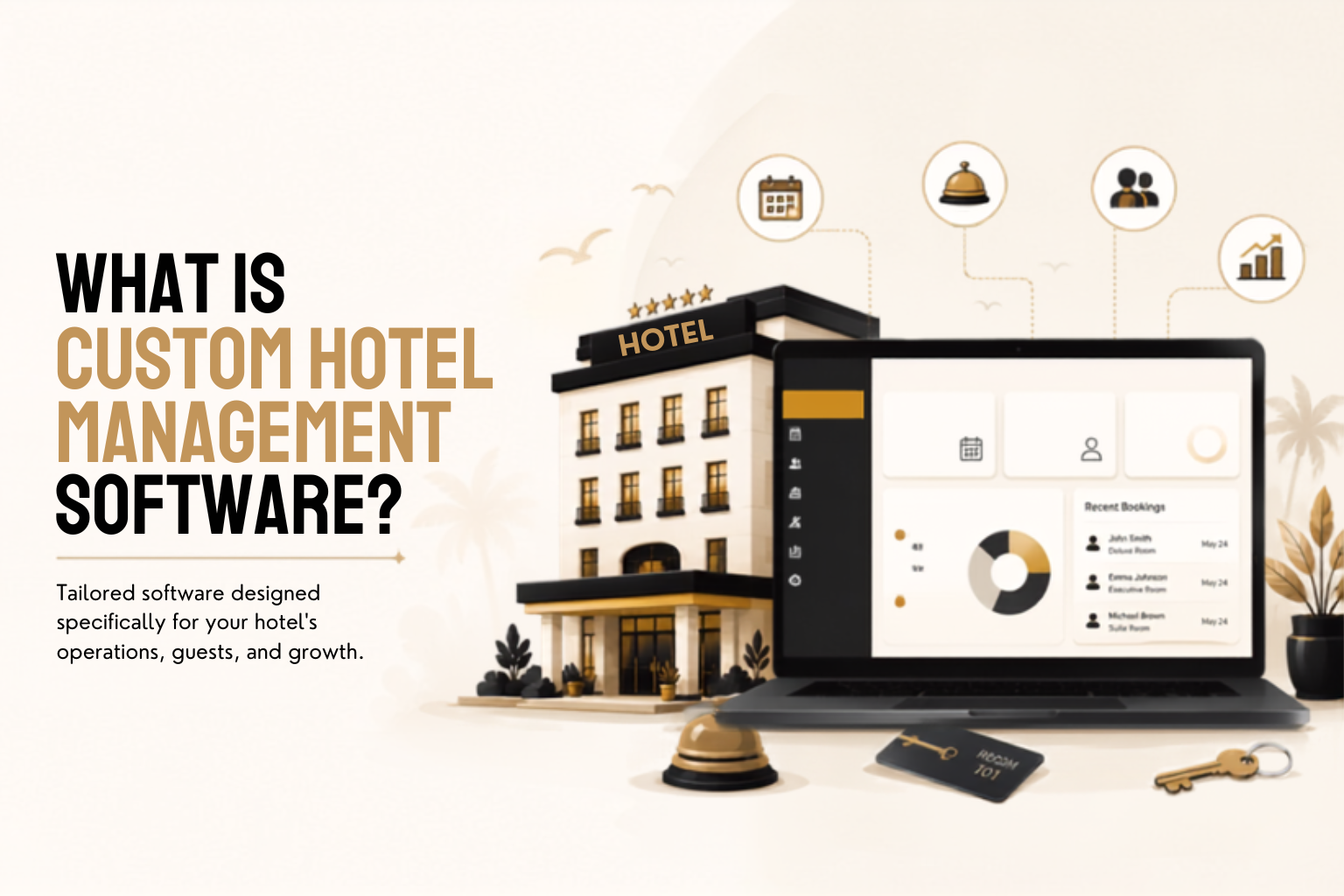
A customized platform allows these workflows to be configured according to business requirements.
For example, a hotel may need:
- Centralized room and reservation management
- Online booking functionality
- Guest profile and booking history
- Automated check-in and check-out workflows
- Housekeeping task management
- Billing and invoice generation
- Payment gateway integration
- OTA and channel integrations
- Restaurant or POS integration
- Staff management
- Business dashboards and reports
- Multi-property management
- WhatsApp, SMS, or email notifications
This approach can make the software more relevant to the hotel’s day-to-day operations instead of forcing staff to adapt to an inflexible system.
Why Hotels Are Moving Towards Custom Software
Hospitality businesses deal with high volumes of time-sensitive information. A room that becomes available, a cancelled reservation, a payment, or a housekeeping update may need to be reflected across multiple departments.
When systems are disconnected, employees may spend unnecessary time checking different platforms and updating information manually.
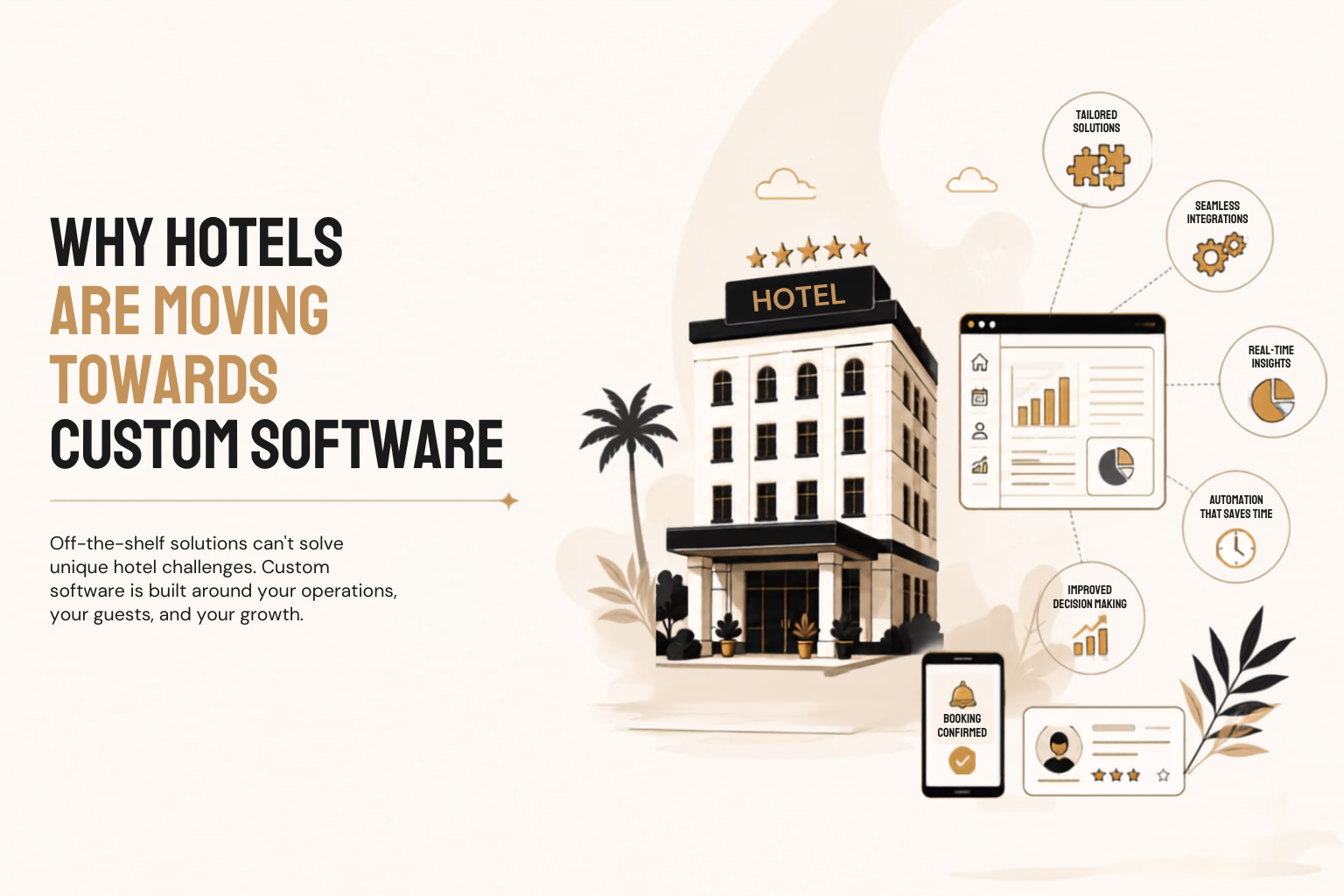
A centralized hotel management software solution can provide one operational view.
| Hotel Operation | How Custom Software Can Help |
| Reservations | Manage bookings and room availability |
| Front Desk | Simplify check-in and check-out |
| Housekeeping | Track room cleaning and room status |
| Billing | Generate invoices and manage payments |
| Guest Management | Store profiles and booking history |
| Reporting | Monitor occupancy, revenue and operations |
| Staff Management | Assign and track operational tasks |
| Multi-Property | Manage multiple locations centrally |
The biggest advantage is not simply having more features. It is having the right features connected to the hotel’s actual workflow.
Key Features of Custom Hotel Management Software
1. Reservation and Booking Management
A strong reservation module can provide a centralized view of upcoming, active, cancelled, and completed bookings. Staff can check room availability, assign rooms, modify reservations, and manage booking information from one interface.
For hotels receiving reservations through different channels, integrations can also help synchronize availability and reduce the possibility of conflicting bookings.
2. Front Desk Management
The front desk is one of the most important parts of hotel operations. Custom software can simplify daily activities such as guest check-in, room allocation, check-out, guest requests, and booking modifications.
A clean dashboard can help reception teams quickly understand which rooms are occupied, available, reserved, under maintenance, or awaiting housekeeping.
3. Housekeeping Management
Housekeeping teams need accurate room-status information to prioritize their work.
With a centralized system, staff can update room conditions in real time and assign cleaning or maintenance tasks. Front-desk employees can then see when a room is ready for the next guest.
4. Billing and Payment Management
Manual billing can create unnecessary delays and errors. Custom hotel software can connect billing workflows with reservations and other hotel services.
Depending on requirements, businesses can integrate payment gateways, accounting systems, tax calculations, receipts, and invoice generation into the platform.
5. Guest Management
Guest information is valuable for delivering a more personalized experience. A custom system can maintain booking history, preferences, communication records, and other relevant information in one place.
This can help hotel teams understand returning guests and provide faster service without repeatedly collecting the same information.
Custom Software vs Standard Hotel PMS
The right choice depends on the property’s requirements.
A standard PMS may be suitable for a hotel looking for common features and a quick setup. However, businesses with unique workflows, specialized integrations, multiple properties, or specific reporting requirements may benefit more from a custom solution.
The objective should not be to build software simply because it is custom. The objective should be to create a system that solves genuine operational problems and can adapt as the business grows.
For hotels planning long-term digital transformation, custom hospitality software can provide greater flexibility across operations, integrations, and future product development.
How Is Custom Hotel Management Software Developed?
Building a custom hotel management platform starts with understanding how the property currently operates. Instead of beginning with a fixed list of features, the development team identifies operational challenges, user roles, integrations, and future requirements.
A typical development process includes the following stages:
1. Requirement Discovery
The first step is understanding the hotel’s business model and operational workflow.
The development team may review:
- Number of rooms and properties
- Booking channels
- Front-desk processes
- Housekeeping workflows
- Billing requirements
- Payment methods
- Staff responsibilities
- Guest communication
- Reporting requirements
- Third-party integrations
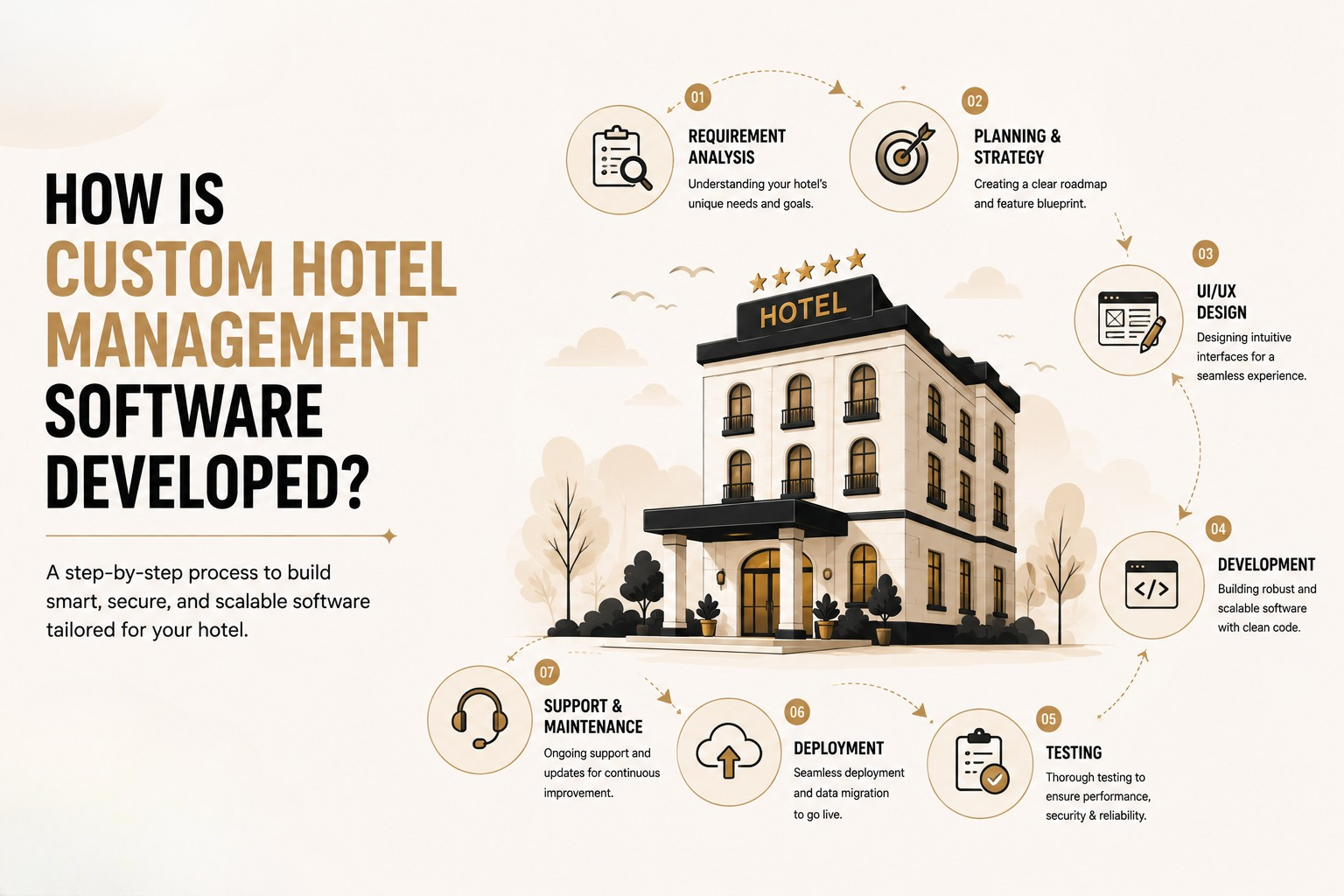
This helps create a software roadmap based on actual business requirements.
2. UI/UX Design and Prototyping
The software should be easy for receptionists, managers, housekeeping teams, and administrators to use.
During this stage, dashboards, booking screens, room-management interfaces, guest profiles, reports, and mobile experiences can be designed before development begins.
A clear interface is particularly important in hospitality because employees often need to complete tasks quickly while serving guests.
3. Software Development
Once the design and functionality are approved, developers build the platform’s frontend, backend, database, APIs, and required integrations.
Depending on the project, the solution can include a web-based management dashboard, mobile application, booking engine, guest portal, or other digital interfaces.
4. Integration
A hotel rarely operates in isolation. The new platform may need to communicate with existing systems such as payment gateways, accounting software, booking platforms, POS systems, communication tools, or OTA channels.
API-based integrations can help different systems exchange information without requiring employees to repeatedly enter the same data.
5. Testing and Quality Assurance
Before deployment, the software should be tested across different workflows.
Important areas include:
- Booking accuracy
- Room availability
- Billing calculations
- Payment processing
- User permissions
- Data security
- Mobile responsiveness
- API integrations
- Performance
- Error handling
Testing is particularly important for reservation systems because incorrect availability or booking information can directly affect hotel operations.
6. Deployment and Continuous Improvement
After testing, the system can be deployed for actual use. Training and documentation can help employees understand the new workflow.
Development should not necessarily end after launch. Hotels may later require new integrations, dashboards, automation features, AI capabilities, or support for additional properties.
Colladome describes its hospitality development approach around discovery, prototyping, technology integration, testing, deployment, and continuous improvement.
What Integrations Can a Hotel Management System Support?
Integrations can be one of the biggest advantages of developing a customized platform.
Depending on the hotel’s requirements, a custom hotel management software solution can potentially connect with:
| Integration | Purpose |
| Payment Gateway | Online payments and transaction processing |
| OTA Platforms | Manage reservations from external booking channels |
| Booking Engine | Increase direct website bookings |
| POS System | Connect restaurant and hotel services |
| Accounting Software | Synchronize financial information |
| WhatsApp/SMS | Booking confirmations and guest communication |
| Automated reservation and service notifications | |
| CRM | Manage guest relationships and communication |
| Access Control | Support digital or smart room access |
| Analytics | Monitor revenue, occupancy and performance |
The exact integrations should be selected according to the hotel’s technology environment rather than added simply to increase the feature list.
How Custom Hotel Software Can Improve Hotel Operations
The primary purpose of a custom system is to solve operational problems.
For example, when reservation, room status, housekeeping, and guest information are connected, employees can spend less time switching between disconnected systems.
A centralized dashboard can also help management understand important business metrics.
Potential benefits include:
Better Operational Visibility
Managers can view reservations, occupancy, room status, revenue, and other operational information from centralized dashboards.
Reduced Manual Work
Automating repetitive activities such as booking notifications, invoices, room-status updates, and reports can reduce unnecessary administrative work.
Improved Guest Experience
Faster check-in, accurate booking information, digital communication, and easier service requests can contribute to a smoother guest journey.
Greater Scalability
A system designed around the hotel’s future requirements can be expanded when the business adds rooms, services, locations, or new operational processes.
More Control Over the Technology
With a custom platform, the business can define workflows and integrations according to its requirements instead of depending entirely on the limitations of a generic PMS.
How Much Does Custom Hotel Management Software Cost?
There is no single price for custom hotel management software.
The total development cost depends on the complexity and scope of the project.
Major cost factors can include:
- Number of software modules
- Web and mobile application requirements
- UI/UX complexity
- Booking engine
- OTA integrations
- Payment gateway integration
- POS and accounting integrations
- AI or automation requirements
- Number of properties
- User roles and permissions
- Cloud infrastructure
- Security requirements
- Ongoing maintenance
A simple hotel management platform will naturally require a different investment from a multi-property enterprise platform with advanced integrations and automation.
For this reason, hotels should first define their requirements and development roadmap before comparing prices.
Why Choose Custom Hotel Management Software Instead of a Generic PMS?
A generic PMS can be an effective choice when a property needs standard functionality and wants to start quickly.
Custom development becomes more attractive when a business has specific workflows that existing platforms cannot accommodate.
For example, a hotel group may require a centralized multi-property dashboard, a unique booking workflow, custom guest applications, specialized reporting, or integration with an existing enterprise system.
The decision should therefore be based on business requirements, scalability, integrations, and long-term technology goals, rather than simply comparing monthly subscription prices.
Why Colladome for Custom Hotel Management Software?
Colladome provides custom software and technology solutions across the hospitality and travel industry, including Hotel & Resort Management and Custom Hospitality Software. Its hospitality offering focuses on streamlining room management, staff coordination, guest services, booking workflows, and digital experiences.
The company also showcases hospitality work through its Staymaster case study, which involved website development, automation, booking-system optimization, payment tracking, and a contactless guest experience.
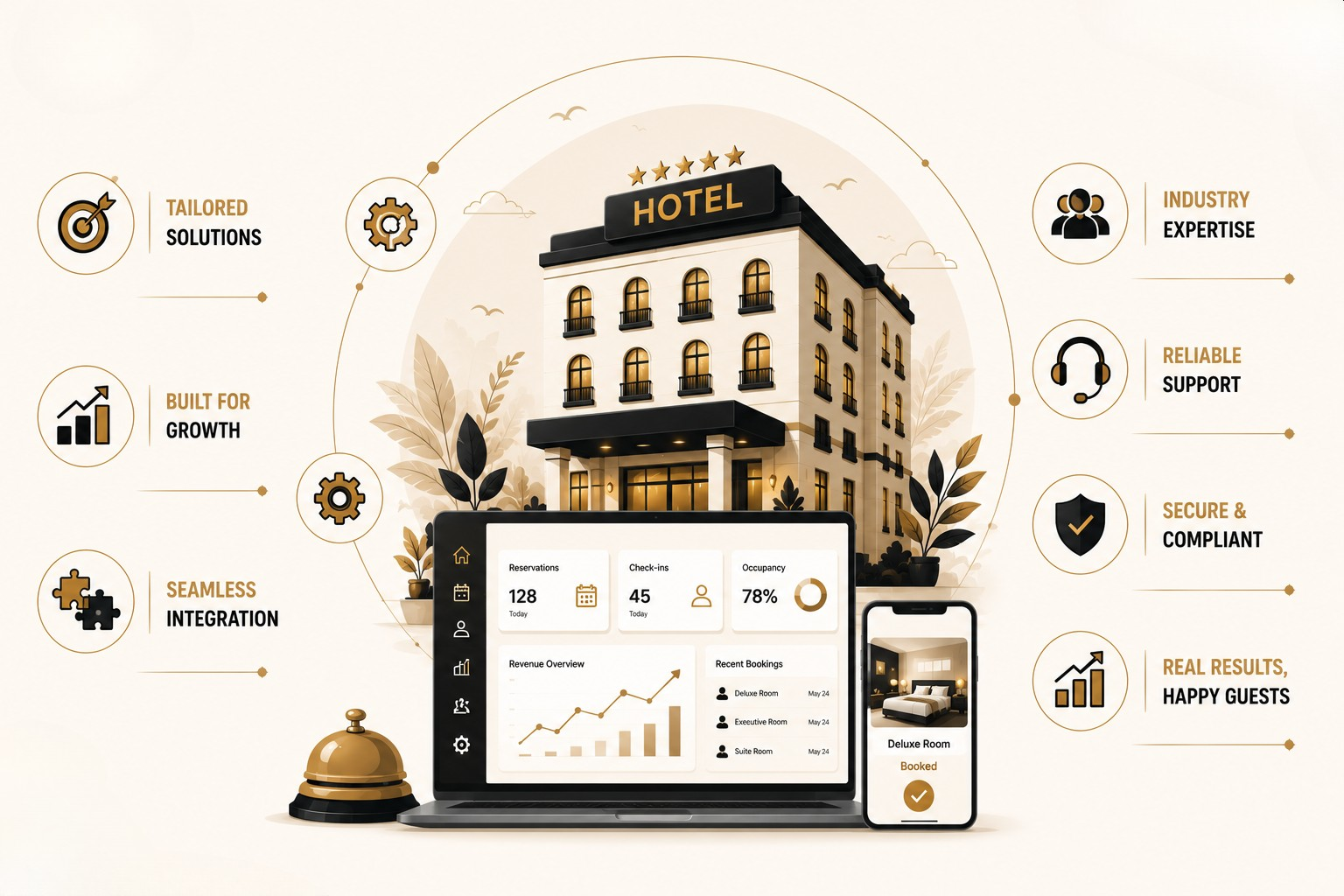
For a hotel, resort, or hospitality business considering custom software, the development process can begin with identifying the current operational gaps and creating a roadmap for the required technology.
Custom Hotel Management Software: Implementation Checklist
Before starting development, hotel owners and management teams should evaluate:
- Current booking and reservation process
- Number of properties and rooms
- Front-desk workflow
- Housekeeping process
- Billing and payment requirements
- OTA and booking integrations
- Guest communication requirements
- Mobile application requirements
- Staff roles and permissions
- Reports and analytics
- Existing software integrations
- Data security requirements
- Future expansion plans
- Maintenance and support requirements
A clear checklist can help prevent unnecessary features from increasing project complexity while ensuring important operational requirements are not missed.
Final Thoughts
The future of hotel operations is increasingly connected, automated, and data-driven. A hotel management platform should therefore do more than store reservations. It should connect the workflows that employees and guests interact with every day.
Custom hotel management software for hotels provides an opportunity to build that technology around the property’s actual requirements.
From reservation and front-desk management to housekeeping, billing, guest communication, analytics, and integrations, a properly planned platform can create a more connected operational environment.
For hotels and hospitality businesses in India looking to modernize their technology, the first step is not choosing software features. It is understanding the operational challenges that the software needs to solve.
Colladome‘s hospitality and travel solutions include hotel and resort management and custom hospitality software, providing a starting point for businesses looking to build tailored digital solutions for their hospitality operations.
Looking to build a custom hotel management platform? Start by mapping your current hotel operations, identifying the biggest gaps, and defining the integrations and features your business actually needs.f