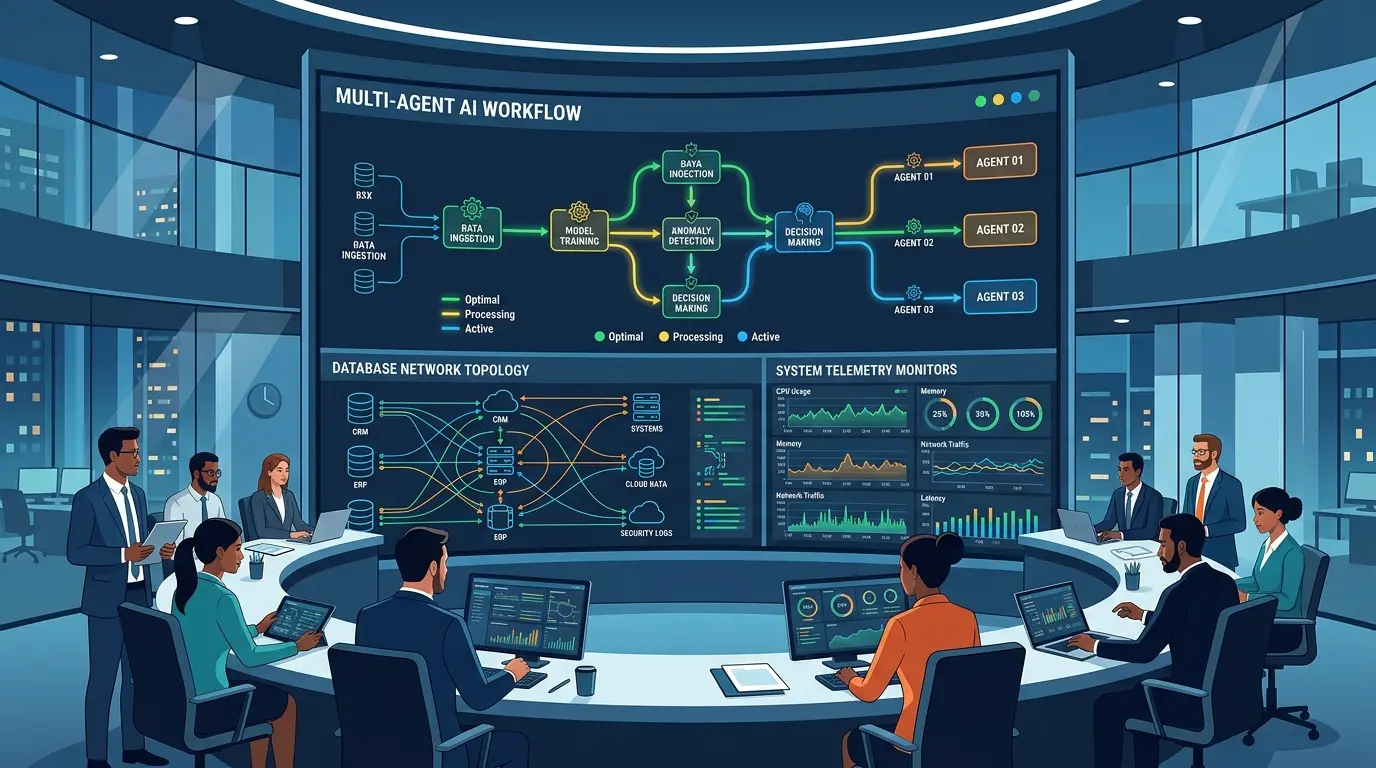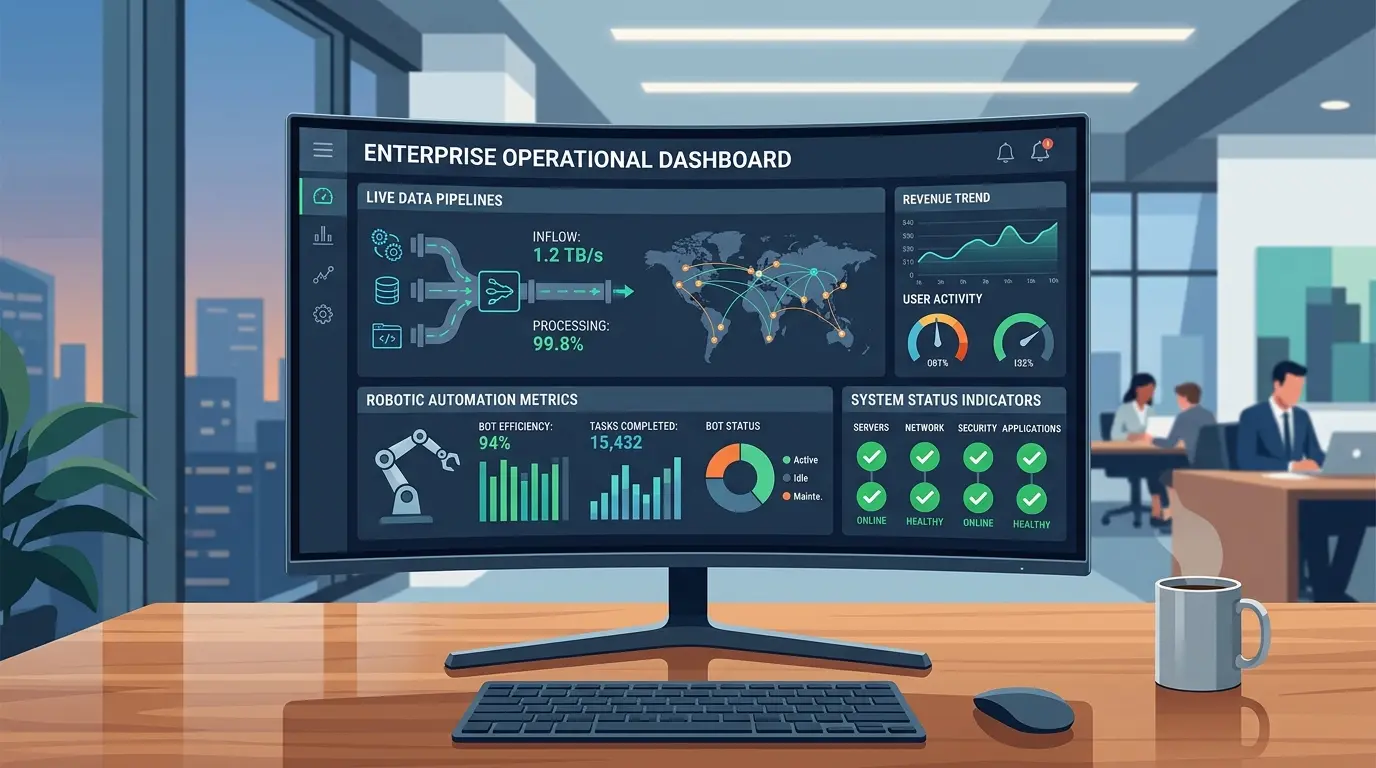

Business process automation with AI is the architectural orchestration of enterprise workflows through machine learning models, optical character recognition (OCR), natural language processing, and autonomous decision logic that ingest unstructured data, resolve operational exceptions, and synchronise legacy databases without human intervention.
Where conventional software requires deterministic if-then scripts, deploying business process automation with AI allows expanding enterprises to replace brittle task automation with adaptive, continuous systems that process transactions and reduce human operational drag across critical operations.
The Hidden Operational Tax of Fragmented SME Workflows
Operational bottlenecks emerge silently across growing enterprises as disconnected software stacks proliferate. Founders and operations heads often attempt to bridge disparate applications using basic robotic process automation tools or manual spreadsheet manipulation. This approach introduces an unsustainable operational tax. Traditional robotic process automation limitations surface immediately when an enterprise encounters variable invoice layouts, non-standard contractual language, or edge-case customer exceptions.
When an internal team spends hundreds of hours re-entering records between billing portals and core systems, error rates escalate and turnaround cycles degrade. Off-the-shelf automation tools merely shift operational overhead from one silo to another, leaving core bottlenecks unaddressed. According to research by McKinsey & Company, systematic process automation using advanced machine learning models can yield up to a 20 percent reduction in operational cost structures across data-heavy operational units. Without cognitive intelligence embedded directly at the integration layer, scaling transaction volumes will always demand linear, costly headcount expansion.
Architectural Shift: Custom AI Automation as an Operational Multiplier
Modern enterprise scaling demands an architectural shift away from point-and-click automation recipes toward dedicated intelligent orchestration. Rather than applying surface-level patches to legacy enterprise workflows, tailored cognitive layers ingest varied inputs, interpret semantic context, and trigger downstream executions across enterprise resource planning systems and internal databases.
Custom enterprise software engineering ensures these cognitive layers reflect your specific business logic. Bespoke machine learning algorithms and natural language parsing engines systematically remove manual friction from data validation, supply management, and client onboarding. Forward-thinking organisations seeking structural realignment often engage specialised AI business consulting before production development. This upfront audit assesses data hygiene, maps API dependencies, and guarantees that engineered automation frameworks solve root structural constraints rather than digitising existing procedural inefficiencies.
Strategic Implementation Pillars: From Bottleneck to Autonomous Execution
A resilient enterprise automation strategy requires phased technical pillars that address operational friction points directly through engineered outcomes:
- Unstructured Data Processing: Manual document sorting and keying consume vital staff hours. Solution: Deploy custom document extraction pipelines that pair neural OCR with transformer-based parsing models. Outcome: An 80% reduction in processing latency across inbound transactional documents.
- Dynamic Decision Routing: Intricate customer triage scenarios frequently stall approval queues when handled via brittle scripts. Solution: Implement predictive classification scoring that categorises complexity and evaluates risk profiles instantly. Outcome: Sustained SLA compliance rates and zero queue congestion during peak volume windows.
- Cross-System Legacy Synchronization: Incompatible API structures between legacy software databases and newer web services result in persistent data silos. Solution: Construct bespoke middleware connectors to orchestrate bi-directional, transactional data writes. Outcome: Real-time operational data consistency across internal departments without costly platform replacements.
- Continuous Workflow Optimization: Rigid logic fails to adapt as supplier agreements, transaction types, or product lines evolve over time. Solution: Integrate supervised machine learning feedback loops that retrain validation parameters on approved exception data. Outcome: Compounding accuracy gains and consistent margin improvements across all operational units.
Core Operational Dimensions of Enterprise AI Automation
Intelligent Document Processing Pipelines
Enterprises running high-volume logistics, procurement, or vendor operations face constant friction with non-standard paperwork. Implementing custom pipelines enables systems to parse unstructured invoices, delivery receipts, and vendor agreements directly into relational database records. By mapping unstructured text into structured database schemas, an organisation eliminates manual data entry completely while ensuring transactional data remains queryable across downstream accounting platforms.
Predictive Exception Handling and Triage
Operational queues frequently stall because edge cases require human intervention. Algorithmic scoring models evaluate incoming anomalies against historical approval datasets, resolving minor discrepancies without human supervision. When transactions match established confidence thresholds, the system executes reconciliation automatically, accelerating turnaround velocity and shielding customer-facing teams from manual exception firefighting.
Role-Based Access Control and Security Frameworks
Enterprise automation architectures must protect operational data integrity through granular technical safeguards. By integrating role-based access control, cryptographic key management, and zero-trust operational pipelines, engineering teams protect sensitive enterprise records during automated transfers. This ensures third-party models never expose internal records, preserving institutional data confidentiality and satisfying strict regulatory requirements.
Strategic Engineering vs Off-The-Shelf Automation SaaS
Data Governance and Proprietary IP Protection
Public multi-tenant SaaS tools expose enterprise data to external model-training risks and third-party data breaches. Bespoke engineering deploys models within dedicated virtual private clouds or secure private infrastructure, ensuring proprietary operational data never leaves company boundaries. This architectural isolation is critical for businesses operating under strict data governance regulations or protecting trade secrets.
Legacy Database and ERP Integration Architecture
Off-the-shelf tools rely on generic webhooks and shallow integrations that fail against legacy database schemas or proprietary software. Custom enterprise software engineering constructs purpose-built API connectors and event-driven middleware. This architecture reads, reconciles, and writes transactional records back to existing databases without requiring high-risk rip-and-replace software migrations.
Long-Term Total Cost of Ownership (TCO)
Standard SaaS subscription tiers penalise business growth with per-seat licensing, API call metering, and usage rate surcharges. Over several operating cycles, these recurring expenses exceed the initial investment of proprietary builds. Investing in custom enterprise software converts ongoing licensing fees into owned digital capital, providing predictable margins as transaction volumes scale.
Business Value Metrics and Operational Impact
Direct Labour Reallocation and Overhead Reduction
Eliminating repetitive clerical tasks liberates skilled personnel from administrative drudgery. Rather than matching invoices or manually verifying ledger entries, operational specialists transition toward strategic vendor negotiation, product development, and customer retention initiatives that directly impact top-line corporate growth.
Cycle Time Compression and SLA Adherence
Automated transactional pipelines process operational data around the clock without latency, fatigue, or operational backlogs. Accelerating processing cycles from days to seconds improves customer satisfaction, tightens cash-flow reconciliation intervals, and strengthens competitive market standing against slower industry peers.
Audit Trail Precision and Compliance Readiness
Manual data handling inevitably generates unrecorded changes and tracking discrepancies that complicate corporate audits. Custom automation engines log every document extraction, approval score, and database write with cryptographic timestamps. This verifiable operational record simplifies compliance audits, mitigates liability, and gives leadership complete transactional transparency.
Strategic Comparison: Legacy Rule-Based Automation vs Custom AI Process Automation
| Operational Vector | Legacy RPA / SaaS Tools | Custom AI Automation Solutions | SME Business Impact | Long-Term Strategic Value |
|---|---|---|---|---|
| Data Ingestion Capability | Requires rigid, pre-defined templates; fails on layout changes. | Multimodal parsing ingests messy, unstructured documentation. | Eliminates manual pre-sorting; decreases input delays by 75%. | Resilient system that accommodates all inbound formats automatically. |
| Handling Workflow Exceptions | Flags minor errors to human teams; causes queue bottlenecks. | Autonomous scoring resolves standard edge cases cleanly. | Reduces operational escalations and maintains uninterrupted SLAs. | Continuous model retraining drives autonomous resolution rates higher. |
| Legacy ERP/System Integration | Shallow screen-scraping; breaks during interface updates. | Native API middleware connects directly to database endpoints. | Ensures operational stability; ends manual re-keying across silos. | Creates a unified, scalable architectural layer across enterprise assets. |
| Scaling Economics | Compounding costs tied to user seats and transactional volumes. | Fixed engineering capital asset with zero per-seat licensing. | Delivers predictable budgets; margins improve with higher volume. | Builds balance-sheet value through owned intellectual property. |
| Data Privacy & Control | Sensitive business data processed on multi-tenant public clouds. | Private cloud or VPC deployment with zero-retention logic. | Prevents IP leakage; simplifies compliance with data regulations. | Maintains absolute control over enterprise proprietary intelligence. |
Sector-Specific Applications: Business Process Automation with AI in Action
Applying business process automation with AI delivers measurable financial and operational advantages when tailored to concrete business domains:
Hospitality and Hotel Operations
Managing high-volume guest properties requires coordinated management across inventory, rate adjustments, and staff scheduling. Standard booking platforms often leave gaps between channel updates and front-desk execution. Through custom hotel management software development, an automated property management system autonomously balances dynamic room pricing across online channels, schedules housekeeping dispatches based on verified guest departures, and validates check-in identification records without human intervention. This setup removes front-desk bottlenecks, reduces overhead, and keeps operational margins predictable across multiple properties.
Industrial Supply and Manufacturing
Manufacturing and distribution enterprises often lose days manually reconciling bills of lading, purchase orders, and supplier invoices. Custom process automation pipelines ingest multi-page shipping documentation, verify line-item quantities against inventory databases, and highlight delivery discrepancies instantly. Linking these pipelines into custom ERP software solutions compresses procurement reconciliation cycles from 14 days to under 30 minutes, allowing procurement officers to capture early-payment discounts and avoid costly inventory shortages.
Enterprise Collaboration and Knowledge Work
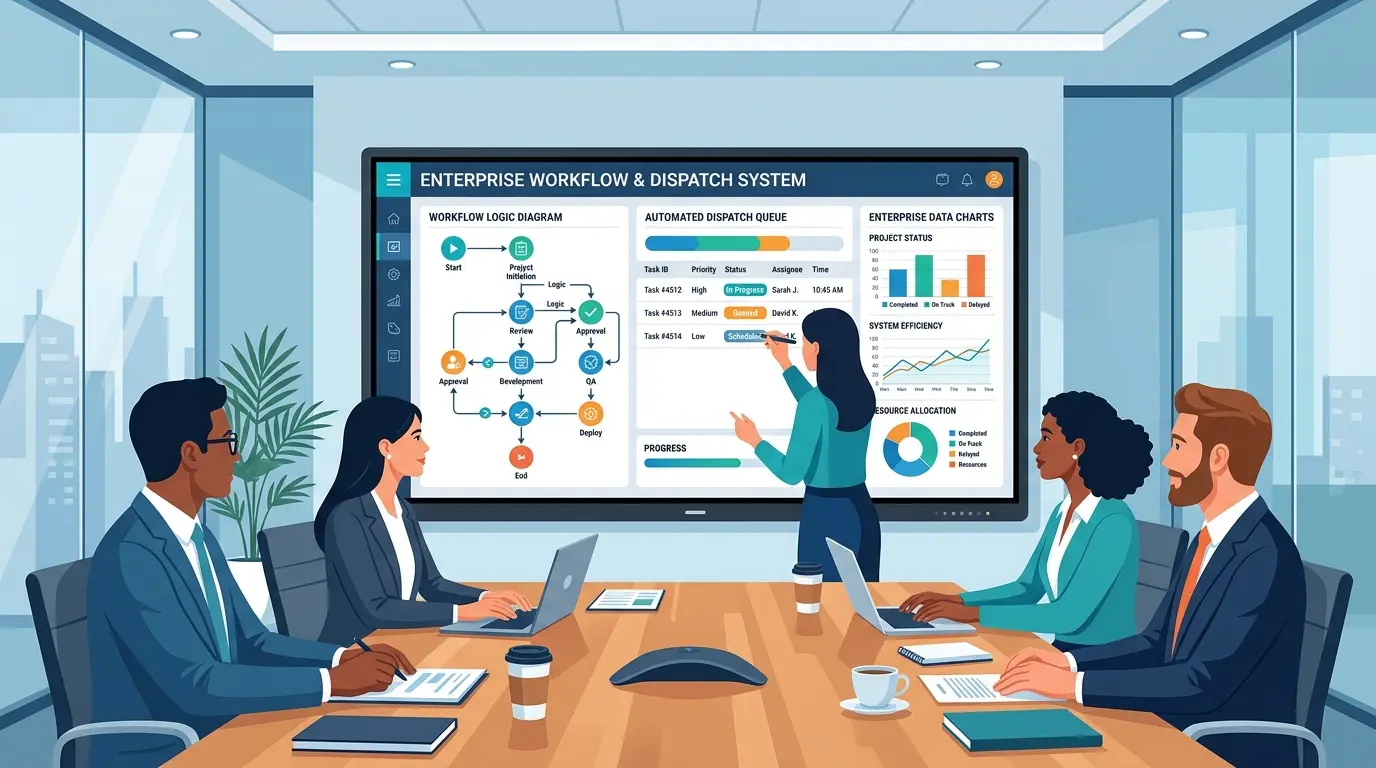
Modern meetings and executive work sessions produce extensive conversational decisions that frequently fail to translate into operational tasks. Tailored whiteboard, smart board, and interactive flat panel (IFP) software extracts spoken action items and handwritten canvas notes in real time. The underlying cognitive layer structure categorises these priorities, updates enterprise project boards, and writes assignments directly to core operational management tools, eliminating post-meeting administrative delays.
Evaluating Your Organization’s Automation Readiness
Transitioning from fragmented, manual workflows to engineered enterprise automation requires assessing foundational readiness before commissioning software development. Operations leaders and founders must identify operational friction points that generate recurrent overhead or create customer delivery bottlenecks.
A rigorous assessment reviews current data cleanliness, evaluates API stability across legacy database environments, and isolates business logic suitable for algorithmic acceleration. Identifying these targets early ensures software investments deliver measurable efficiency gains rather than superficial features. Connecting with an enterprise engineering partner provides clarity on development phases, compliance boundaries, and return on investment benchmarks, establishing an engineered path toward scalable, automated execution.
Building Resilient Enterprise Workflows with Intelligent Automation
Sustainable enterprise growth requires eliminating manual bottlenecks that limit operational capacity. Business process automation with AI transforms disconnected transactional silos into unified, resilient systems that process work at scale without linear headcount costs. By replacing manual record management and brittle scripts with engineered cognitive pipelines, business leaders protect margins, compress cycle times, and free core teams to drive bottom-line expansion.
Colladome engineers bespoke software architectures, AI transformation frameworks, and custom enterprise web applications designed to remove critical business constraints. Let’s make the next big thing together! Connect with our engineering consulting team to review your workflow architecture and explore custom automation opportunities for your organisation.