
Most companies are not short on data. They are short on data they can trust. Sales numbers sit in one system, customer records in another, and website analytics in a third. When leadership asks a simple question, someone spends two days stitching together spreadsheets, and the answer still comes with a warning that “the numbers might not match.”
That is the problem data engineering solves. The benefits of data engineering show up in faster reports, cleaner data, and analytics and AI projects that actually work. This article explains what data engineering is, where the value comes from, how custom data engineering differs from off-the-shelf tooling, how to find the best data engineering company for your needs, and what data engineering cost in India looks like.
What Is Data Engineering?
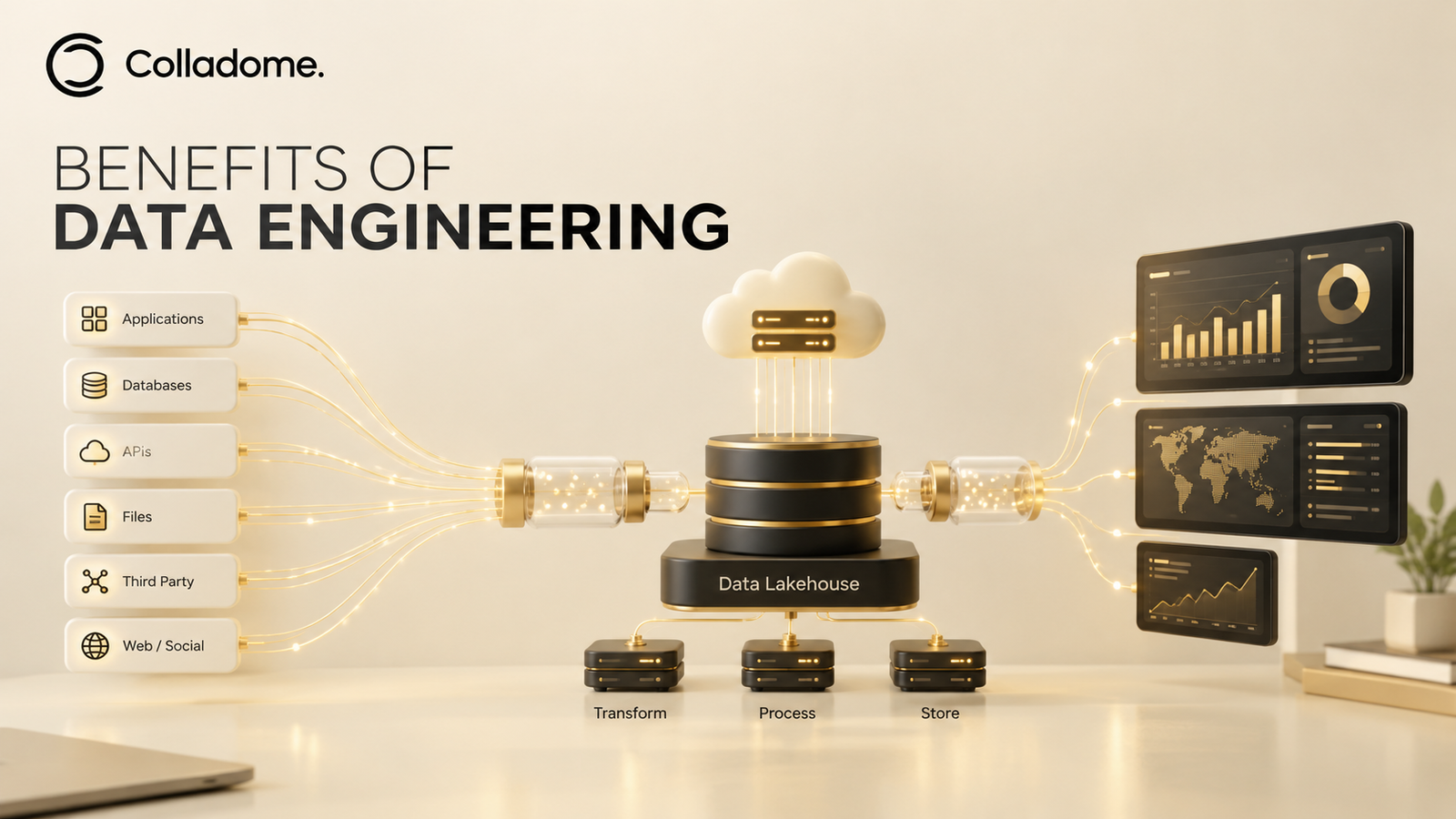
Data engineering is the practice of building the systems that collect, move, clean, store, and organize data so it is ready to be used. Data analysts and data scientists depend on this work, but they rarely do it themselves. If analysis is the cooking, data engineering is the kitchen, the supply chain, and the plumbing behind it.
In practice, data engineering covers several connected pieces. Data pipelines move information automatically from sources such as apps, databases, and third-party tools into a central location. Data warehouses and data lakes store that information in a structure built for reporting and analysis. Transformation and cleaning processes fix duplicates, missing values, and inconsistent formats. Orchestration and monitoring make sure pipelines run on schedule and alert the team when something breaks. And governance and security controls decide who can see what, and keep the data compliant with privacy rules.

Why Businesses Invest in Data Engineering
The main reason is simple: decisions are only as good as the data behind them. As companies add more tools, more customers, and more channels, data scatters across systems. Without engineering effort, teams either work from incomplete information or spend most of their time preparing data instead of using it.
Data engineering is also the foundation for almost every modern data initiative. Business intelligence dashboards, machine learning models, personalization engines, and AI assistants all need reliable, well-organized input. A company that skips the foundation often finds that its analytics and AI projects stall, not because the models are weak, but because the data feeding them is messy or unavailable.
Key Benefits of Data Engineering
One Trusted Version of the Truth
When data from sales, finance, operations, and marketing flows into a single structured source, teams stop arguing about whose numbers are right. Everyone works from the same definitions and the same figures.
Faster, Easier Reporting
Automated pipelines refresh reports without manual exports and copy-pasting. Leaders get current numbers on demand rather than waiting for someone to compile them at the end of the week.
Higher Data Quality
Cleaning, validation, and consistency checks are built into the process. Errors are caught early rather than discovered after a wrong decision has been made.
Real-Time or Near-Real-Time Insight
Modern pipelines can stream data as it is created, which supports use cases like fraud detection, live inventory tracking, and instant customer personalization.
A Foundation for AI and Machine Learning
Models need large volumes of clean, well-labeled data. Strong data engineering makes AI projects faster to start and more reliable once they are running.
Lower Costs Over Time
Automating manual data handling saves staff hours, and well-designed storage and processing avoid paying for more infrastructure than needed.
Scalability
A well-built data platform handles growth in volume, sources, and users without needing a complete rebuild each time the business expands.
Better Security and Compliance
Central control over data access, along with logging and encryption, makes it much easier to meet privacy regulations and answer audit questions.
Happier, More Productive Analysts
Data teams spend far less time hunting for and fixing data, and more time producing insights that move the business forward.
What Is Custom Data Engineering?
Ready-made tools can handle common cases, such as connecting a popular CRM to a reporting dashboard. But many businesses have unusual systems, strict compliance needs, high data volumes, or very specific reporting requirements that generic connectors cannot handle well.
Custom data engineering means designing the pipelines, storage, and processing around your own data sources, business rules, and goals. A custom approach might include building connectors for older internal systems, designing a warehouse structure that mirrors how your business actually reports, or setting up real-time streaming for a use case that batch tools cannot support.
The trade-off is that custom work takes more time and a larger upfront investment than assembling standard tools. It earns its cost when your requirements cannot be met off the shelf, or when data is central enough to your product or operations that performance, flexibility, and control really matter.
How to Find the Best Data Engineering Company
The best data engineering company for you is not necessarily the largest or the most heavily advertised. It is the one whose experience, working style, and technical depth match your project. Several questions help narrow the field.
First, ask about relevant experience. A team that has built pipelines for businesses like yours, in similar industries and at similar data volumes, will anticipate problems that a generalist team would only discover mid-project. Second, check technical range. Strong providers are comfortable with modern cloud platforms, warehouses, and orchestration tools, and can explain why they recommend a given stack for your situation rather than defaulting to what they know best. Third, ask how they handle data quality and security from the start, not as an afterthought. Fourth, find out what happens after delivery, including monitoring, documentation, and support when a pipeline breaks. And fifth, ask for references or case studies with real outcomes, such as reduced reporting time or improved data accuracy.
How to Spot Top Data Engineering Companies
When comparing top data engineering companies, marketing language can look nearly identical from one provider to the next. A side-by-side comparison against concrete criteria cuts through that.
| Criteria | What Strong Providers Show |
| Project portfolio | Documented pipelines and platforms already running in production |
| Technical depth | Cloud, warehousing, streaming, and orchestration expertise |
| Data quality practices | Built-in testing, validation, and monitoring |
| Security approach | Access control, encryption, and compliance awareness |
| Documentation and handover | Clear documentation so your team is never locked in |
| Client feedback | Verified reviews on independent platforms such as Clutch or Google |
One more signal worth checking is documentation. A provider who leaves behind clear documentation and trains your team is working to make you independent, while one who keeps everything opaque may be building dependence instead.
Data Engineering Cost in India
Data engineering cost in India is generally lower than in the US, UK, or Australia, which is why many international companies hire Indian teams for pipeline and platform work. The savings come from a large pool of experienced engineers, lower operating costs, and strong competition among providers.
The final price depends mainly on the number and complexity of data sources, the data volume and how fast it needs to be processed, whether you need batch or real-time pipelines, the cloud platform and tools involved, security and compliance requirements, and how much ongoing support you want after launch. A small project connecting a handful of sources into a warehouse sits at the lower end, while a large real-time platform with many integrations and strict governance sits at the higher end.
Providers typically quote through fixed-price projects for clearly defined work, time-and-material arrangements for evolving scope, or dedicated team models for ongoing needs. When you compare proposals, look at what each one includes. Ask about testing, monitoring, documentation, and support, since a low quote that leaves these out can lead to extra costs later. A phased proposal that starts with a small, well-defined first stage is often a safer way to begin than committing to a large build immediately.
Signs You Need Data Engineering Support
Many companies realize they need help only after the pain becomes serious. A few signs appear earlier. Reports take days to prepare because data has to be pulled together manually. Different teams quote different numbers for the same metric. Analysts spend most of their time cleaning data rather than analyzing it. Dashboards break whenever a source system changes. Or an AI or analytics project has stalled because the underlying data is not reliable or accessible.
If two or three of these sound familiar, an initial assessment from a data engineering company can map your current data landscape and show which problems to fix first.
Common Mistakes in Data Engineering Projects
A few mistakes appear again and again. Teams sometimes start by choosing tools before defining the business questions the data should answer, which leads to impressive infrastructure that nobody uses. Others try to connect every possible data source at once, instead of starting with the few that matter most. Skipping data quality checks lets errors flow quietly into reports. Ignoring documentation leaves the business dependent on one or two people who understand how things work. And treating the platform as finished at launch, rather than something that needs monitoring and updates as sources and needs change, often leads to slow decay in reliability.
A skilled provider builds its process to prevent these issues, starting small, testing continuously, and documenting as it goes.
Final Thoughts
The benefits of data engineering go well beyond tidier databases. Done well, it gives a business trusted numbers, faster reporting, and a dependable base for analytics and AI, while lowering costs and risk.
Whether you are exploring custom data engineering, comparing top data engineering companies, looking for the best data engineering company for your situation, or planning a budget around data engineering cost in India, begin with the business questions you need answered. The right partner will build the pipeline and platform around those questions, not the other way around.