
Launching an app on both iPhone and Android used to mean two codebases, two teams, and double the maintenance. Flutter changed that equation for a lot of businesses, and it is now one of the most talked-about ways to build mobile apps.
If you have heard the name but are not sure what it means for your project, this article answers the practical questions. It explains what is Flutter app development, how it works, where it fits best, what Flutter app development services include, how to evaluate a Flutter app development company, how to recognize the best Flutter app development company for your needs, and when custom Flutter app development is the right call.
What Is Flutter App Development?
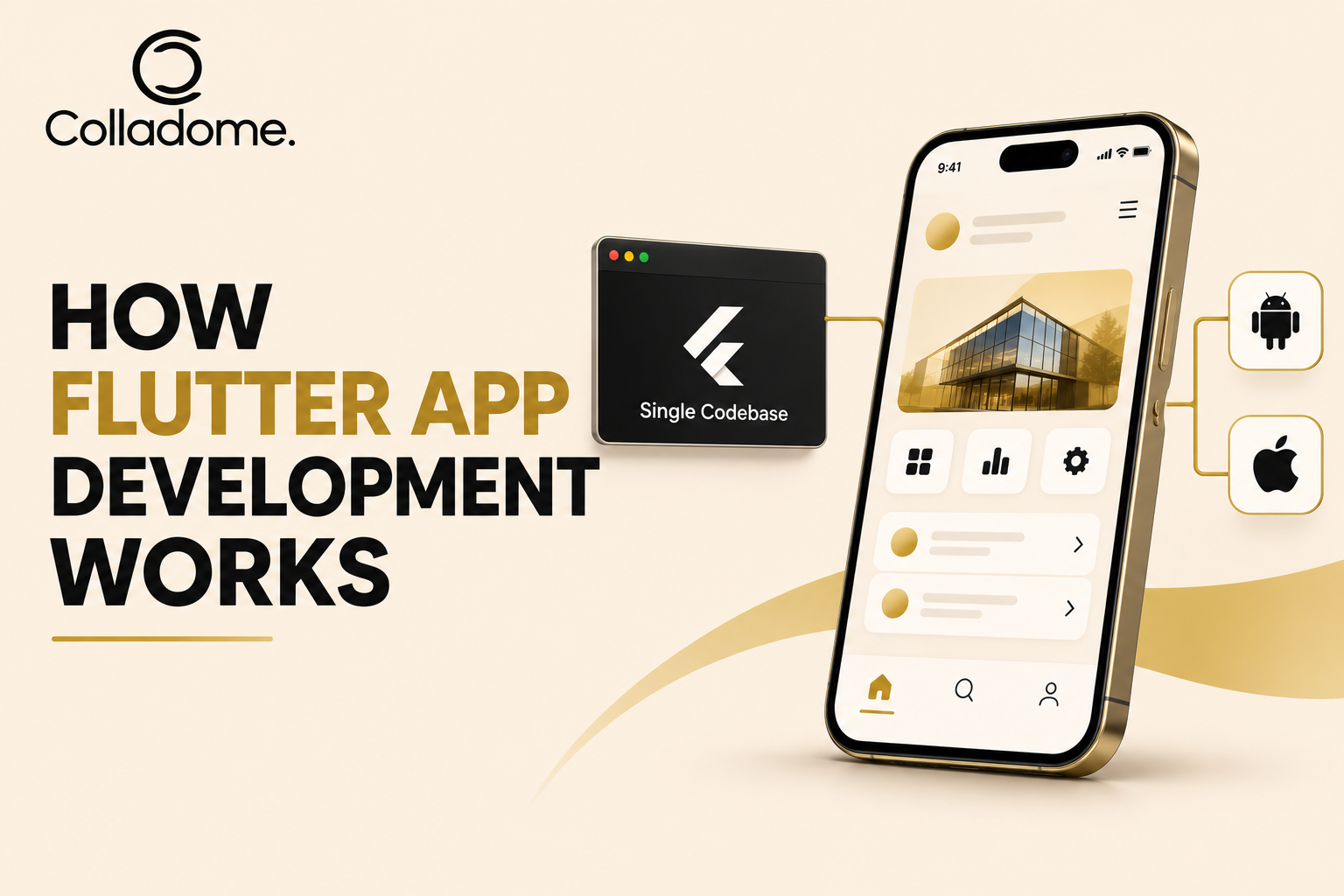
Flutter is an open-source toolkit created by Google for building user interfaces. Flutter app development is the process of designing, building, testing, and maintaining apps with that toolkit. Developers write the app once, in a language called Dart, and the same code can run on Android, iOS, the web, and desktop platforms.
This is what people mean by cross-platform development. Instead of building one app in Kotlin for Android and another in Swift for iOS, a Flutter team maintains a single shared codebase. Flutter draws its own interface elements instead of relying on each platform’s built-in ones, which is why apps can look and behave consistently across devices.
Two features explain much of Flutter’s popularity. Hot reload lets developers see changes almost instantly while the app is running, which speeds up design and testing. And Flutter’s rich library of ready-made, customizable widgets lets teams build polished interfaces without starting from scratch.
How Flutter App Development Works
A Flutter project follows the same broad path as any app project, with a few advantages built into the toolkit.
It starts with discovery, where the team defines goals, users, and the features that matter most for the first release. Design comes next, producing screens and a clickable prototype. Because Flutter handles visuals itself, designers have a lot of freedom, and what they design is usually what users see on both platforms.
Development then proceeds in short cycles. Developers build the interface with widgets, add the app’s logic, and connect it to a backend, databases, and third-party services through APIs. Where the app needs something specific to one platform, such as a particular sensor or a native payment feature, Flutter can call platform-specific code through plugins. Testing covers functionality, performance, and appearance across a range of devices, and the finished app is then published to Google Play and the Apple App Store, with updates released as needed.
Key Benefits of Choosing Flutter
One Codebase for Multiple Platforms
Maintaining a single codebase can reduce development time and make updates simpler, since a fix or feature is written once and delivered to both platforms.
Consistent Look and Feel
Because Flutter controls how the interface is drawn, your brand and user experience can appear the same on Android and iOS, rather than drifting apart on each platform.
Fast Iteration
Hot reload shortens the feedback loop between idea and result, which helps teams refine designs and fix issues faster.
Strong Performance for Most Apps
Flutter apps are compiled to native code, and for typical business, e-commerce, social, and service apps the performance feels smooth to users.
Expandable Beyond Mobile
The same toolkit can target web and desktop, so a business can extend a product to more platforms later without starting from zero.
Active Community and Ecosystem
A large developer community and a wide range of packages mean many common features, from payments to maps, already have well-tested building blocks.
When Flutter Is a Good Fit, and When It May Not Be
Flutter suits many projects well. It is a strong option for startups that need to reach both platforms quickly on a controlled budget, for apps where a custom, branded interface matters, for business and service apps with standard features, and for products planning to expand to web or desktop.
It may be less ideal in a few situations. Apps that depend heavily on very new or highly specialized platform features may need extra native code. Projects with extremely demanding graphics, such as advanced 3D games, often use dedicated game engines instead. And teams with a large existing native codebase may prefer to extend it rather than switch. An honest provider will tell you if Flutter is not the right match, rather than recommending it by default.
What Flutter App Development Services Include
When you look at Flutter app development services, the scope should cover the whole life of the app, not just coding. Typical services include product consulting and discovery, UI and UX design, cross-platform app development, backend and API development, third-party integrations such as payments, maps, and notifications, quality assurance across devices, deployment to the app stores, and ongoing maintenance and updates.
Some providers also offer migration services, helping move an existing native or older cross-platform app to Flutter, and modernization services, which refresh the design and code of an app that has aged. Check that testing, store submission, and support are part of the proposal, since gaps in these areas often create surprise costs later.
How to Choose a Flutter App Development Company
A Flutter app development company should demonstrate real Flutter experience, not just general mobile skills. Look for published apps built with Flutter that you can download and try. Ask how long the team has worked with the toolkit and how they handle state management, app architecture, and performance, since these choices shape how easy the app will be to maintain.
Ask about their process, including how often you will see working builds, how feedback is handled, and who your point of contact will be. Find out how they test across devices and operating system versions, how they handle security and user data, and what support looks like after launch.

Spotting the Best Flutter App Development Company
The best Flutter app development company for you will match your project’s size, industry, and goals. The comparison below can help you evaluate candidates side by side.
| What to Evaluate | What a Strong Company Shows |
| Flutter portfolio | Live Flutter apps in the app stores that you can test |
| Technical depth | Clean architecture, state management skill, native integration experience |
| Design capability | Polished, consistent interfaces that follow platform conventions |
| Testing practices | Automated and manual testing across devices and OS versions |
| Communication | Regular demo builds, clear milestones, and a single point of contact |
| After-launch support | Defined terms for maintenance, updates, and bug fixes |
| Client feedback | Verified reviews on independent platforms such as Clutch or Google |
Beyond the checklist, notice how a company behaves during the sales process. Teams that ask thoughtful questions about your users and are willing to recommend a smaller first release usually build better products than those that agree to everything.
When Custom Flutter App Development Makes Sense
Templates and low-code builders can work for very simple apps, but many businesses need more. Custom Flutter app development means designing and building the app around your specific workflows, branding, and integrations rather than adapting your business to a ready-made product.
It is worth considering when your app has unique features or business rules, needs a distinctive brand-focused interface, connects to internal systems or specialized devices, or must support future growth and new features. Custom development also gives you full ownership of the code, which keeps your options open for the future.
The trade-off is a higher upfront investment and a longer timeline than a template approach. Many teams manage this by launching a focused first version with core features, then expanding based on real user feedback.
What Affects Timeline and Effort
Business owners often ask how long a Flutter project will take, and the honest answer is that it depends on scope. A few factors have the biggest influence. The number of screens and features is the most obvious one. Custom animations and highly tailored interface elements take more design and development time than standard layouts. Backend complexity matters too, since an app that needs user accounts, real-time data, or heavy business logic involves more work than one that mainly displays content.
Integrations with payment gateways, maps, analytics, or internal systems add testing effort, and so do requirements for offline use or strict security. Finally, the review and approval speed on your side makes a real difference, because slow feedback cycles stretch any schedule. Ask a prospective provider to break the timeline into phases so you can see where time goes and where scope can be trimmed for a faster first release.
Common Mistakes in Flutter Projects
A few pitfalls appear regularly. Choosing Flutter simply because it is popular, without checking that it fits the project, can lead to workarounds later. Packing too many features into the first version delays launch and learning. Ignoring platform conventions can make an app feel slightly foreign to users on one platform. Skipping performance testing on older and lower-end devices can hurt reviews. And treating launch as the finish line, with no plan for updates as Flutter and the operating systems evolve, leaves the app behind over time.
Final Thoughts
Understanding what is Flutter app development comes down to a simple idea: one toolkit and one codebase that can deliver a polished app on multiple platforms. For many businesses, this means they can launch faster, maintain consistent design, and simplify maintenance—provided the project suits this approach.
Whether you are comparing Flutter app development services, evaluating a Flutter app development company, searching for the best Flutter app development company, or considering custom Flutter app development, begin with a clear brief and direct questions. The right partner will engage seriously with your goals before suggesting a solution.