For founders and CXOs navigating the complexities of digital expansion, the prospect of custom software development often comes with significant apprehension regarding budget uncertainty and project delays. Understanding the true android app development cost and timeline is paramount, not just for financial planning but for strategic resource allocation. This guide aims to demystify these critical factors, offering a robust framework to evaluate your investment. We’ll move beyond generic estimates, providing the practical insights needed to gain clarity and exert precise control over your Android app project’s financial and temporal commitments, ensuring predictable outcomes for your business objectives.
Navigating the Murky Waters: Why Android App Development Costs and Timelines Remain a Mystery
Founders and decision-makers often face significant frustration when planning custom Android app development. The journey is frequently plagued by unpredictable Android app development budgets, making strategic financial planning a nightmare. What starts as a clear vision can quickly spiral into scope creep, leading to missed deadlines and significant delays in market entry. This project uncertainty directly impacts potential ROI and operational efficiency.
A persistent lack of transparency from development partners, coupled with vague estimates, further exacerbates these issues. Generic solutions fail to provide the granular detail and control needed to mitigate risks effectively. SMEs require clarity, not guesswork, to manage resources and achieve business objectives, yet they consistently encounter an opaque process that hinders sound decision-making and project predictability.
Colladome’s Transparent Approach to Android App Development Cost and Timeline
Colladome’s methodology offers the definitive solution for achieving unparalleled clarity and predictability in your Android app projects. We tackle the common problem of uncertainty by employing a structured, phased approach, meticulously combined with detailed requirements gathering and expert consultation. This process precisely clarifies your android app development cost and timeline from the outset. Our approach is exceptionally effective for small and medium enterprises seeking custom Android solutions, ensuring complete transparency, accurate estimations, and robust alignment with specific business goals. With Colladome, you gain a partner committed to delivering your vision with predictable outcomes and no hidden surprises.
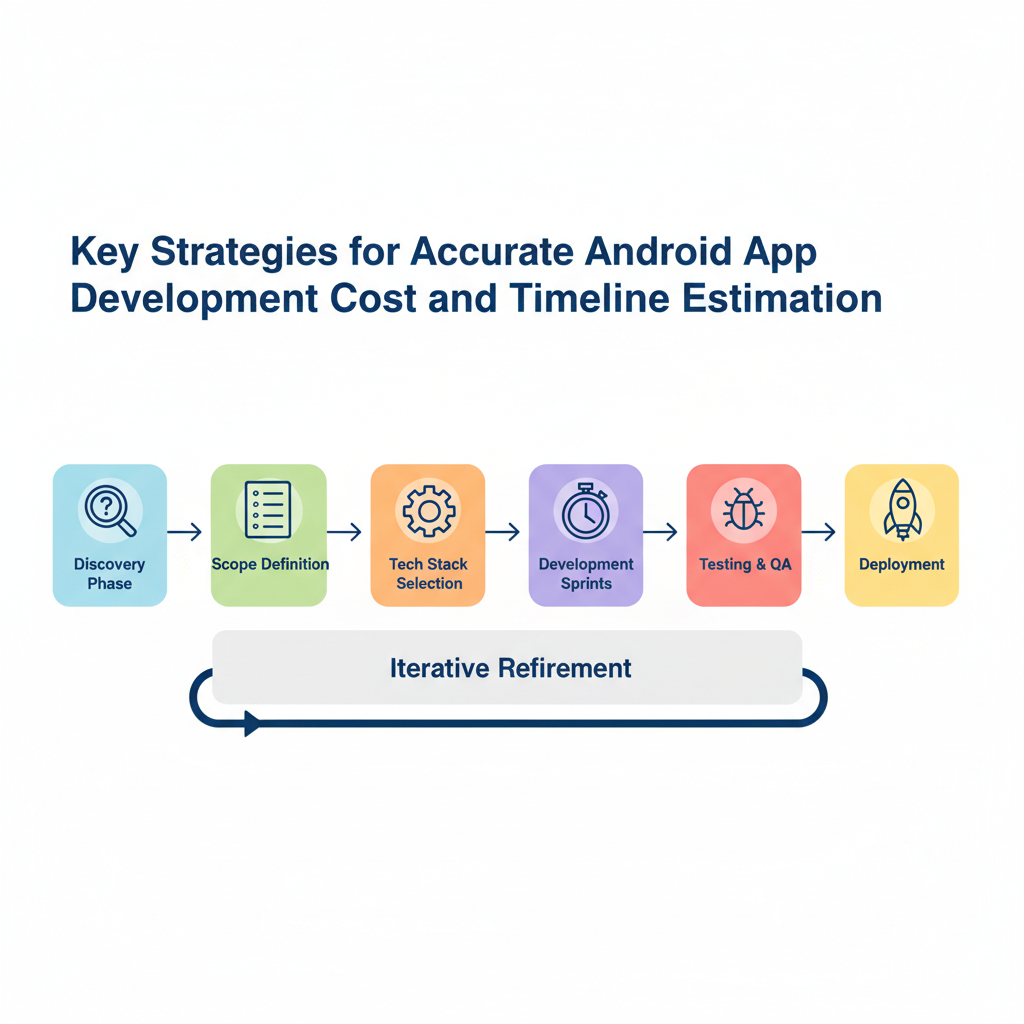
Key Strategies for Accurate Android App Development Cost and Timeline Estimation
- Problem: Vague requirements inevitably lead to significant budget overruns and project delays.
Solution: Conduct detailed, interactive discovery workshops to meticulously define all features, user stories, and technical specifications upfront.
Outcome: This proactive approach yields highly precise estimates, critical for effective ‘budget planning for Android apps’. - Problem: Uncontrolled scope creep can derail development, inflating costs and extending timelines indefinitely.
Solution: Adopt an iterative development methodology with fixed sprints and a robust change management protocol, locking objectives for each ‘Android app project phase’.
Outcome: Ensures controlled feature delivery, maintains project focus, and prevents costly budget and timeline inflation. - Problem: Underestimating technical complexities or integration challenges results in unexpected roadblocks and extensive rework.
Solution: Perform early technical feasibility studies, comprehensive architecture reviews, and develop proof-of-concept prototypes for critical functionalities.
Outcome: Proactive identification of hurdles enables realistic ‘timeline optimization’ and mitigates risks, avoiding expensive mid-project pivots. - Problem: Inefficient resource utilization and communication gaps hinder productivity and prolong development cycles.
Solution: Implement agile methodologies that foster transparent communication and cross-functional team collaboration, leveraging advanced project management tools.
Outcome: This optimizes resource allocation, streamlines workflows, and enhances overall cost-effectiveness throughout the development lifecycle.
Core Factors Influencing Android App Development Cost
Feature Complexity & Scope
More features, custom integrations, and complex logic directly increase the android app development cost and timeline. SMEs must balance desired functionality with budget to achieve a viable product. This ensures a strong ROI and effective market positioning without overspending, maximizing initial value proposition for sustained growth.
UI/UX Design Sophistication
A highly polished, intuitive, and branded user interface requires significant design effort, impacting the overall android app development cost and timeline. Superior UX enhances user engagement and retention, directly contributing to revenue growth through repeat usage and positive brand perception, securing a competitive advantage in the market.
Technology Stack & Integrations
Choosing specific programming languages, frameworks, and third-party APIs affects both the android app development cost and timeline. Complex integrations with existing systems can improve operational efficiency and data synergy, justifying higher initial investment for long-term gains and streamlined business processes that drive competitive advantage.
Team Size & Expertise
The number of developers, designers, QAs, and project managers, along with their experience level, directly dictates the hourly or project-based android app development cost and timeline. A skilled team delivers higher quality faster, reducing future maintenance costs and accelerating market entry for a crucial competitive edge.
Post-Launch Support & Maintenance
Ongoing updates, bug fixes, security patches, and new feature additions are crucial but contribute to the long-term android app development cost. Neglecting maintenance leads to instability, user churn, and missed revenue opportunities. Proactive support ensures sustained operational efficiency and user satisfaction, protecting your investment.
Understanding the Android App Development Timeline: Key Phases
Discovery & Planning Phase
This initial phase involves detailed requirements gathering, market research, and defining the app’s objectives and scope. A thorough discovery phase, though adding to the initial android app development timeline, minimizes costly rework later, ensuring the final product aligns with business goals and market needs for strategic positioning.
Design & Prototyping Phase
Crafting wireframes, mockups, and interactive prototypes allows stakeholders to visualize the app’s flow and aesthetics. Iterative design, while part of the android app development timeline, reduces development risks by identifying usability issues early. This leads to a superior user experience, enhancing user adoption and potential revenue streams.
Development Sprints & Iterations
The core coding phase is typically broken into agile sprints, each delivering functional modules. The duration of these sprints directly impacts the overall android app development timeline. Efficient, well-managed sprints accelerate time-to-market, allowing businesses to capitalize on opportunities faster and achieve significant revenue growth.
Quality Assurance & Testing
Rigorous testing across various devices and scenarios is essential to identify and fix bugs, ensuring a stable and reliable application. This phase, integral to the android app development timeline, prevents post-launch issues that could harm reputation and user retention, safeguarding revenue and enhancing operational efficiency.
Deployment & Launch
Preparing the app for submission to the Google Play Store, including necessary documentation and compliance checks, marks the final stage before public release. A smooth deployment minimizes delays in reaching the target audience, directly impacting the speed at which the app can start generating revenue and establishing market presence.
Post-Launch Optimization
After launch, monitoring app performance, gathering user feedback, and planning iterative improvements are vital for long-term success. This ongoing phase, while not part of the initial android app development timeline, ensures the app remains competitive, addresses user needs, and continues to drive revenue growth and user satisfaction.
Strategies to Optimize Your Android App Budget and Accelerate Timeline
Prioritizing MVP Features
Focusing on a Minimum Viable Product (MVP) with core functionalities significantly reduces the initial android app development cost and timeline. This strategy allows for faster market entry, gathering real user feedback to inform future iterations, optimizing resource allocation for features that truly drive revenue and user engagement.
Agile Development Methodologies
Employing agile sprints and iterative development fosters flexibility, allowing for adjustments based on feedback without derailing the entire project. This approach can shorten the overall android app development timeline and reduce costs by minimizing rework, ensuring the product evolves to meet changing market demands.
Clear Communication & Feedback Loops
Establishing robust communication channels between the client and development team is paramount. Prompt feedback and clear requirements mitigate misunderstandings, reducing costly revisions and accelerating the android app development timeline. This efficiency directly impacts operational costs and time-to-market, enhancing profitability.
Leveraging Cross-Platform Tools (where appropriate)
For certain app types, using frameworks like React Native or Flutter can develop for both Android and iOS from a single codebase. This significantly reduces the overall android app development cost and timeline compared to native development, enabling broader market reach more efficiently and cost-effectively.
Partnering with Experienced Developers
Collaborating with a reputable development partner brings expertise and efficiency, leading to a more predictable android app development cost and timeline. Their insights help avoid common pitfalls, ensure high-quality delivery, and accelerate market entry, positively impacting revenue growth and competitive advantage.
| Criteria | Fixed-Price Model | Time & Material Model |
|---|---|---|
| Cost Predictability | High. Total android app development cost is agreed upfront. Ideal for strict budgets but can be higher initially to cover developer risks. | Low. Cost depends on actual hours spent and resources used. Provides flexibility but final cost can vary. |
| Scope Flexibility | Low. Scope is rigidly defined. Changes lead to formal change requests, increasing cost and potentially delaying timeline. | High. Easy to adapt to evolving requirements, add or remove features iteratively without formal change orders, impacting cost dynamically. |
| Timeline Predictability | High (initially). Defined milestones and completion timeline are set. Delays can occur if scope changes or unforeseen issues arise. | Moderate. Iterative development allows for adjustments, but the overall completion timeline can shift based on scope evolution and new requirements. |
| Risk Management | Transfers most financial risk to the developer (if scope is well-defined). Client risks paying for features that might not be fully needed or understood later. | Shares risk. Client pays for actual work, reducing risk of paying for unused features. Client bears risk of scope creep leading to higher costs. |
| Suitability for Project Type | Best for projects with extremely clear, stable requirements and a well-defined scope (e.g., MVP with minimal unknowns, small utility apps). | Ideal for complex, innovative projects with evolving requirements, R&D, or long-term partnerships where flexibility is key to success. |
| Quality Control | Quality is tied to the initial specification. Developers might prioritize delivering minimum viable features within budget, potentially impacting overall polish if scope is tight. | High. Continuous feedback and iteration allow for better alignment with evolving quality expectations and user needs, leading to a more refined product over time. |
Real-World Impact: How Understanding Android App Development Cost and Timeline Drives Business Success
Strategic management of Android app development cost and timeline is not merely a project management exercise; it’s a critical driver of business success across diverse industries. By gaining clarity on these factors, organizations can make informed decisions that translate directly into tangible benefits.
Startup Launching an Innovative MVP
A startup aiming to disrupt a market with an innovative Android MVP leverages precise cost and timeline estimates to secure funding and prioritize core features. This strategic clarity ensures rapid development and a focused launch, enabling faster market entry and early user validation while optimizing precious startup capital.
Established SME Digitizing Internal Operations
An established SME seeking to digitize internal workflows via a custom Android application benefits from a clear understanding of development costs and timelines. This foresight allows for accurate budgeting, phased implementation, and minimal disruption, ultimately leading to enhanced operational efficiency and optimized resource allocation across departments.
Service Business Expanding with a Customer-Facing Mobile App
A service business expanding its reach with a new customer-facing Android app utilizes detailed cost and timeline projections to define its feature roadmap and marketing strategy. This proactive approach ensures the app delivers maximum value, leading to improved customer engagement, expanded market presence, and a stronger competitive edge.
Businesses exploring custom Android app solutions often face uncertainty regarding project scope and budget. Decision-makers evaluating their next mobile project understand the critical need for precise project planning to avoid unforeseen expenses and delays. To gain clarity and predictability for your android app development cost and timeline, consider a no-obligation consultation with Colladome. Our experts will discuss your specific custom Android app development requirements, helping you define a clear path forward. You’ll receive a tailored cost estimate and a detailed timeline, ensuring you have the expert guidance needed to make informed decisions for your project’s success.
Achieving Clarity in Your Android App Development Journey
Navigating the complexities of Android app development requires a crystal-clear understanding of its associated cost and timeline. This clarity is paramount, not just for financial planning, but as the cornerstone for successful project execution and robust business growth. We’ve reinforced that while challenges exist, budget predictability and timely delivery are genuinely achievable with a strategic approach and the right development partner. Don’t let uncertainty derail your vision. Take the definitive step towards realizing your Android app’s full potential. Contact Colladome today for a personalized consultation where we’ll discuss your unique app vision and provide expert, transparent guidance on optimizing your cost and timeline planning.