
Let’s get one thing straight right away. AI isn’t around to destroy the world of enterprise software. It’s not dismantling ERP systems. It’s not uprooting CRM systems or reformulating the accumulated business logic from the last few decades. Nor is it set to substitute the individuals who are deeply dependent on these tools daily.
Yet somehow, that’s the story many leaders are hearing. AI is presented as a disruptive technology: something that replaces, overrules, or totally reinvents existing systems. It is a mistake to categorize AI in this way. And to be honest, it’s not very helpful.
Here’s the thing. How AI Is Redefining Enterprise Software is not a story of displacement. “It’s a story of reinforcement,” said Azure Vice President Mark Collins. “It’s a story of how we make systems smarter, workflows more seamless, and our decision agility faster, all while preserving and building
There is enterprise software. There is a reason why. It’s stable. It’s structured. It’s embedded. Artificial intelligence does not alter this. Artificial intelligence is positioned upon this. Instead of asking, “Will AI replace Enterprise Software?”
The more pertinent question is: “How does AI improve enterprise software so that it benefits mankind?” That’s what this blog covers.
How AI Is Redefining Enterprise Software, Not Replacing?
The answer is that AI is most effective when it is integrated with a system that already works.
But our longer answer would be: AI functions as an intelligent layer; it improves, quietly, how the enterprise platforms think, adapt, and respond. AI doesn’t rewrite rules. AI learns patterns. AI doesn’t disrupt workflows. AI improves workflows.
“How AI Is Redefining Enterprise Software” is, in the end, an evolution. Not a revolution. Ongoing progress toward more intelligent, more responsive solutions that ultimately drive enterprise success without requiring new initiatives to begin from scratch. Let’s take this apart.
Decision Support
Enterprise leaders are making decisions on a daily basis. Big decisions. Small decisions. Some are based on facts. Some are based on gut.
AI doesn’t substitute judgment. It enhances judgment. Instead, AI becomes a decision-support mechanism. It reviews past data. Notices trends that go unnoticed by humans. Reveals insights at the right time, not hidden in dashboards that go unattended.
Thus, well, rather than speculating, leadership receives context. For instance, effective use of AI can point out irregular patterns of spending, point out risks in the supply chain, and even indicate what needs to be given priority based on inputs fed into the system in real-time. The final decision, however, has to be taken by
This is an important point within the text “How AI is Redefining Enterprise Software”. AI is informative. People make decisions. And that’s how it should be.
Smarter Automation
Automation is nothing new in the realm of enterprise software. There have been rules-based workflows for decades. But AI enables automation to be flexible.
Instead of having ‘if this, then that’ reasoning, AI adjusts. AI learns from exceptions. AI changes according to outcomes. AI progresses over time.
Take, for example, invoice processing that is based on understanding context, as opposed to formatting. Or customer service workflows that direct complaints based on urgency, and not categories. Yes, tasks become faster. More importantly, they become smarter.
And what about the systems you’re already using? They’re not replaced. They’re upgraded. That is another example of how AI is Redefining Enterprise Software because it enhances efficiency without impacting functionality.
Better Data
“Enterprise data is messy,” says Aizenberg. “Anybody who has experience with large systems will tell you that Duplicates. Incomplete records. Conflicting information. As far as data issues are concerned, AI does not work magically. However, it helps to cleanse, authenticate, as well as add value to the data.
It detects anomalies. It resolves inconsistencies. It forecasts missing values. And eventually, it enhances the quality of data. Why is this important? This means that better data enables better forecasting. Better forecasting enables better planning. Better planning enables the occurrence of fewer surprises.
Thus, in discussions about how AI is Redefining Enterprise Software, ensuring data accuracy is a major component. This is because AI not only performs analysis on data but also enhances the data itself.
Human Collaboration
There is a concern about AI being a replacement for human involvement. However, the reverse is occurring in the enterprise world. AI does the repetitive, time-consuming tasks, freeing time for people to concentrate on strategy, creativity, or judgment. AI deals with noise; people deal with subtlety.
For instance, product managers can dedicate more time to analyzing insights as opposed to reporting them. Developers can concentrate on architecture and not necessarily do all the testing themselves. Everyone can ask better questions as opposed to seeking the numbers.
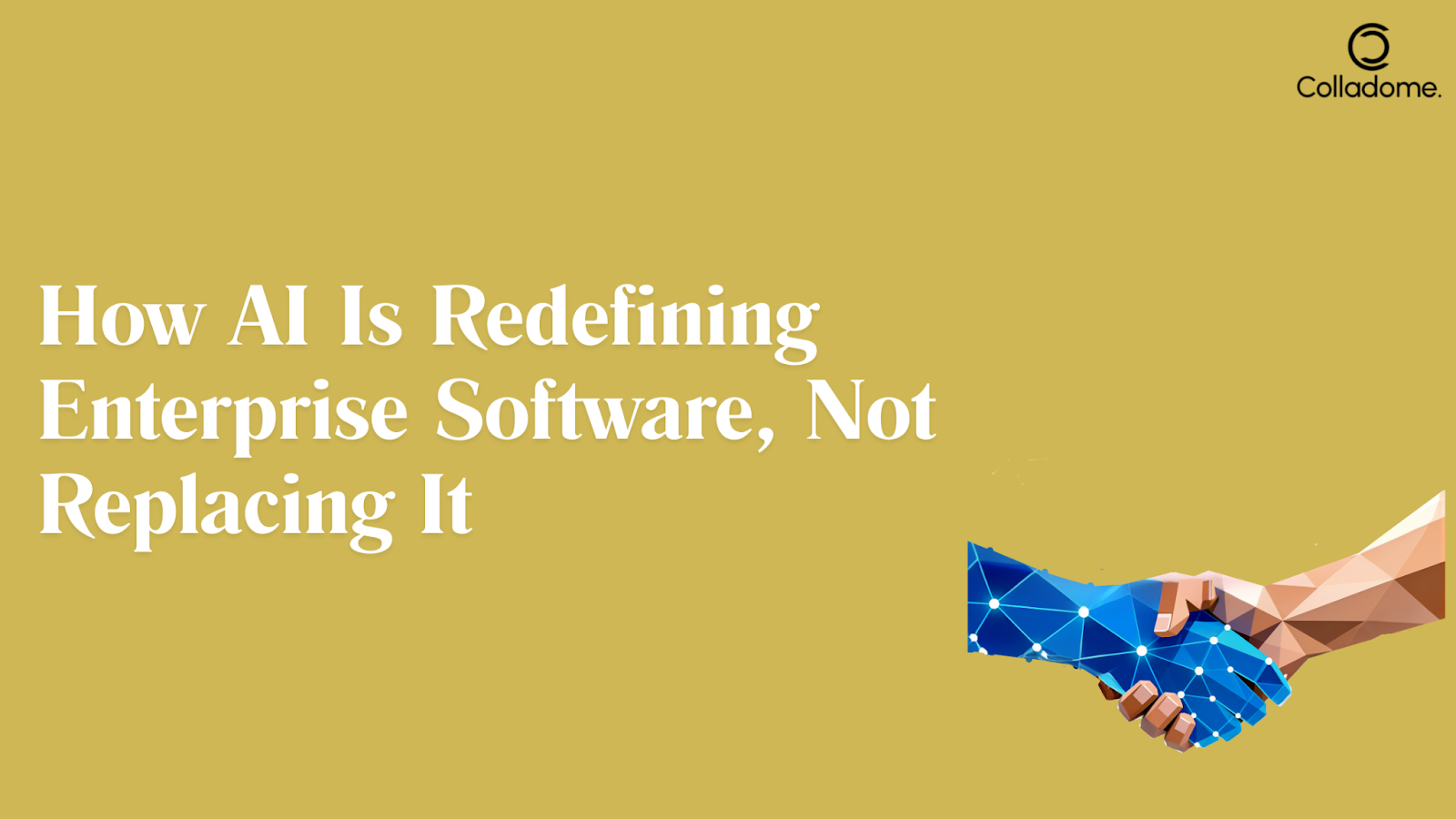
It’s within this human-artificial intelligence partnership that the true value lies. And this is at the heart of “How AI Is Redefining Enterprise Software,” not a substitute for people, but a partner.
User Experience
Enterprise software hasn’t always been user-friendly. Complex menus. Dense dashboards. Steep learning curves. However, this is changing. Through the use of natural language interfaces, predictive suggestions, and contextual hints, it’s now easier for everyone to use the platform – without losing any power.
Users are able to ask questions as an alternative to clicking through a series of screens. The system is anticipating needs and not waiting for input. The interface changes based on user behavior.
So, well, enterprise software begins feeling less like a machine, and it feels like a helpful assistant. That change in usability is yet another reason why How AI is Redefining Enterprise Software is so important.
- It increases adoption.
- It reduces friction.
- It increases productivity.
Legacy Systems
At this point, most leaders become nervous. What about our legacy systems? The good news: No reboot is necessary in AI.
Today, the AI tools are designed to integrate. These tools are linked through APIs. These tools co-exist on the current platforms. These tools are designed to honor the current workflow. This makes it possible for businesses to “modernize incrementally and safely and so.
Rather than tearing out what may have taken years to develop, AI prolongs its useful life. It injects intelligence without inducing instability. And that’s huge. Because How AI is Redefining Enterprise Software is about more than keeping up with the latest trends. It’s about safeguarding investments and finding new ways to deliver business value.
Strategic Insight
Artificial intelligence is not only functional. It’s now strategic. AI enables leaders to view a bigger picture based on patterns of data across departments, markets, and periods of time. It points out potential dangers earlier than a human would be able to do so. It allows viewing a bigger picture based on patterns of data across departments, markets
It does not replace strategy teams; it enables them. Rather, there will be proactive decision-making, and instead of planning, organizations opt for action
Again, this is consistent with the overall theme of How AI Is Redefining Enterprise Software: intelligence added to existing systems, and not necessarily replacements.
Responsible Adoption
Now, a pause here. AI is not magic. Nor is AI risk-free. Responsible Adoption: It matters to be a Responsible Adoption organization, whereby an organization
The vendors and users of enterprise software must ensure that their AI systems are interpretable, secure, trustworthy, and free from values contradicting business. Bias must also be mitigated. Privacy must be ensured. The end goal isn’t about going fast. The end goal is about trust.
This is the final, but perhaps the most critical, chapter of the book “How AI Is Redefining Enterprise Software.” Smarter systems are only possible if a certain level of trust can be established in the systems.
Struggling to Redefine Enterprise Software? Ask Us
Therefore, the lesson learned is: How AI Is Redefining Enterprise Software isn’t about disruption and replacement. It is a story of collaboration, efficiency that is not marked by chaos, and intelligence and instability are not synonymous with success and failure. AI enhances what already exists. AI helps in making better decisions, having better workflows, and having human-centered systems.
Having Colladome in this process has great significance. As a collaborative online environment for business teams, developers, and key decision-makers, Colladome encourages the type of innovation made possible by AI, all while preserving what already works. The future of enterprise software is no less human. It’s brighter, together.