
In theory, US businesses have access to the world’s best technology, talent, and tools. In reality, many brands still struggle with custom websites that fail to scale, convert, or support long-term growth.
Despite heavy investments, websites often become bottlenecks instead of growth engines. This gap isn’t about technology; it’s about strategy, execution, and alignment.
This blog breaks down why custom web development in the USA still challenges businesses, what’s going wrong behind the scenes, and how decision-makers can approach custom websites as revenue-driving assets instead of sunk costs.
The Real Problem With Custom Web Development USA
Many US brands choose custom web development, expecting flexibility, scalability, and performance. Instead, they end up with slow builds, rising costs, and limited returns. The problem isn’t custom development itself; it’s how businesses approach, plan, and execute it.
Misaligned Goals
Custom websites often start with the wrong question: “What should our website look like?” instead of “What should our website achieve?”
When leadership, marketing, and tech teams operate in silos, the website becomes a design project rather than a business system. Marketing wants conversions, tech wants clean architecture, and leadership wants speed, but no one aligns these priorities early.
This misalignment leads to:
- Features that don’t support revenue goals
- Overbuilt systems with low adoption
- Delays caused by endless revisions
Businesses exploring custom web development USA need alignment before code. Without shared goals, even the best development team will build the wrong solution.
Undefined Success
Many custom websites launch without clear success metrics. There’s no agreement on what “working” actually means.
Is success:
- Higher qualified leads?
- Faster sales cycles?
- Lower operational workload?
- Better customer experience?
Without defined outcomes, teams rely on opinions instead of performance data. The website looks “finished,” but the business impact remains unclear. Decision-makers evaluating custom websites should treat success metrics as non-negotiable, not optional.
Why Existing Website Approaches Fail US Businesses?
US brands don’t struggle because they lack tools. They struggle because they rely on outdated development models that prioritize speed or aesthetics over long-term performance, scalability, and business alignment.
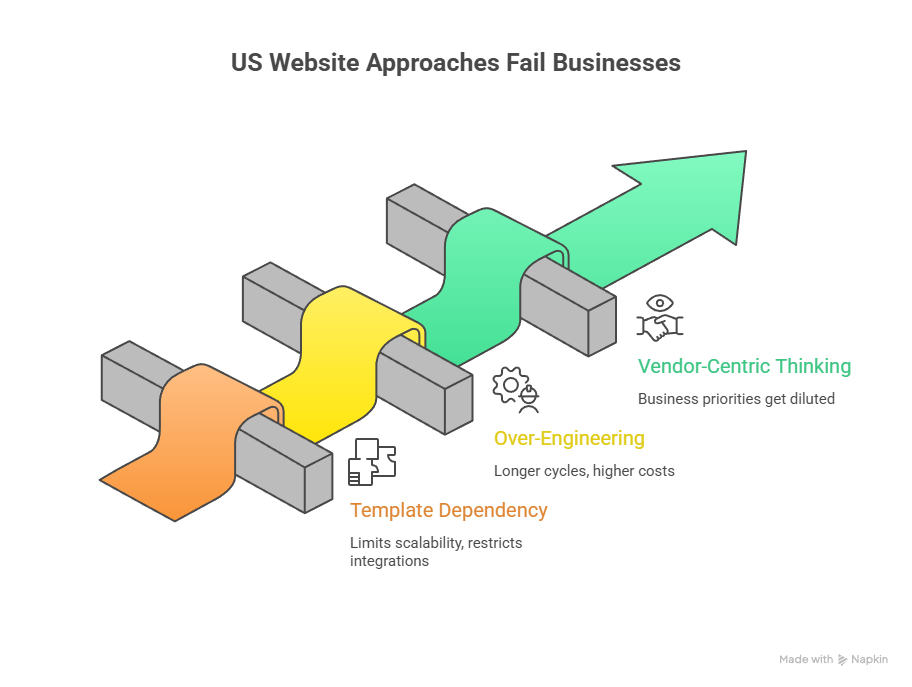
Template Dependency
Many businesses start with templates to save time and cost, then try to “customize” them later. This hybrid approach often creates technical debt early. Templates:
- Limit scalability
- Restrict integrations
- Force businesses to adapt processes to the website
Over time, teams spend more time fixing workarounds than building growth features. What looks affordable upfront becomes expensive long-term. Custom web development in the USA should be custom from the foundation, not patched together.
Over-Engineering
On the other extreme, some brands overbuild. They invest heavily in features they might need someday. This leads to:
- Longer development cycles
- Higher maintenance costs
- Lower team adoption
Instead of enabling growth, the website becomes complex and fragile. Flexibility is lost because every change requires a heavy development effort. Smart custom development balances present needs with future scalability, not hypothetical use cases.
Vendor-Centric Thinking
Many US brands outsource development without retaining strategic ownership. They rely entirely on vendors to define scope, architecture, and decisions. When vendors drive strategy:
- Business priorities get diluted
- Knowledge stays external
- Changes become costly
Organizations planning growth need websites they control, not systems they depend on vendors to explain.
The Hidden Complexity of Custom Web Development
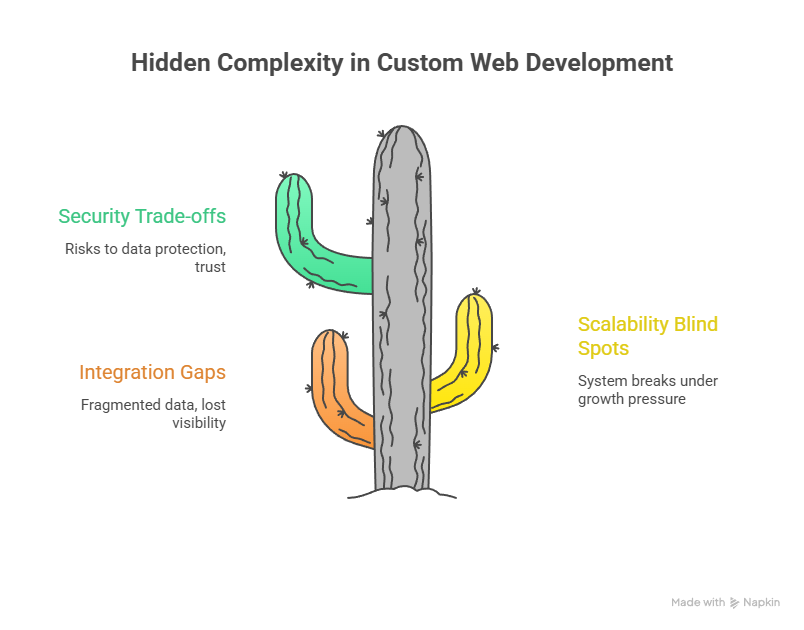
Custom websites fail not because of visible issues, but because of hidden complexity; architecture decisions, integration gaps, and scalability blind spots that only surface after launch.
Integration Gaps
Modern businesses rely on CRMs, ERPs, marketing automation, analytics, and internal tools. Custom websites must integrate seamlessly with these systems. When integrations are treated as “add-ons”:
- Data becomes fragmented
- Teams lose visibility
- Manual work increases
A custom website should act as a central business hub, not a standalone asset.
Scalability Blind Spots
Many websites perform well at launch but break under growth pressure. Traffic increases, new regions are added, or product lines expand, and the system can’t keep up.
Scalability isn’t just about servers. It includes:
- Code structure
- Content management flexibility
- Workflow automation
Businesses investing in custom web development USA must plan for scale from day one, not after problems appear.
Security Trade-offs
Security often becomes an afterthought, especially when timelines are tight. This creates risks around data protection, compliance, and trust. US brands operate in a highly regulated environment. A custom website must be secure by design, not patched with plugins later.
Traditional vs Modern Custom Web Development Approaches
Not all custom development approaches are equal. Understanding the difference between traditional and modern models helps decision-makers avoid costly mistakes and choose systems that support long-term business growth.
Traditional vs Modern Custom Web Development
Aspect | Traditional Approach | Modern Custom Approach |
Focus | Design & launch | Business outcomes |
Planning | Feature-based | Goal-driven |
Scalability | Limited | Built-in |
Integrations | Afterthought | Core requirement |
Ownership | Vendor-led | Business-led |
ROI Tracking | Rare | Continuous |
This shift is critical for organizations evaluating custom web development in the USA with growth in mind.
How Strategic Custom Web Development Solves These Issues
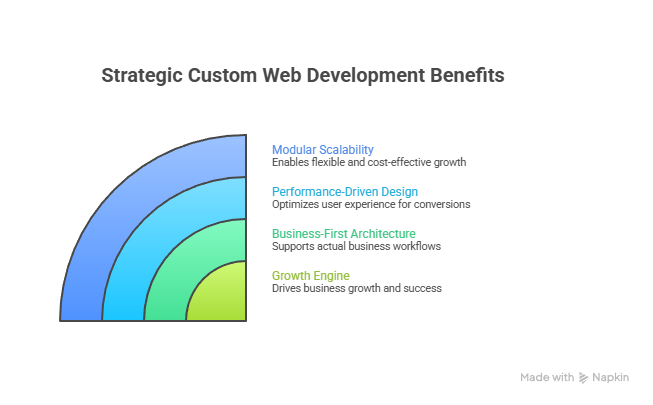
When done strategically, custom web development stops being a technical expense and starts becoming a growth engine. It connects technology directly to business goals, removes operational friction, and creates measurable impact across marketing, sales, and internal teams; something most traditional websites fail to deliver.
Business-First Architecture
Most websites fail because they are designed from the outside in. They start with pages, layouts, and visuals, then try to “fit” business needs later. Strategic custom web development flips this approach completely.
Here, the foundation is not designed; it’s how the business actually works. Developers and strategists begin by understanding:
- How leads are generated and qualified
- How sales teams engage prospects
- How data flows between systems
- How internal teams use the website daily
This approach ensures the website supports real workflows instead of forcing teams to work around technical limitations.
For example, instead of a generic contact form, the system may route inquiries differently based on service type, geography, or urgency. Instead of manual reporting, dashboards pull real-time data from integrated tools.
The outcome is practical and measurable:
- Internal processes move faster
- Fewer handoffs and follow-ups are needed
- Teams spend less time fixing issues and more time executing strategy
In this model, the website becomes an operational asset, not just a marketing channel. US brands investing in custom web development USA gain systems that work with their business, not against it.
Performance-Driven Design
Many businesses confuse “good design” with “good-looking design.” Strategic custom web development treats design as a performance tool, not an art project. Every element is intentional:
- Headlines guide decision-making
- Layouts reduce friction
- Navigation removes confusion
- Calls-to-action align with user intent
Instead of asking, “Does this look nice?” the real question becomes, “Does this move the user forward?” Performance-driven design focuses on:
- Reducing drop-offs
- Improving engagement
- Guiding users toward high-value actions
This matters because most US business websites don’t suffer from a lack of traffic; they suffer from poor conversion. Visitors arrive, but they don’t take action because the experience isn’t built around decision-making.
Strategic design directly impacts:
- Conversion rates
- Sales pipeline quality
- Marketing ROI
US brands are serious about custom web development. The USA should expect design decisions backed by logic, testing, and outcomes; not personal opinions or trends.
Modular Scalability
One of the biggest advantages of strategic custom web development is modular scalability. Instead of building a rigid system that breaks under pressure, modern architectures are designed to grow. This means businesses can:
- Add new features without rebuilding the core
- Integrate new tools as operations evolve
- Expand into new markets or regions smoothly
Modular systems treat the website like a flexible platform, not a fixed product. This approach delivers three major business benefits:
- Lower long-term costs
You avoid expensive rebuilds every time the business changes direction. - Faster innovation
New ideas can be tested and launched quickly without disrupting existing operations. - Reduced risk
Changes are isolated, controlled, and predictable.
For growing US organizations, this turns expansion from a stressful event into a planned process. Growth becomes manageable instead of disruptive, exactly what custom web development in the USA should enable.
Before vs After: Business Impact of Strategic Custom Websites
Understanding outcomes helps decision-makers justify investment. Here’s how businesses typically experience change when moving from reactive websites to strategic custom platforms.
Area | Before Custom Strategy | After Custom Development |
Lead Quality | Inconsistent | Highly targeted |
Conversion Rates | Stagnant | Measurably improved |
Team Efficiency | Manual processes | Automated workflows |
System Flexibility | Rigid | Scalable |
Decision Visibility | Limited data | Actionable insights |
These outcomes define the real value of custom web development in the USA.
Common Industry Scenarios Where Custom Websites Make a Difference
Across industries, businesses face similar challenges: systems that don’t scale, teams slowed by manual work, and digital platforms that limit growth. Custom websites solve these problems when they’re built around operational realities instead of generic assumptions.
Growth-Stage Businesses
As businesses move from early growth to scale, off-the-shelf platforms begin to crack. What once worked becomes restrictive. Common pain points include:
- Inflexible workflows
- Limited integrations
- Performance issues under higher traffic
Strategic custom websites adapt as the business evolves. They support changing sales models, new customer segments, and expanding markets without forcing costly workarounds.
For growth-stage companies, custom web development in the USA provides stability during expansion, allowing leadership to focus on growth instead of technical limitations.
Service-Based Organizations
Service businesses rely heavily on efficient inquiry handling, qualification, and onboarding. Generic websites often create bottlenecks by pushing everything into manual follow-ups.
Strategic custom websites automate large parts of this process:
- Smart forms qualify leads before human involvement
- Workflows route requests to the right teams
- Onboarding steps are streamlined
This reduces response times, improves client experience, and lowers operational costs. For service organizations, the website becomes an extension of the team, not an inbox that creates more work.
Multi-Location Operations
Businesses operating across multiple locations or regions face unique challenges. They need consistency without losing local flexibility. Custom platforms solve this by:
- Centralizing branding and data
- Allowing location-specific content
- Maintaining unified reporting
Templates struggle here because they force uniformity or fragmentation. Strategic custom web development balances both.
Organizations planning expansion often realize too late that their website wasn’t built for this level of complexity. Custom web development in the USA addresses this before it becomes a problem.
Why US Brands Still Delay Fixing the Problem?
Even when problems are obvious, many US businesses delay fixing their websites. The real danger isn’t the delay itself; it’s the compounding cost of inefficiency, missed opportunities, and lost competitive advantage that grows quietly over time.
Short-Term Thinking
Websites are often treated as sunk costs rather than long-term assets. Leaders approve small fixes instead of addressing foundational issues.
This results in:
- Temporary solutions
- Growing technical debt
- Increasing maintenance costs
Short-term thinking feels safer, but it creates bigger risks later.
Decision Fatigue
With countless agencies, tools, and opinions, decision-makers feel overwhelmed. The easiest choice becomes no choice. Ironically, delaying decisions increases:
- Costs
- Complexity
- Risk
Strategic clarity reduces fatigue, but only if businesses step back and evaluate needs holistically.
Fear of Disruption
Many teams worry that rebuilding will interrupt operations. This fear keeps outdated systems in place longer than they should be.
Strategic custom development minimizes disruption by:
- Aligning with existing workflows
- Phasing implementation
- Maintaining continuity
The real disruption comes from staying stuck, not from evolving.
How Decision-Makers Should Evaluate Custom Web Development in the USA?
Choosing the right approach matters more than choosing a vendor. Decision-makers should evaluate custom web development based on strategic alignment, long-term flexibility, and measurable business impact; not speed or surface-level features.
Key Evaluation Criteria
When evaluating custom web development in the USA, leaders should focus on:
- Clear business outcomes
The project should be tied to specific goals like revenue growth, efficiency, or scalability.
- Scalable architecture
The system must support growth without constant rebuilding.
- Integration readiness
The website should work seamlessly with existing tools and future systems.
- Data and performance visibility
Decision-makers need insights, not guesses.
- Ownership and flexibility
The business, not the vendor, should control its digital foundation.
Businesses exploring custom web development in the USA should prioritize partners who ask strategic questions, challenge assumptions, and focus on long-term value; not those who rush straight to code.
Struggling to Find the Right Digital Marketing Services? Ask Us
At Colladome, we don’t treat websites as one-time projects. We treat them as business systems designed to support growth, efficiency, and long-term decision-making.
Our approach starts with understanding how your business actually operates your sales flow, marketing goals, internal processes, and growth plans. From there, we design and build custom digital platforms that align technology with real business outcomes, not assumptions.
For US brands investing in custom web development USA, we help:
- Replace rigid websites with scalable, modular platforms
- Eliminate operational friction through smart integrations
- Improve conversion performance with purpose-driven design
- Build digital foundations that evolve as the business grows
Organizations working with Colladome don’t just launch websites. They gain a digital infrastructure that supports smarter decisions, stronger performance, and sustainable growth.
If you are evaluating your next phase of digital growth, this is the right time to start a conversation.