
The Architectural Breakdown of Legacy Conversational Interfaces
Legacy conversational software introduces severe operational drag in high-throughput enterprise environments. First-generation natural language processing engines rely on static decision trees and rigid intent classifiers. When customer queries deviate slightly from pre-programmed paths, these systems fail catastrophically. The result is brittle intent matching, conversational dead-ends, and acute hallucination risks that actively erode consumer trust.
Furthermore, early conversational bots operate in complete isolation from operational data stores. They lack stateful context across user sessions and cannot execute authenticated, multi-step database mutations. For small and medium enterprises (SMEs) managing hospitality properties, supply chains, or financial services, disconnected interfaces inflate operational headcount. Support teams spend hundreds of hours manually verifying transactions that should occur automatically. Resolving these operational bottlenecks requires retiring isolated conversational silos in favour of deeply integrated chat bot development services.
The Shift to Autonomous Agentic Workflows and Context-Engineered AI
To eliminate system isolation, the industry is transitioning toward context-engineered architectures powered by autonomous agentic swarms. Unlike traditional conversational models that merely predict the next token in a string, modern agents dynamically decompose high-level business directives into discrete technical tasks. They independently select internal tools, validate intermediate responses, and update enterprise records.
A custom enterprise web application bridges raw language models with core operational systems. Integrating advanced Retrieval-Augmented Generation (RAG) with high-dimensional vector databases grounds AI reasoning inside private enterprise knowledge bases. Through rigorous data pipelines, organizations eliminate factual fabrication while enforcing granular access controls across multi-tenant environments. This engineering discipline transforms natural language into a resilient orchestration layer for enterprise computing.
Core Strategic Pillars Shaping Enterprise AI Chatbot Architecture
Engineering leaders evaluating their digital roadmaps must design around four foundational pillars that define modern conversational systems:
- Context Window Drift and Hallucination: Raw foundation models degrade in coherence over extended interactions. Implementing multi-tiered RAG with contextual semantic chunking and dynamic metadata routing delivers sub-second retrieval accuracy. This architectural pattern enforces zero-leakage compliance while preserving auditability across every query response.
- Static Responses Versus Real-World Execution: Descriptive chatbots merely answer questions, whereas agentic systems execute actions. By leveraging deterministic function calling and OpenAPI-compliant execution layers, conversational agents trigger real-time balance settlements, inventory adjustments, and scheduling workflows without human intervention.
- Data Sovereignty and Vendor Lock-in: Relying entirely on proprietary public APIs exposes organisations to regulatory liabilities and sudden pricing volatility. Enterprise deployments favor hybrid infrastructures that combine lightweight, open-weights models running in private virtual clouds with strict on-premises data isolation. This eliminates operational constraints while dropping inference latency below 200 milliseconds.
- Fragile Integration Loops: Hardcoded point-to-point connectors frequently fracture under enterprise software updates. Resilient implementations deploy custom middleware adapters that unify legacy Enterprise Resource Planning (ERP) and Property Management Systems (PMS) with modern event-driven messaging buses. This setup ensures continuous, bidirectional synchronization across corporate departments.
Autonomous Agentic Networks and Operational Delegation
Task-Decomposition Multi-Agent Swarms
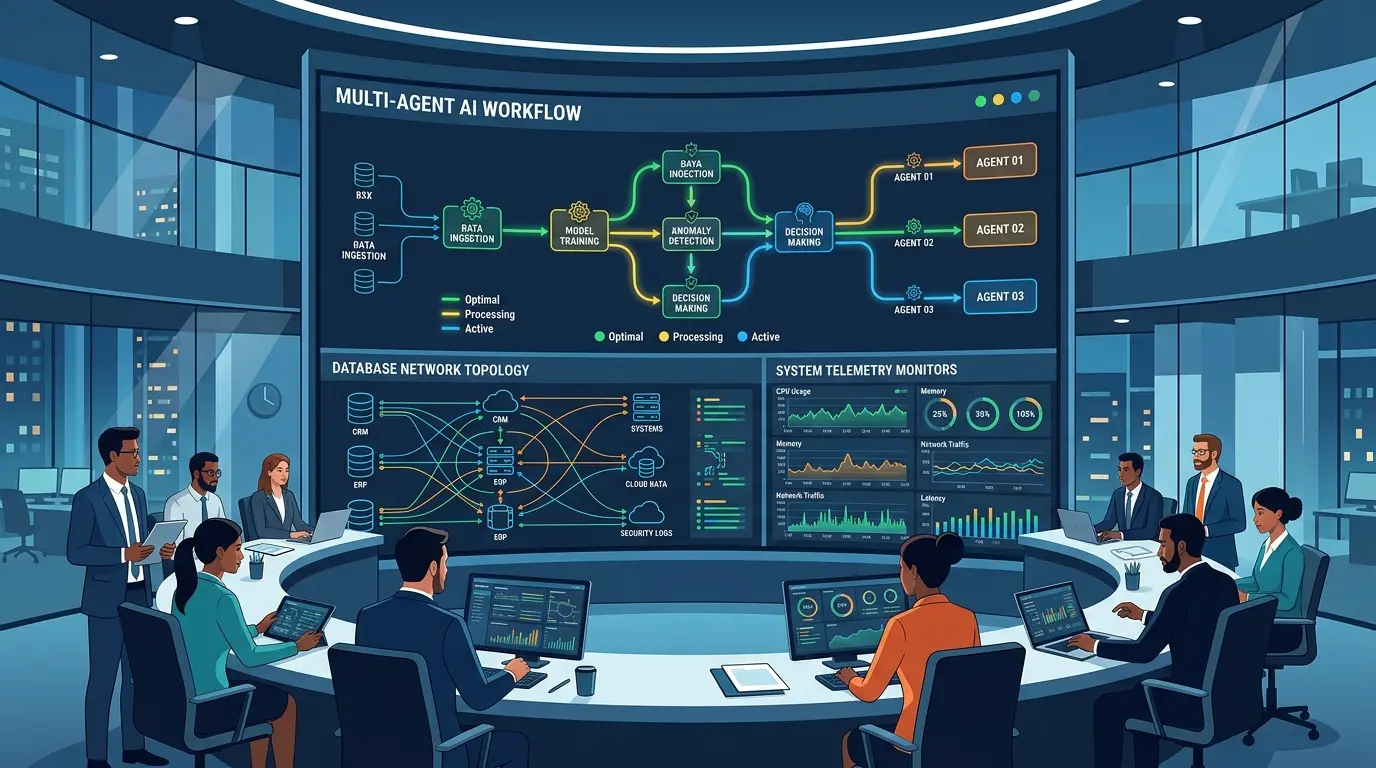
Modern enterprise chatbots utilize specialized multi-agent architectures coordinated by an orchestrator node. Instead of forcing a monolithic model to parse complex tasks, the orchestrator divides requests into parallel sub-tasks handled by specialized agents. This separation of concerns slashes inference costs, accelerates processing speeds, and enforces rigorous verification standards across mission-critical workflows.
Deterministic Function Calling for ERP Operations
Enterprise reliability demands verifiable precision. Contemporary conversational engines incorporate structured JSON-schema function calling, allowing the language model to interface directly with core database schemas. Organizations deploying modern ERP software development services establish closed-loop transactional workflows that update inventory levels, process supplier purchase orders, and generate invoices with verifiable operational accuracy.
Self-Correction Loops and Automated Validation
High-reliability conversational deployments leverage reflective feedback loops to audit system outputs prior to user delivery. When an agent attempts an API call that returns a schema error, internal validator nodes identify the discrepancy and automatically prompt the model to adjust arguments. This autonomous self-healing mitigates runtime failures and protects backend database integrity.
Advanced Contextual Grounding and Private RAG Architectures
Hybrid Vector-Graph Retrieval for Complex Taxonomies
Standard vector search often struggles with relational concepts and hierarchical data topologies. Leading engineering practices combine dense vector embeddings with knowledge graph databases. Graph-RAG architectures allow conversational agents to traverse explicit semantic relationships, uncovering accurate supply-chain dependencies and organizational hierarchies that standard semantic similarity searches consistently miss.
Private Document Ingestion Pipelines
Enterprise data environments demand continuous, automated knowledge ingestion. Modern systems utilize asynchronous document parsing pipelines that convert unstructured PDFs, internal wiki pages, and operational logs into structured markdown representations before vectorisation. Automated re-indexing schedules ensure conversational agents reference up-to-the-minute enterprise intelligence, preventing data staleness across operational teams.
Dynamic Metadata Filtering for Multi-Tenant Systems
Enterprise platforms serving diverse departments or client accounts require strict logical partitioning. Integrating dynamic metadata filtering into vector retrieval pipelines ensures conversational agents only parse documents associated with an authenticated session’s tenant ID. This mathematical isolation guarantees complete information compartmentalization without requiring discrete, costly database clusters for every department.
Enterprise Security, Governance, and Sovereign Models
Role-Based Semantic Firewalls and RBAC Controls
Security architectures must evaluate natural language inputs for operational clearance before routing prompts to underlying model clusters. Semantic firewalls enforce strict Role-Based Access Control (RBAC) protocols, ensuring sensitive payroll or proprietary source code remains invisible to unauthorized staff. These defensive layers intercept adversarial prompt injections and prevent data leakage at the API perimeter.
On-Premises and Edge LLM Inference Optimization
Organizations subject to rigorous compliance frameworks, such as healthcare and defense, increasingly host quantized language models directly on local hardware accelerators. Through techniques like 4-bit weight quantization and low-rank adaptation (LoRA), enterprise teams achieve high-throughput local inference with zero external data transmission, reducing cloud compute overhead by upwards of 40%.
Immutable Audit Logging for Regulatory Compliance
Enterprise compliance mandates complete traceability for automated system decisions. Modern chatbot platforms incorporate append-only cryptographic logging mechanisms that capture the entire interaction chain: the initial prompt, retrieved RAG context snippets, model parameter configurations, and downstream tool invocation outputs. This comprehensive audit trail satisfies international compliance standards and accelerates external operational audits.
Multimodal Systems and Cross-Domain Hardware Synergy
Unified Voice-to-Action Low Latency Streaming
Advancements in native multimodal architectures remove the friction of separate speech-to-text, text-reasoning, and text-to-speech pipelines. Modern models process audio streams end-to-end with sub-300-millisecond response latency. This breakthrough enables real-time conversational telephony and field operations where workers interact with enterprise databases entirely hands-free.
Vision-Language Integrations for Operational Diagnostics
Multimodal conversational agents now parse real-time video feeds and static technical imagery alongside textual directives. Maintenance teams use these capabilities to upload equipment photographs, allowing the system to cross-reference diagnostic manuals, pinpoint hardware faults, and draft verified maintenance tickets directly into property management or warehouse systems.
Unified Interfaces for Interactive Displays and Smart Workstations
Conversational systems are moving rapidly beyond web browser windows into interactive flat panels (IFP), smart whiteboards, and ruggedized shop-floor hardware. Purpose-built conversational layers integrated into custom workstation software allow collaborative enterprise teams to query internal metrics, annotate diagnostic schematics, and update production schedules through touch and voice interfaces simultaneously.
Organisations deploying international platforms frequently balance resource allocations by pairing affordable AI chatbot development services for cost-efficient engineering with strategic compliance frameworks verified by an established AI chatbot development company in USA. Grounding conversational engineering within an authoritative framework ensures adherence to global security baselines, such as the NIST AI Risk Management Framework.
| Operational Dimension | Legacy Chatbots (Pre-2024) | Modern Autonomous AI Agents (2026) | Engineering Complexity | Enterprise Business Impact |
|---|---|---|---|---|
| Reasoning & Intent Understanding | Brittle rule-based decision trees with basic regex matching | Dynamic multi-agent reasoning using context-aware foundation models | Moderate; requires specialized semantic prompting pipelines | Eliminates misrouted customer inquiries by over 80% |
| Backend Integration & Action Execution | Read-only queries via rigid webhooks; no multi-step executions | Deterministic function calling via secure, authenticated OpenAPI tools | High; mandates custom transactional middleware layers | Automates end-to-end task fulfillment without human escalation |
| Knowledge Grounding & Factual Verification | Static keyword databases with frequent conversational dead-ends | Hybrid Vector-Graph RAG with continuous, real-time re-indexing | High; requires dedicated embedding pipelines and vector DBs | Prevents factual hallucinations and ensures auditable accuracy |
| Data Privacy, Governance & RBAC | Open token passing with vulnerable external public endpoints | Zero-trust semantic firewalls with granular role-based masking | Very High; involves cryptographic logs and local model inference | Guarantees enterprise regulatory compliance and data sovereignty |
| Operational Maintenance Overhead | Manual script authoring and constant intent-retraining loops | Autonomous self-correction nodes with continuous operational feedback | Moderate; focuses on pipeline monitoring over script writing | Cuts internal support engineering maintenance hours by 65% |

Sector-Specific Implementations: Translating 2026 Trends into Operational Value
Applying the latest AI chatbot development trends 2026 across specific industries reveals how autonomous architectures remove longstanding operational constraints and drive measurable revenue growth.
In hospitality, bespoke conversational interfaces replace traditional front-desk friction. Modern systems connect directly to custom hotel management software for hotels, letting guests manage check-ins, modify billing configurations, and request room upgrades automatically. Autonomous agents verify room inventory, apply seasonal pricing adjustments through property management systems, and dispatch IoT service work-orders directly to housekeeping staff, entirely removing manual administrative overhead.
Across smart manufacturing and supply chain hubs, shop-floor operators interact with real-time inventory databases using conversational edge workstations and interactive flat displays. Workers verbally query component availability, initiate restocking dispatches, and review equipment maintenance playbooks without stepping away from production machinery. This immediate, hands-free context retrieval slashes diagnostic downtime and stabilizes factory floor throughput.
Within enterprise SaaS and financial services, autonomous accounting agents parse unstructured invoices, reconcile bank records against general ledgers, and flag cross-border tax discrepancies. The conversational interface serves as an auditable control cockpit. Financial controllers review high-value discrepancies, approve deterministic payment batches, and enforce regulatory approval hierarchies with zero manual spreadsheet data entry.
Navigating Technical Feasibility and Enterprise Deployment
Organisations evaluating these architectural transitions must balance API cost, data governance, and backend integrations. Transitioning from experimental prototypes to mission-critical infrastructure requires an engineering-first approach rather than purchasing generic off-the-shelf wrappers. Technical leadership auditing their current conversational capabilities should focus on readiness assessments before committing to large-scale model deployments. Auditing internal data pipelines, identifying transactional bottleneck constraints, and establishing clear security baselines ensures long-term return on engineering investments.
Preparing Your Enterprise Architecture for Next-Generation Conversational AI
Aligning with emerging AI chatbot development trends 2026 requires technical leaders to view conversational systems as core infrastructure rather than isolated support plugins. Competitive advantage no longer stems from merely hosting a language model; it belongs to organizations that integrate autonomous agentic workflows, verified contextual retrieval, and granular data security directly into their proprietary operational stacks.
Building resilient, high-throughput systems demands specialized engineering expertise that understands the complex intersection of enterprise software, legacy database synchronisation, and secure artificial intelligence transformation. Colladome partners with forward-thinking enterprises, founders, and CXOs to design bespoke digital platforms that eliminate operational drag and unlock sustainable scale. Let’s make the next big thing together!