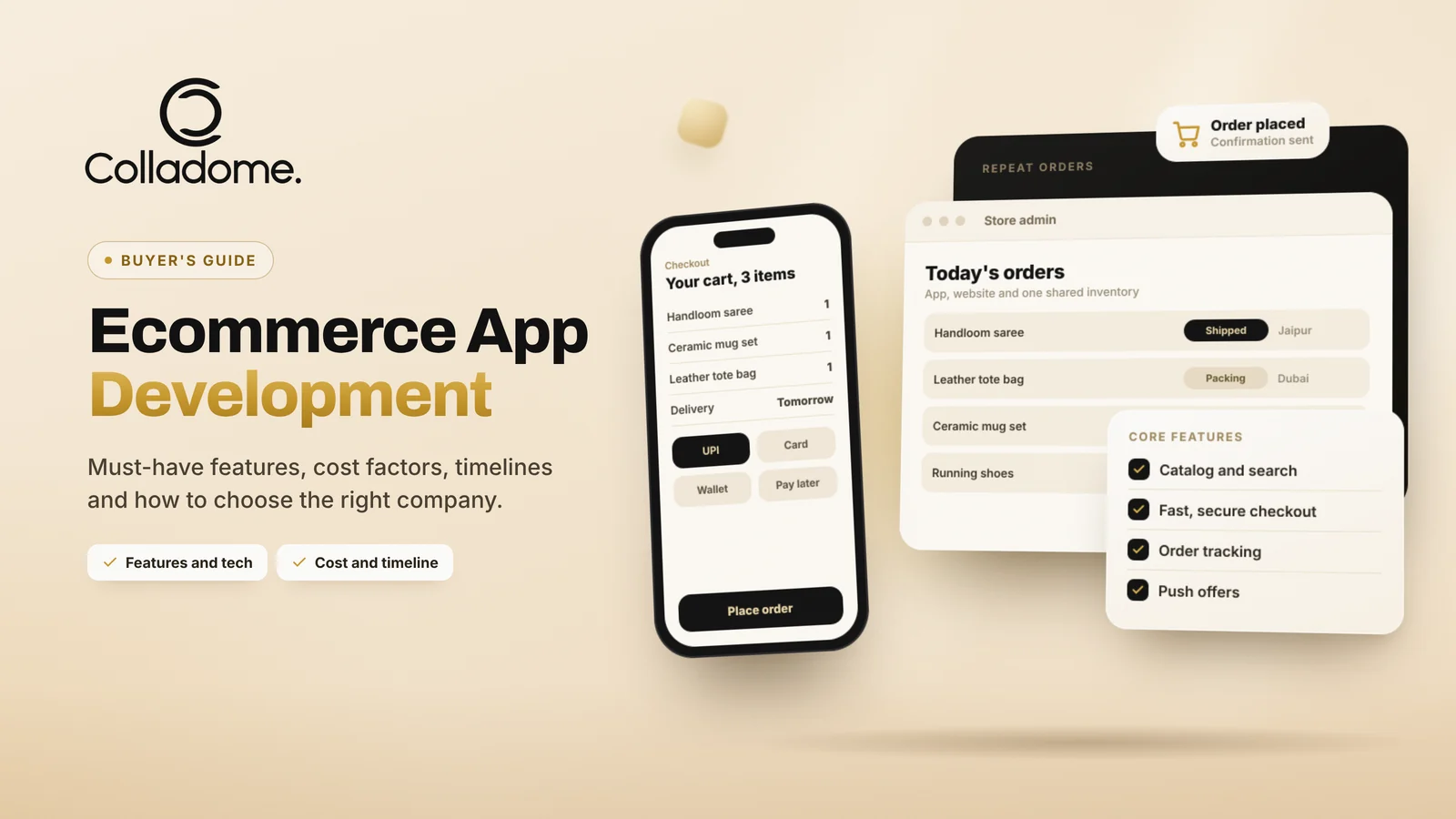

Ecommerce app development is the process of planning, designing, building and launching a mobile shopping app that lets customers browse products, pay and track orders from their phone. The cost depends on features, platforms, integrations and the team you hire. In short, a clear scope and the right partner matter more than any price list.
Key takeaways
- Every ecommerce app needs six core features: catalog and search, cart and checkout, payments, order tracking, accounts and an admin panel.
- Cross-platform frameworks such as Flutter suit most shopping apps, while native builds suit heavy AR or device features.
- Cost is driven by features, platforms, integrations, design depth and team location, so there is no fixed price.
- A simple store app often takes about three to four months, and a marketplace can take six months or more.
- Choose a partner with live store apps, a written scope, in-house QA and clear code ownership terms.
This guide covers the features shoppers expect, the main tech choices, what drives the budget, the build process and how to pick a company. In addition, it shows how Colladome builds commerce apps for brands in India, the UAE, the USA and beyond.
What Is Ecommerce App Development?
Ecommerce app development means creating a mobile app where people can find, buy and reorder products. It covers research, UI and UX design, front-end and back-end coding, payment and shipping integrations, testing and store release. After launch, it also includes updates, monitoring and new features based on real shopper data.
An ecommerce app is different from a mobile website. For example, an app sits on the home screen, can send push notifications and can remember the shopper. As a result, it is often the channel for loyal, repeat buyers. A website, on the other hand, is better for discovery through search.
Most brands therefore run both. The app connects to the same product catalog, inventory and order system as the website. That way, stock, prices and offers stay the same everywhere.
Why Do Retail Brands Build an Ecommerce App?
Brands build an ecommerce app to own the relationship with repeat customers. An app gives a faster checkout, saved addresses and payments, and direct push messages. It also lets the brand use loyalty points, personal offers and order history to bring buyers back without paying for every visit through ads.
Here are the most common business reasons:
- Repeat purchases: one-tap reorders and saved carts reduce effort for loyal buyers.
- Direct marketing: push notifications reach customers without an ad budget for each message.
- Better data: the app shows what people view, search and abandon.
- Brand control: you own the experience instead of relying only on marketplaces.
- New features: camera search, AR try-on or live chat are easier inside an app.
However, an app only pays off when people keep using it. So, plan the reasons a customer will open it again before you plan the screens.
Must-Have Features of an Ecommerce App
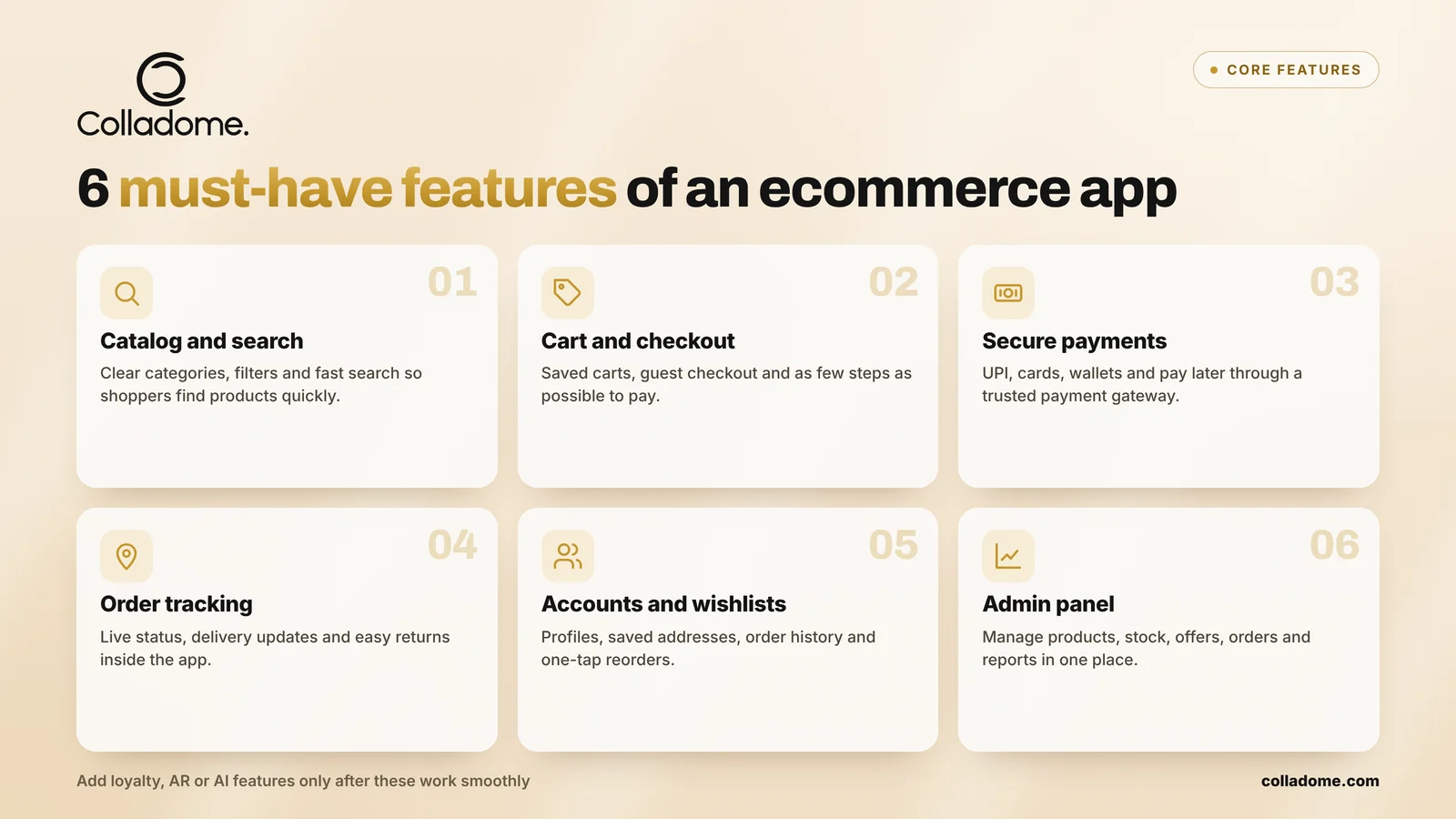
A good ecommerce app needs six core features: a product catalog with search and filters, a cart and fast checkout, secure payments, order tracking, user accounts with wishlists, and an admin panel to manage products and orders. Everything else, such as loyalty or AR, should be added once these basics work smoothly.
Beyond the core, these features often lift sales and retention:
- Push notifications for price drops, back-in-stock alerts and order updates.
- Personal recommendations based on browsing and past orders.
- Ratings, reviews and product questions.
- Coupons, gift cards and loyalty points.
- Live chat or a support chatbot.
- Multi-language and multi-currency support for cross-border selling.
Meanwhile, the admin side matters just as much. Your team needs simple tools for stock, pricing, offers, returns and reports. If these tools are slow, daily work suffers and errors creep in.
Native, Cross-Platform or PWA: Which Should You Choose?
For most shopping apps, a cross-platform framework such as Flutter or React Native is the practical choice. It uses one codebase for Android and iOS, so it is faster and usually cheaper to build. Native apps make sense for heavy AR, complex animations or deep device features. A PWA suits brands testing mobile demand first.
| Approach | How it works | Best for | Trade-off |
| Native (Kotlin, Swift) | Separate apps for Android and iOS | AR try-on, rich animations, heavy device use | Higher cost and longer build |
| Cross-platform (Flutter, React Native) | One shared codebase for both stores | Most D2C, retail and grocery apps | Some device features need extra native work |
| Progressive web app (PWA) | A mobile website that behaves like an app | Early testing and low budgets | Limited push and store presence, especially on iOS |
| Platform app builder | An app generated from an existing store platform | Small catalogs on a standard theme | Little control over design and features |
If you want to go deeper on the framework question, read our guide on Flutter app development. In most cases, the right choice comes from your feature list, not from trends.
How Much Does Ecommerce App Development Cost?
Ecommerce app development cost depends on five things: the number of features, the platforms you launch on, the integrations you need, the depth of design and the location of the team. Because of this, there is no fixed price. A focused store app costs far less than a multi-vendor marketplace with live tracking.
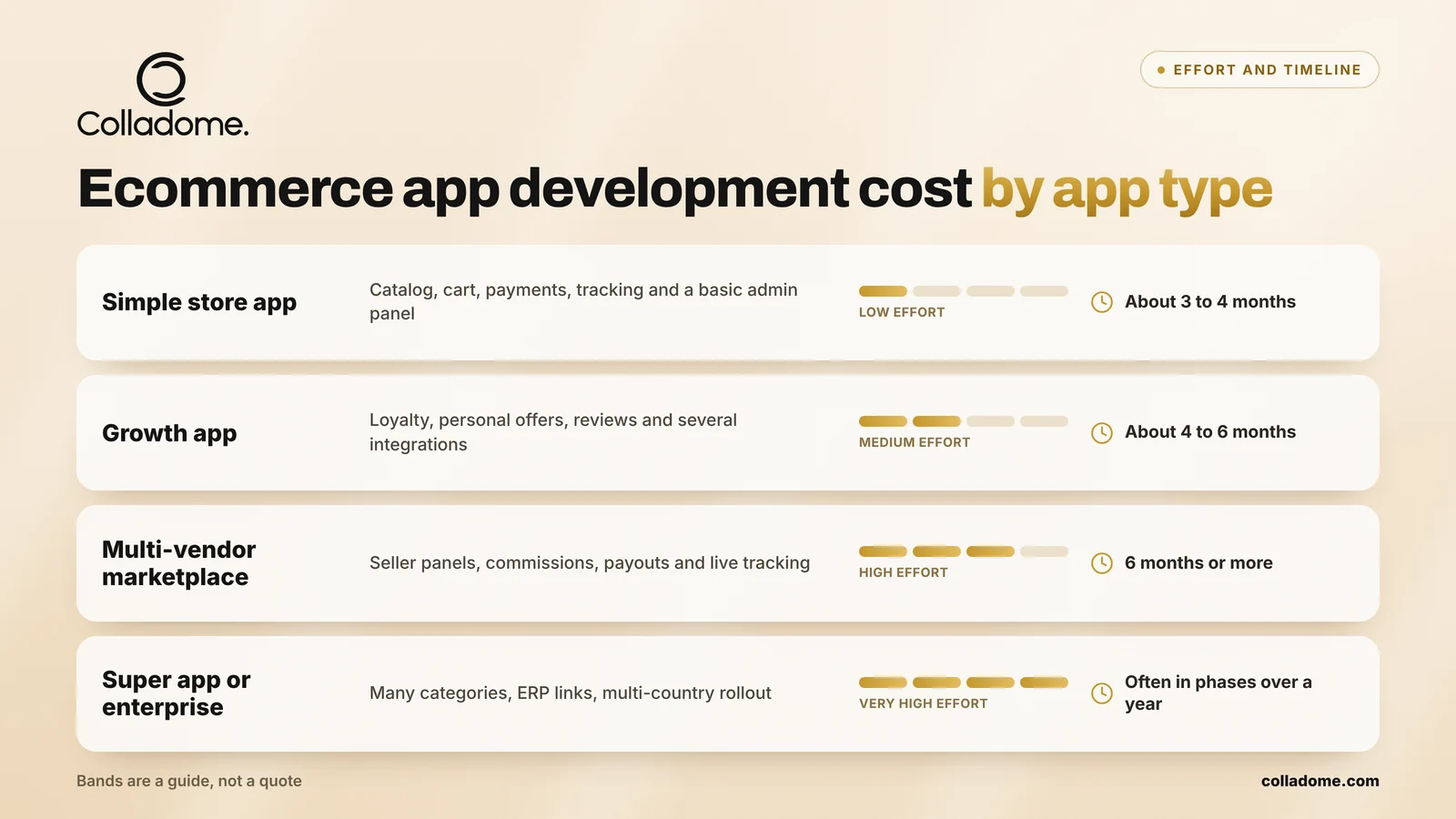
In addition, watch for costs that sit outside the first quote:
- Payment gateway fees and app store developer accounts.
- Cloud hosting, image delivery and third-party APIs such as SMS or maps.
- Ongoing maintenance, OS updates and security patches.
- Marketing to get the first downloads.
For a wider look at how software budgets are built, see our breakdown of custom software development cost. It explains pricing models and how to compare quotes fairly.
Want a realistic estimate for your store? Share your idea with Colladome and our team will map the scope, timeline and budget with you.
The Ecommerce App Development Process, Step by Step
The ecommerce app development process usually runs in seven steps: discovery, UX and UI design, architecture, development, integrations, testing and launch. After that, support and growth work continue. Each step ends with something you can review, so problems are caught early and the budget stays under control.
- Discovery: define goals, target shoppers, must-have features and success metrics.
- UX and UI design: wireframes, visual design and a clickable prototype you can test.
- Architecture: choose the stack, database, hosting and how the app links to your store.
- Development: build the app screens, APIs and admin panel in short sprints.
- Integrations: connect payments, shipping, inventory, CRM and analytics.
- Testing: check speed, security and checkout flows on real devices.
- Launch and growth: release on the stores, monitor crashes and improve with real data.
Good testing is where many projects win or lose. That is why we run every build through dedicated QA and testing before release.
How Long Does It Take to Build an Ecommerce App?
A simple store app with core features usually takes about three to four months from discovery to launch. A mid-size app with loyalty, personal offers and several integrations often takes four to six months. A multi-vendor marketplace or a super app can take six months or more and is often released in phases.
Timelines grow when the scope keeps changing. They also grow when content, product data or payment approvals arrive late. So, prepare your catalog data and business accounts early.
A smart way to save time is to launch a minimum viable product first. Then, add features based on what shoppers actually use.
How to Choose an Ecommerce App Development Company
Choose an ecommerce app development company that shows live shopping apps, explains its process clearly, gives a written scope and has in-house design, development and QA. It should also confirm that you will own the source code and the store accounts. Finally, check how it handles support after launch.
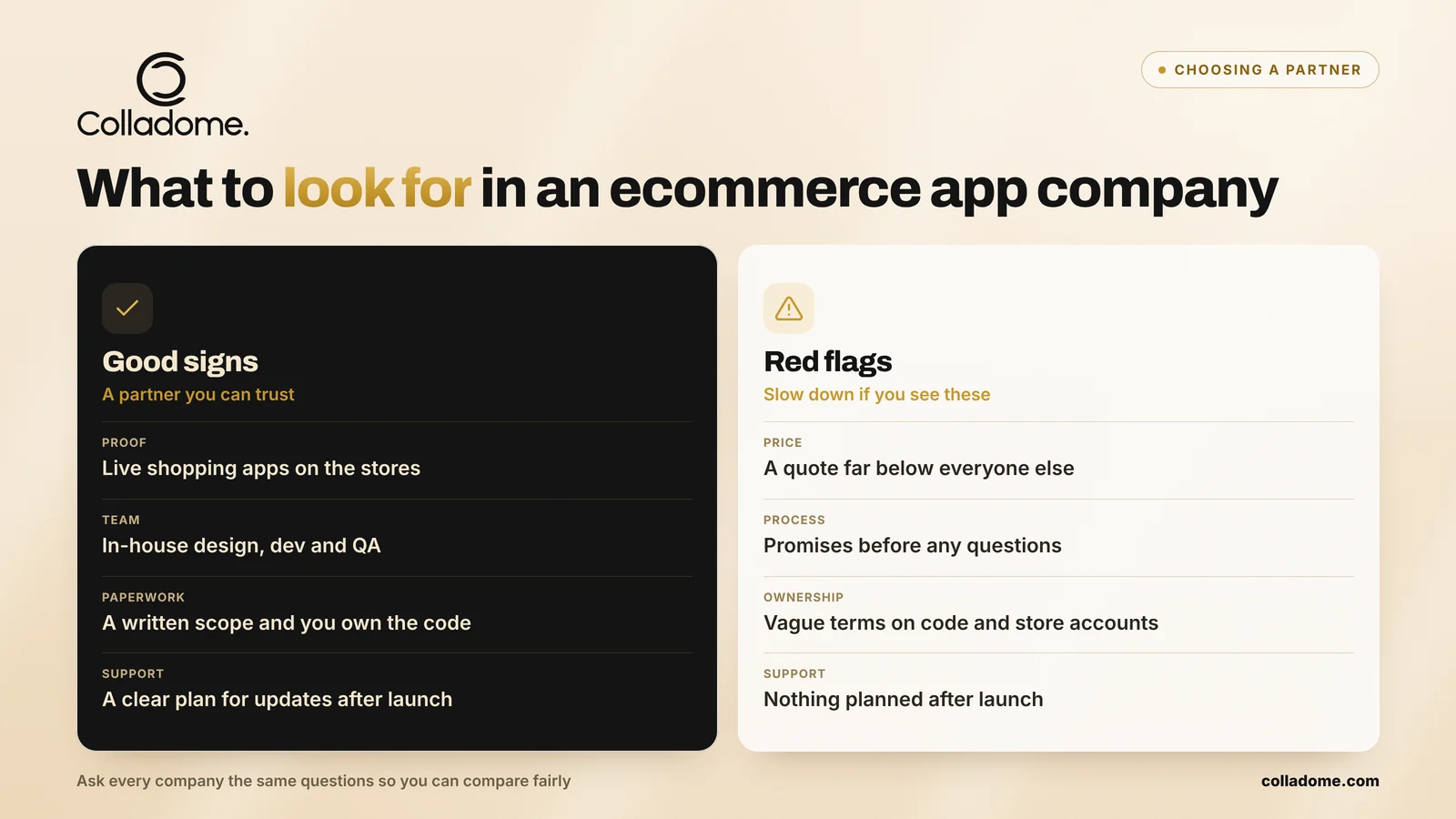
Use these questions in your first calls:
- Can you show live ecommerce or ordering apps on the stores?
- Who will work on my project, and who is my single point of contact?
- How do you handle payment, shipping and inventory integrations?
- What is included in the quote, and what is billed separately?
- How do you test on real devices before launch?
- Who owns the code, designs and store accounts?
- What support do you offer after release?
If you are comparing local teams, our guide to choosing an app development company in Jaipur covers more checks and red flags.
Common Mistakes to Avoid
The most common mistakes are building too many features at once, ignoring checkout speed, skipping real-device testing and forgetting the admin side. Many brands also plan the launch but not the months after it. As a result, the app looks good on day one but loses users soon after.
- Copying a big marketplace: start with what your shoppers need, not with every feature you have seen.
- Long checkout: every extra step can lose a buyer, so keep it short.
- Weak product data: poor photos and missing sizes hurt sales more than design.
- Ignoring store rules: app stores have payment and content rules, so read the App Store Review Guidelines early.
- No retention plan: decide how push messages, offers and loyalty will bring people back.
How Colladome Can Help
Colladome handles ecommerce app development end to end, from discovery and design to development, integrations, testing and growth. We are a custom software, AI and digital solutions company with offices in Jaipur, Hyderabad, Dubai and Portland. So far, we have delivered 500+ projects across 25+ industries, and we are ISO 9001 and CMMI Level 3 certified.
Our e-commerce software development services cover mobile commerce apps, payment gateway integration, inventory systems and secure shopping carts. In addition, our mobile app development team builds for Android and iOS.
Here are a few examples from our work:
- Right4Paws: a pet ecommerce app with real-time inventory, product catalogs and secure ordering.
- Homes Kitchen: a food-tech platform in Hyderabad with online ordering, real-time tracking and secure payments.
- RajRani Jewellers: a luxury jewellery store that brought Shopify, WooCommerce and Firebase together.
You can explore more of our retail work on the ecommerce industry page.
Ready to Start Your Ecommerce App?
The best first step is a short discovery call. In that call, we look at your products, your shoppers and your current store. Then, we suggest the right platform, a phased feature plan and a realistic timeline. That way, you start with a clear plan instead of a guess.
Ready to turn your store into an app your customers love? Talk to Colladome today and get a clear scope, timeline and estimate for your ecommerce app development project.
Frequently Asked Questions
How much does ecommerce app development cost?
Ecommerce app development cost depends on features, platforms, integrations, design depth and team location, so there is no single price. A simple store app costs far less than a multi-vendor marketplace. The best way to get a reliable figure is a short discovery phase that fixes the scope before the build starts.
How long does it take to build an ecommerce app?
A simple store app with core features usually takes about three to four months. An app with loyalty, personal offers and several integrations often takes four to six months. A marketplace can take six months or more. Launching an MVP first and adding features later is the fastest safe route.
Should I build a native or cross-platform ecommerce app?
Most shopping apps work well on a cross-platform framework such as Flutter or React Native, because one codebase serves Android and iOS. Native apps are better for heavy AR, complex animations or deep device features. Our guide on Flutter app development explains the trade-offs.
What features should an ecommerce app have?
Every ecommerce app needs a product catalog with search, a cart and fast checkout, secure payments, order tracking, user accounts with wishlists and an admin panel. After these work smoothly, you can add push offers, recommendations, reviews, loyalty points, live chat and multi-currency support.
Do I need an app if I already have an ecommerce website?
Not always. A website is better for discovery through search, while an app is better for loyal, repeat buyers. If many customers buy from you again and again, an app with push notifications and one-tap reorders can lift repeat sales. Both should share the same catalog and inventory.
How do I choose an ecommerce app development company?
Pick a company that shows live shopping apps, gives a written scope, has in-house design, development and QA, and confirms you own the code and store accounts. Also ask about support after launch. Our checklist for choosing an app development company in Jaipur lists more checks.
Can my ecommerce app connect to my existing store and ERP?
Yes. A well-built app connects to your existing store platform, inventory, ERP, CRM and shipping partners through APIs. This keeps prices, stock and orders the same across the app and website. Colladome plans these links during discovery as part of its e-commerce software development services.