
The choice of staff augmentation vs outsourcing comes down to one question: who should manage the work? With staff augmentation, you add skilled people to your own team and you stay in charge. With outsourcing, you hand a defined project to an external partner, and that partner owns the delivery. Both models save hiring time. However, they suit very different situations.
This guide explains staff augmentation vs outsourcing in plain terms: how each model works, where they differ, what they cost, and how to pick the right one. In addition, it covers hybrid setups that many growing companies use today.
What Is Staff Augmentation?
Staff augmentation means you bring in external professionals to fill specific skill gaps. They join your existing team for a set period. They attend your stand-ups, use your tools and follow your processes.
In short, you get extra hands without a long hiring cycle. For example, you might add two React developers for a six-month product push. Or you might add a DevOps engineer while you move to the cloud.
The vendor handles recruitment, payroll and HR. Meanwhile, you handle daily tasks, priorities and code reviews. Colladome offers this model through its resource augmentation services.
What Is IT Outsourcing?
Outsourcing means you hand a full project, or a full function, to an outside company. You agree on the goals, scope, timeline and budget. Then the partner plans the work, builds the team and manages delivery.
As a result, you focus on outcomes rather than tasks. You review progress at milestones. Meanwhile, the partner handles the people, the process and the quality checks.
Common examples include building a new mobile app, creating an internal portal, or running ongoing testing. Many firms use a full-cycle software development partner for this kind of work.
Staff Augmentation vs Outsourcing: Key Differences
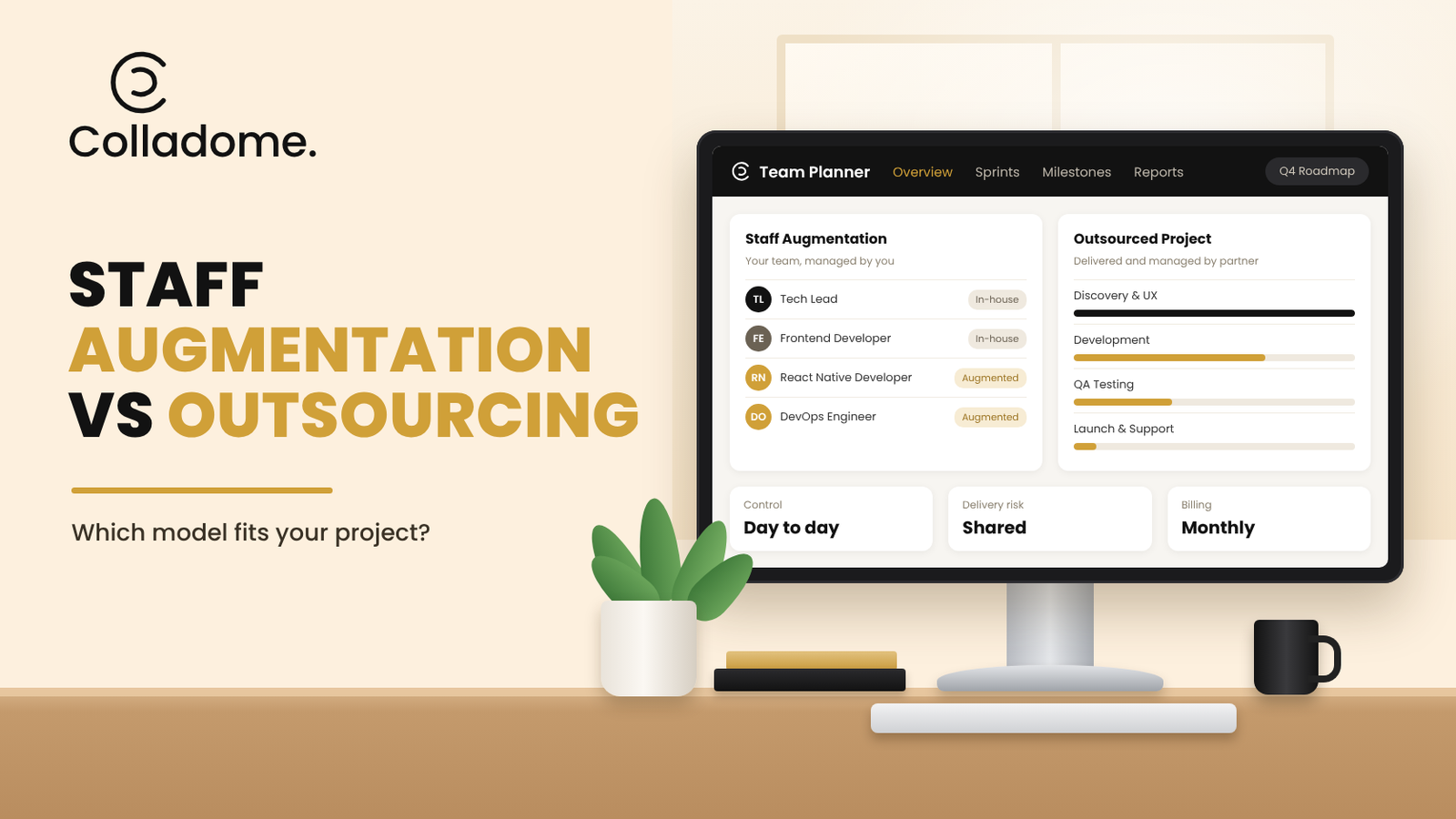
Both models give you outside talent. Still, they split control, risk and effort in different ways. The table below sums up the main gaps.
| Factor | Staff Augmentation | Outsourcing |
| Who manages the work | You do | The vendor does |
| What you buy | Skilled people and their time | A finished result or service |
| Control over process | High, day to day | Lower, at milestones |
| Delivery risk | Mostly with you | Mostly with the vendor |
| Internal effort needed | Strong in-house leads | A product owner for reviews |
| Best scope type | Evolving, ongoing work | Clear, well-defined projects |
| Typical billing | Monthly or hourly per person | Fixed price or per milestone |
In other words, staff augmentation adds capacity, while outsourcing adds capability and accountability. So, the right choice depends on what your team lacks.
Benefits and Drawbacks of Staff Augmentation
Staff augmentation works best when you already have a strong team and a clear process. Here is what you gain and what you take on.
Benefits:
- Full control: you set priorities and review every task.
- Fast start: vendors often share profiles within days, not months.
- Easy scaling: you can add or release people as the roadmap changes.
- Knowledge stays close: extra staff work inside your codebase and tools.
- No long-term payroll: you avoid recruitment, benefits and exit costs.
Drawbacks:
- You need managers with time to guide and review new people.
- Onboarding still takes effort, especially in complex systems.
- If the project slips, the risk stays with you.
- Knowledge can leave when the contract ends, unless you document well.
Benefits and Drawbacks of Outsourcing
Outsourcing suits teams that want results without building or running a delivery team. Similarly, it has clear gains and trade-offs.
Benefits:
- Less management load: the vendor runs the team and the process.
- Complete skill set: you get designers, developers, testers and a project manager together.
- Shared risk: the partner is accountable for quality and deadlines.
- Predictable budget: fixed-price deals make planning easier.
- Focus: your staff can stay on core business work.
Drawbacks:
- You have less say in daily technical choices.
- Changes in scope often mean new estimates and extra cost.
- Poor communication can cause gaps between what you meant and what gets built.
- Vendor lock-in is a risk if code and documents are not handed over properly.
Cost Comparison: Staff Augmentation vs Outsourcing
In the staff augmentation vs outsourcing cost debate, neither model is always cheaper. Instead, the total cost depends on scope, duration and how much management you can provide.
With staff augmentation, you pay a rate for each person. The bill is simple to read. However, you also carry hidden costs, such as your managers’ time, onboarding and any rework.
With outsourcing, the quote usually covers the whole team and the process. At first glance, it can look higher. Yet it often includes project management, testing and support that you would otherwise pay for separately.
| Cost Item | Staff Augmentation | Outsourcing |
| Talent fees | Per person, per month or hour | Included in project price |
| Project management | Your own team | Usually included |
| Quality assurance | Add separately if needed | Usually included |
| Cost of scope change | Low, you just re-plan | Higher, may need a change request |
| Internal overhead | Higher | Lower |
Therefore, compare the full cost of each option, not just the hourly rate. For a deeper look at budgets, read our guide on hiring models and development cost in India.
When to Choose Staff Augmentation Over Outsourcing
Staff augmentation is the better fit in these cases. In fact, most teams that pick it already have a working delivery process.
- You have a tech lead or CTO who can guide new people.
- You need a specific skill, such as AI, cloud or a certain framework.
- Your roadmap changes often, so a fixed scope would not hold.
- You want to keep the product knowledge inside your company.
- You face a short-term spike, like a launch or a big release.
For instance, a startup with two in-house engineers may add three more for a launch. After that, it can scale back down. We explain this approach further in our post on IT staff augmentation services.
When Outsourcing Beats Staff Augmentation
On the other hand, outsourcing makes more sense in these situations:
- You have no in-house tech team, or it is fully busy.
- The project has a clear scope, budget and deadline.
- You want one partner accountable for the outcome.
- The work is outside your core skills, such as testing or DevOps.
- You prefer to review milestones rather than manage tasks.
For example, many firms outsource ongoing QA testing or DevOps services. That way, specialists handle the work while the core team keeps building features.
The Hybrid Model: A Dedicated Team
Some projects do not fit neatly into either box. In that case, a dedicated team can bridge the gap. The vendor provides a stable team that works only on your product. Additionally, the vendor often adds a project manager and QA.
So, you get the control and continuity of staff augmentation. At the same time, you get some of the structure and accountability of outsourcing. This model suits long-term products with a steady roadmap.
Another common mix is to outsource a new module while augmenting the core team. As a result, you move faster on both fronts without overloading anyone.
How to Decide on Staff Augmentation vs Outsourcing
Use these questions to settle the staff augmentation vs outsourcing decision for your project:
- Do you have strong technical leadership in-house? If yes, augmentation is easier to run.
- How clear is the scope? A fixed scope points to outsourcing. An evolving one points to augmentation.
- Who should own the risk? If you want the vendor to be accountable, outsource.
- How long will the work last? Short bursts suit augmentation. End-to-end builds often suit outsourcing.
- Where should knowledge live? If it must stay in-house, augment and document well.
Next, check the vendor itself. Look at past work, references, security practices and time zone overlap. Our checklist on how to choose the right software development company lists the key questions to ask.
Common Mistakes to Avoid
Many teams pick a model for the wrong reasons. As a result, they lose time and money. Watch out for these traps.
- Choosing on rate alone: a low hourly rate means little if quality or speed suffers.
- Skipping onboarding: even skilled people need access, context and a clear first task.
- Vague scope in outsourcing: unclear requirements lead to change requests and delays.
- No exit plan: always agree on code ownership, documentation and handover upfront.
- Ignoring time zones: plan a few hours of daily overlap for questions and reviews.
Above all, treat the staff augmentation vs outsourcing choice as a business decision, not only a hiring one. Your goals, not habit, should guide it.
How Colladome Can Help
Colladome is a custom software, AI and digital solutions company. We are headquartered in Jaipur, with offices in Hyderabad, Dubai and Portland, USA. Over the years, we have delivered 500+ projects across 25+ industries. We are also ISO 9001 and CMMI Level 3 certified.
We support both models. Through team extension, we place skilled developers, designers, testers and DevOps engineers inside your team. Alternatively, we can own a full project from discovery to launch and support.
For example, we develop and maintain the portals for Rainbow Children’s Hospitals. You can explore more of our case studies to see how we work across sectors. If you are unsure which model fits, our IT consulting team can help you map the right setup.
Choose the Model That Fits Your Goals
In summary, staff augmentation gives you more control and flexible capacity. Outsourcing, on the other hand, gives you a complete team and clear accountability. Meanwhile, a dedicated team sits in between. The best choice depends on your leadership, scope, timeline and appetite for risk.
Not sure where to start? Talk to Colladome today for a free consultation. We will review your project and suggest the model that fits it best.
Frequently Asked Questions
What is the main difference between staff augmentation and outsourcing?
The main difference is who manages the work. With staff augmentation, you add external specialists to your team and you direct their daily tasks. With outsourcing, you hand a defined project to a partner, and that partner plans, manages and delivers it. So augmentation adds capacity, while outsourcing transfers delivery responsibility and much of the risk.
Is staff augmentation cheaper than outsourcing?
Not always. Staff augmentation often shows a lower rate per person, but you also pay for your own managers, onboarding and any rework. Outsourcing quotes usually include project management, testing and support. Therefore, compare the full cost of each option over the project’s life, not just the hourly rate on the proposal.
When should a company choose staff augmentation?
Choose staff augmentation when you already have strong technical leadership and a working process. It suits evolving roadmaps, short-term spikes and specific skill gaps such as AI, cloud or mobile. It also keeps product knowledge inside your company. Colladome provides this through its resource augmentation services.
When is outsourcing the better option?
Outsourcing works best when the scope, budget and deadline are clear, and when you lack an in-house tech team or its time. It also suits work outside your core skills, such as QA testing or DevOps. You review milestones, while the partner runs the team, the process and quality checks from start to launch.
What is the difference between a dedicated team and staff augmentation?
With staff augmentation, individual specialists join your existing team for a set period. A dedicated team is a stable group that works only on your product, often with its own project manager and QA. It gives you continuity and control, plus more structure. It is a strong choice for long-term products with a steady roadmap.
Who owns the code in staff augmentation and outsourcing?
In both models, the client should own the code and related work. However, ownership depends on the contract, so confirm it in writing before work starts. Also agree on documentation, repository access and handover steps. These terms protect you if you change vendors or bring the work back in-house later.
How do I choose the right staff augmentation or outsourcing partner?
Check live work, client references, security practices, communication and time zone overlap. Ask how they onboard people, track quality and handle scope changes. Certifications such as ISO 9001 and CMMI Level 3 show defined processes. Our guide on choosing a software development company lists more questions to ask.
Can I combine staff augmentation and outsourcing?
Yes. Many companies outsource a new module or a separate project while augmenting their core product team. This hybrid approach lets you move faster on several fronts without overloading in-house staff. To plan the right mix for your roadmap, you can talk to Colladome for a free consultation.