
Hospitality software development services encompass the engineering, integration, and deployment of bespoke digital platforms tailored specifically for hotel operations, resorts, and multi-property hospitality groups. These enterprise services replace disconnected commercial software by designing unified property management systems (PMS), high-throughput channel distribution pipelines, direct-booking engines, and custom hardware integrations. Running a modern hospitality brand involves much more than taking bookings; tailored engineering removes manual operational constraints and establishes unified operational control.
As portfolio scale increases, standard commercial tools struggle to sustain complex multi-tier rates, automated housekeeping dispatch, and unified guest intelligence. Investing in dedicated enterprise software allows operators to eliminate third-party transactional commission fees, secure complete ownership of guest telemetry, and scale property portfolios without exponential per-key SaaS licensing penalties.
The Structural Limitations of Legacy Hospitality Architecture
Modern hospitality enterprises encounter severe friction when expanding multi-property portfolios across fragmented legacy platforms. Typical operations depend on disparate applications stitched together with brittle third-party connectors. Front desk software rarely synchronises cleanly with central reservation systems, inventory channels, or on-premise point-of-sale terminals. This structural disconnect creates severe operational bottlenecks that drain profitability and distort performance metrics.
According to analysis by the American Hotel & Lodging Association, operational technology must directly enhance workforce productivity and guest responsiveness to preserve operating margins in high-cost environments. Traditional off-the-shelf software consistently fails to achieve this alignment due to three persistent technical vulnerabilities:
- Channel API Latency: Batch-driven inventory updates cause distribution delays across Online Travel Agencies (OTAs), triggering double bookings and requiring expensive manual rate parity interventions.
- Fragmented Guest Data Silos: Customer profiles remain trapped across separate booking engines, point-of-sale terminals, and loyalty databases, completely preventing unified CRM personalisation across sister properties.
- Hardware-Software Decoupling: Proprietary room locks, self-service check-in kiosks, and conference facility hardware operate on isolated local networks, remaining entirely detached from centralized cloud billing.
Custom Software Architecture: Eliminating Operational Friction Across Properties
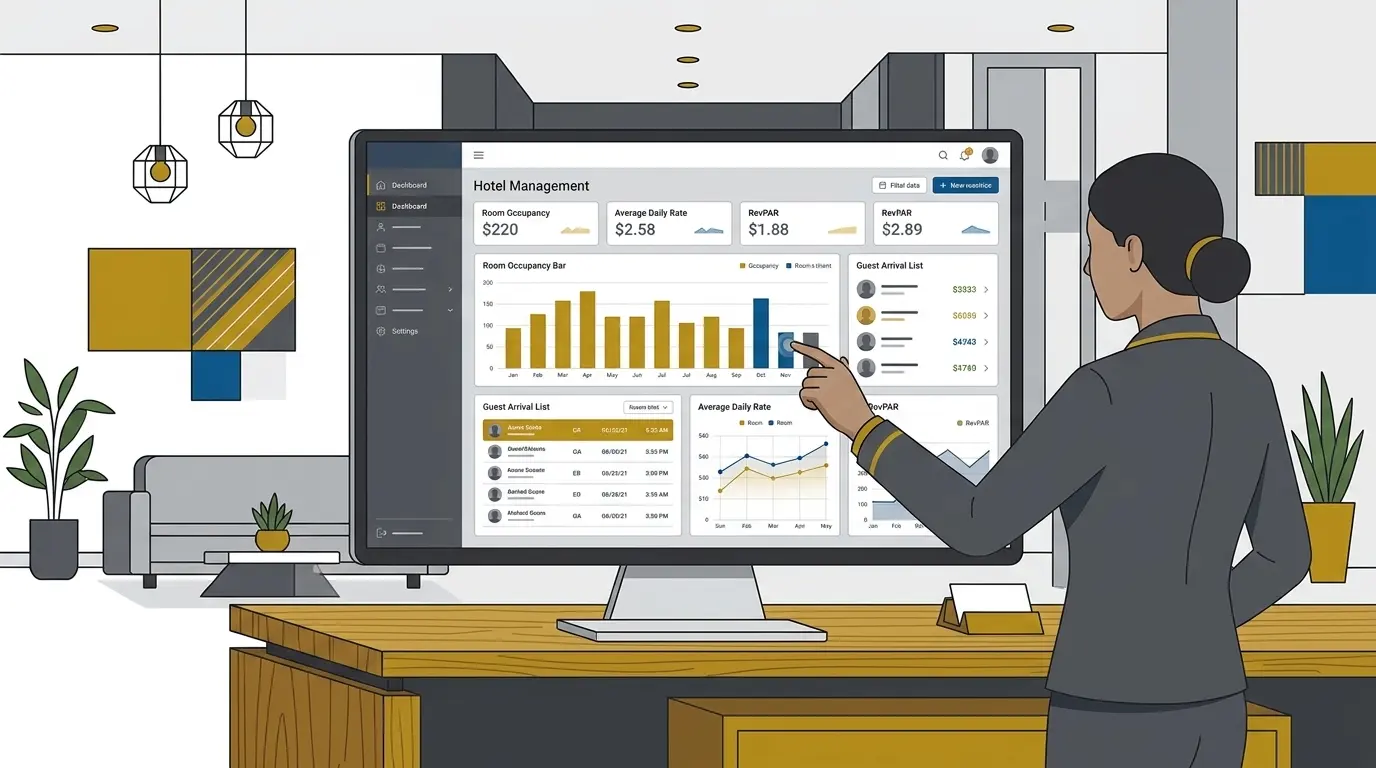
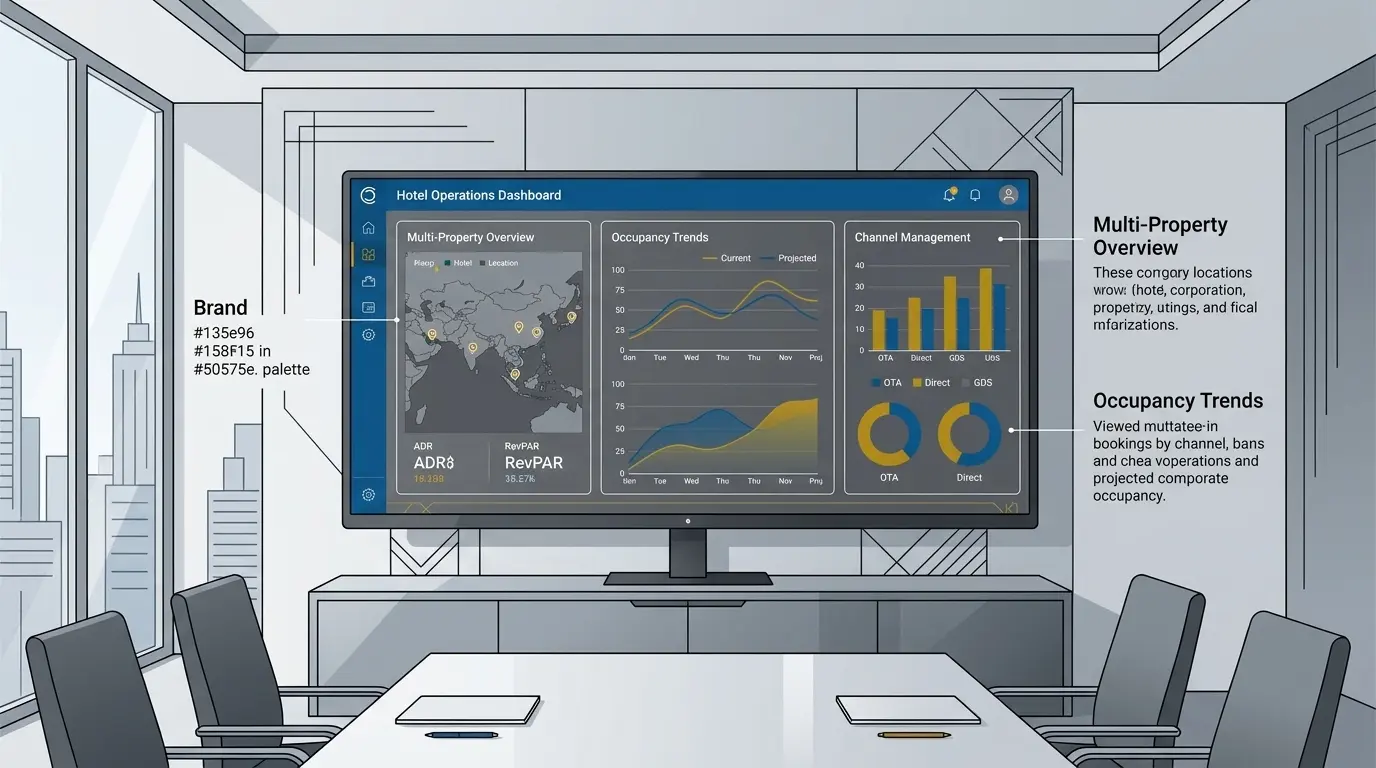
Tailored hospitality software development services eliminate structural debt by replacing rigid SaaS subscriptions with a modular, microservices-driven enterprise web application. Rather than conforming operational workflows to commercial software parameters, custom engineering models software data schemas directly around your organization’s multi-property workflows. Centralized inventory control, real-time RevPAR analytics, and dynamic pricing algorithms operate within a singular unified database.
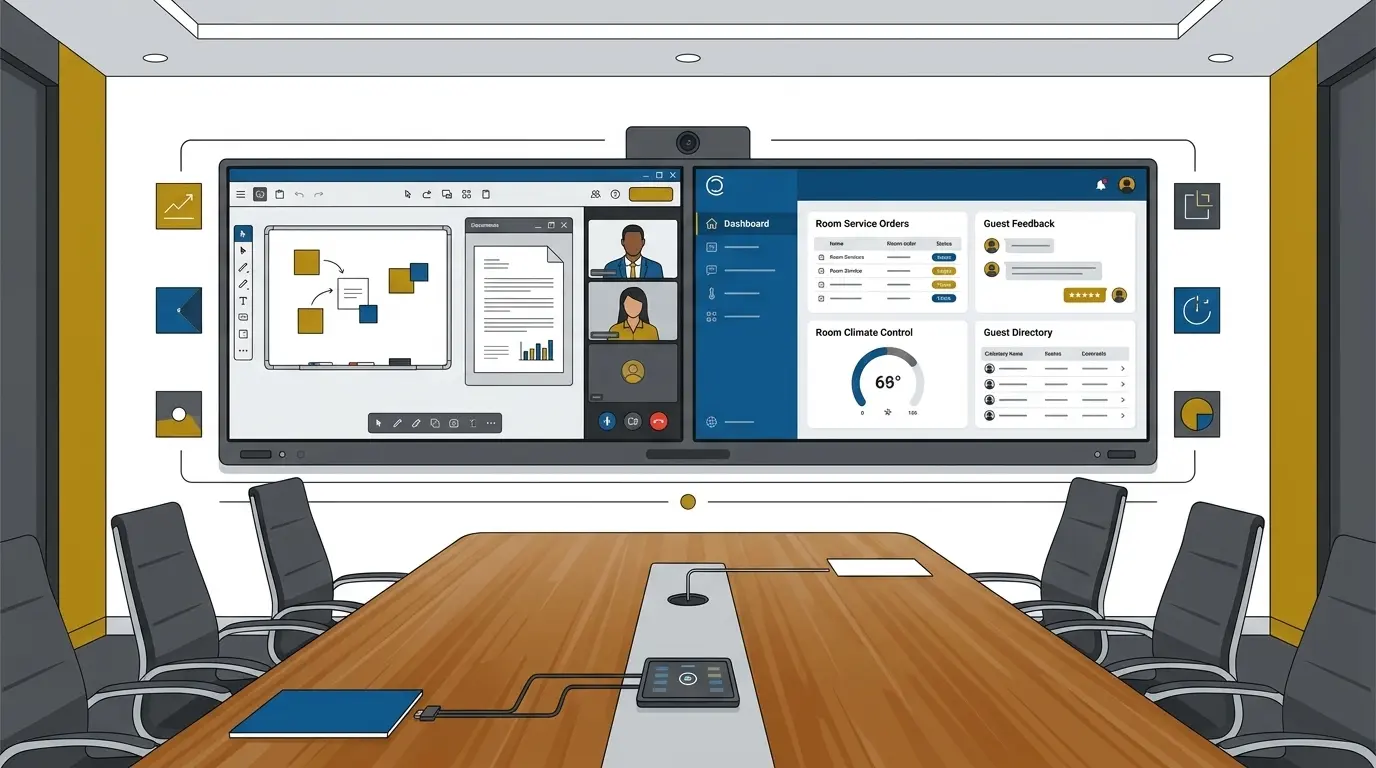
At Colladome, the strategic engineering process pairs cloud-native enterprise software development with contextual automation. By bridging digital management dashboards with physical hardware endpoints—including interactive flat panels (IFP) and smart meeting room boards—enterprise operators gain seamless control over their real estate assets. This architectural modernization eliminates redundant vendor fees, lowers OTA distribution overhead, and establishes complete operational visibility across all physical locations.
Core Pillars of Modern Hospitality Software Engineering
Developing resilient enterprise infrastructure requires systematic execution across four foundational operational domains:
- Multi-Property PMS & Reservation Infrastructure — Problem: Distributed hotel groups suffer multi-tenant data concurrency conflicts and fractured guest folios across geographic regions. | Solution: Build a centralized relational database schema featuring distributed caching, sub-second latency, and isolated property tenancy rules. | Outcome: Instant portfolio-wide room availability checks and unified guest transaction ledgers across all sites.
- Custom Channel Manager & Direct Booking Engines — Problem: Third-party distribution middleware charges substantial transaction fees while suffering frequent synchronization dropouts. | Solution: Implement custom two-way XML/JSON asynchronous webhook pipelines directly linked to major OTA extranets and global distribution systems. | Outcome: Zero-latency inventory parity, protection against rate parity penalties, and maximized direct booking margin retention.
- Intelligent Housekeeping & Workforce Automation — Problem: Manual room dispatching via radio or paper clipboards leads to delayed check-ins and unrecorded maintenance tickets. | Solution: Deploy responsive staff-facing progressive web applications connected to real-time IoT room sensors and automated cleaning priority queues, expanding on proven hotel workforce management automation. | Outcome: Room turnover times drop by up to 35%, with immediate front-desk availability updates.
- Interactive Displays & Meeting Space Ecosystems — Problem: Conference spaces rely on unintegrated audiovisual setups, requiring manual scheduling and disconnected billing logs. | Solution: Engineer custom software interfaces for interactive flat panels (IFP) and smart boards directly integrated into central PMS banquet billing modules. | Outcome: Automated hourly room billing, digital session note distribution, and frictionless enterprise guest experiences.
Core Modules Required for Scalable Hotel Operations
Centralized Property Management System (PMS) Architecture
Enterprise PMS platforms require high-throughput relational databases, such as PostgreSQL clusters, configured with multi-tenant tenancy models. The architecture isolates property-level records while allowing centralized executive reporting. Front-line reception interfaces leverage optimistic UI caching to complete guest check-in sequences within sub-second response windows, even during peak group arrivals.
High-Frequency Channel Management Pipelines
Direct channel manager integrations require robust distributed message queues, such as RabbitMQ or Kafka, to ingest and broadcast inventory mutations. As soon as a guest reserves an executive suite on a direct web portal, the system distributes inventory deductions to external OTAs instantly, removing overbooking risks and maintaining synchronized pricing rules.
Automated Financial & RevPAR Yield Engines
Yield management modules replace manual spreadsheet updates with algorithmic pricing logic. The system continuously evaluates booking velocity, local competitive pricing scrapers, historical pacing, and seasonal demand. By automatically adjusting room rack rates across channels in real time, hotels maximize revenue per available room (RevPAR) systematically.
Deep System Integrations and Hardware Ecosystems
Contactless Kiosks and Smart Lock IoT Protocols
Modern guest arrival experiences rely on seamless hardware-software communication. Custom development connects cloud applications to on-premise hardware using secure IoT protocols. Mobile applications and self-service kiosks interface directly with Bluetooth Low Energy (BLE) and RFID door lock controllers, generating digital room keys securely upon automated passport verification and payment gateway authorization.
Dedicated IFP and Smart Board Conference Solutions
Business hotel performance depends heavily on corporate facility utilization. Bespoke hospitality engineering bridges interactive flat panel (IFP) touch displays and smart board firmware with property billing engines. Corporate guests interact with custom whiteboard environments during executive conferences, with usage duration, digital catering requests, and printing services billed automatically to the master corporate folio.
Legacy ERP and Accounting Synchronization
Hotels handle extensive transactional volumes across food and beverage outlets, retail stores, and spa centers. Bi-directional database connectors synchronize point-of-sale (POS) terminal outputs directly with corporate accounting ledgers, detailed in our guide to ERP software development for enterprise control. This continuous reconciliation eliminates end-of-day manual ledger audits and flags procurement variances automatically.
Architectural Governance, Security, and Scalability
Role-Based Access Control (RBAC) and Audit Logs
Securing sensitive operational controls requires granular role-based access frameworks. Reception personnel interact exclusively with guest check-in modules, while night auditors, general managers, and finance controllers access distinct analytical tools. Immutable append-only audit logs track every folio adjustment, rate override, and manual discount to eliminate internal fraud vectors.
Data Protection and Payment Security Standards
Hospitality software handles sensitive credit card details and personal identity documentation daily. Engineering architectures must incorporate PCI-DSS Level 1 compliant tokenization pipelines, ensuring payment credentials never touch raw internal databases. Encrypted data vaults and strict access isolation guarantee absolute compliance with global data privacy frameworks like GDPR.
Cloud Infrastructure and Multi-Region Availability
International and multi-property operators require uninterrupted platform stability. Infrastructure deployed across high-availability cloud clusters utilizes automated multi-region failovers and containerized microservices managed via Kubernetes. This architectural pattern guarantees continuous uptime, allowing properties to process arrivals, night audits, and transactions without operational disruption.
Commercial Evaluation: Custom Hospitality Software vs. Off-The-Shelf SaaS Platforms
Hospitality executives must weigh short-term deployment convenience against long-term operational leverage when selecting property systems. The following matrix illustrates the strategic trade-offs between commercial SaaS packages and an owned enterprise software asset:
| Decision Criteria | Off-The-Shelf SaaS Platforms | Custom Hospitality Software Development | Operational Impact | Strategic Winner |
|---|---|---|---|---|
| Long-Term Cost Structure | Compounding per-room, per-month licensing fees that scale aggressively with portfolio growth. | Fixed engineering capital expenditure resulting in fully owned corporate software intellectual property. | Capitalization shifts from uncontrollable recurring operating expenses to long-term corporate assets. | Custom Hospitality Software |
| Feature Customization & Scalability | Rigid, generalized product roadmaps shaped by generic global market demands. | Tailored software modules engineered around specific brand workflows and operations. | Eliminates procedural workarounds and enhances front-line staff execution speed. | Custom Hospitality Software |
| Data Ownership & Analytics | Aggregated telemetry stored in closed vendor ecosystems with constrained API export limits. | Absolute proprietary database ownership with unrestrained data warehousing and real-time BI access. | Enables proprietary guest profiling, automated retention models, and deep revenue forecasting. | Custom Hospitality Software |
| Third-Party Hardware & IFP Integration | Restricted strictly to the software vendor’s approved, monetized partner hardware catalogs. | Open hardware driver integration covering proprietary IoT door locks, kiosks, and conference IFP displays. | Removes hardware vendor lock-in and modernization barriers across physical facilities. | Custom Hospitality Software |
| Direct Booking Commission | Third-party booking modules frequently impose micro-commissions or gateway surcharges per stay. | Proprietary direct-booking infrastructure processing transactions with zero vendor commissions. | Preserves 100% of room margin on direct reservations, boosting bottom-line profitability. | Custom Hospitality Software |
When selecting a dedicated hotel management system development company, operators transition from software renters to platform owners. For a comprehensive economic breakdown, review our detailed analysis on custom hotel PMS vs SaaS PMS pricing models.
Operational Scenarios: Where Custom Hospitality Software Generates Measurable Value
Custom engineering delivers concrete commercial returns by removing specific operating barriers across varied business footprints:
- Boutique Multi-Property Chains: A regional operator managing multiple historic boutique properties struggled with fragmented channel sync errors and disjointed inventories. By deploying a unified custom enterprise PMS engine, the brand consolidated multi-site availability, eliminated recurring overbooking compensations, and achieved a 24% uplift in direct web bookings within eight months.
- Business & Conference Resort Facilities: A commercial resort facility integrated meeting-room interactive flat panels (IFPs) directly into its centralized PMS banqueting module. Corporate event organizers could reserve AV capabilities on demand, while hardware telemetry automated accurate billing back to corporate guest folios, cutting administrative billing reconciliation by 40 hours per month.
- Fast-Growing Regional Hotel Groups: An expanding mid-market brand with over 500 keys migrated away from tiered per-room SaaS subscriptions. Transitioning to an owned multi-tenant cloud application allowed the business to eliminate annual recurring software licensing fees, redirecting capital toward property expansion while retaining full architectural control over future AI features.
Evaluating the Transition to an Owned Hospitality Tech Stack
Modernizing core hospitality systems represents a critical strategic commitment that requires methodical operational planning. Founders, Chief Operating Officers, and Technology Heads must initiate this process not as an immediate procurement exercise, but through an objective architectural discovery audit. Evaluating technical debt, measuring channel API latency overhead, and quantifying total SaaS subscription expenditure across a three-year horizon establishes clear baseline criteria.
Engaging specialized hospitality software development services early allows technical strategists to map existing operational workflows, define API integration dependencies, and validate data migration plans without disrupting active guest operations. This disciplined discovery phase clarifies technical boundaries, ensuring subsequent development sprints translate directly into measurable operational efficiency.
Building High-Performance Hospitality Infrastructure
Hospitality enterprises cannot achieve lasting market distinction or agile operations while relying on generic, off-the-shelf software stacks designed for the lowest common denominator. Commercially constrained systems lock operators into compounding licensing costs, fragment guest intelligence, and restrict physical hardware integration. Custom enterprise software engineering provides the operational foundation required to secure proprietary data, reduce third-party distribution commissions, and deliver exceptional, frictionless guest experiences across properties.
Colladome partners with ambitious hospitality brands and SMEs to engineer scalable, enterprise-grade software solutions, advanced PMS architectures, and integrated display ecosystems. Let’s make the next big thing together!