
The SME Bottleneck: Why Off-the-Shelf SaaS and Legacy Workflows Fail Modern Enterprises
Mid-market enterprises frequently encounter structural friction when scaling operations. Traditional software ecosystems and commercial SaaS platforms force rigid, linear processes that rarely accommodate complex operational nuances. As departments layer disconnected single-purpose tools over outdated systems, fragmented data silos proliferate. This dynamic accelerates licensing overheads while leaving fundamental operational constraints unaddressed.
Public generative AI interfaces present severe enterprise risks. Passing proprietary operational data, financial records, or client records through public consumer models exposes businesses to data leakage and regulatory compliance liabilities. Consumer tools lack domain contextualisation, producing generic hallucinations rather than deterministic business intelligence. Relying on superficial tooling exacerbates three systemic risks:
- Escalating Subscription Costs: Per-seat recurring charges expand rapidly across operational departments without generating permanent enterprise assets.
- Critical Data Exposure: Commercial third-party platforms often retain prompt inputs for retraining, breaching privacy boundaries and client trust.
- Workflow Rigidity: Standard SaaS platforms cannot integrate bi-directionally with bespoke enterprise resource planning (ERP) databases, leaving operational gaps that require manual resolution.
Architectural Leverage: Unlocking Value Through Custom Generative AI Engineering
Engineering bespoke generative solutions resolves legacy bottlenecks by placing institutional context at the core of system architecture. Purpose-built models, private retrieval-augmented generation (RAG) vector pipelines, and specialised application programming interfaces (APIs) allow businesses to automate intricate, non-linear workflows while retaining total data sovereignty. Rather than adapting operational models to rigid external software, custom systems adapt directly to existing operational realities.
Through generative AI development service frameworks, organisations establish private knowledge graphs that interface securely with core databases. Engineering owned models eliminates the latency and hallucinations associated with public interfaces. Technical leaders assessing these operational vectors frequently explore custom AI solutions when off-the-shelf options fail, ensuring software architectures scale synchronously with market expansion.
The Strategic Imperative: Core Business Gains Derived from Generative Engineering
Deploying dedicated generative infrastructure delivers quantifiable operational efficiency across key enterprise vectors:
1. Unstructured Enterprise Data Activation: Most SMEs remain trapped by unstructured dark data stored in legacy contracts, internal wikis, and historical logs. Bespoke semantic RAG vector pipelines parse this information in real time, cutting cross-system search latency by up to 70% and providing immediate answers to operational staff.
2. Cognitive Process Automation: High-volume back-office administrative burdens consume valuable operational bandwidth. Deploying deterministic agentic models automates unstructured data entry, reconciles accounts, and updates operational databases without manual intervention, accelerating cycle completion times from days to seconds.
3. Enterprise IP and Domain Context Retention: Employee turnover often drains critical institutional knowledge from growing companies. Fine-tuning models on historical organisational workflows captures internal know-how into permanent digital assets that advise incoming teams and maintain baseline standards.
4. Scalable Customer Operations: Outdated, rigid decision trees often fail during complex customer queries, damaging customer sentiment. Intent-aware generative engines resolve edge cases contextually, executing direct transactional tasks within core software without requiring linear headcount expansion.
Operational Modernisation and Process Velocity
Automated Multi-Source Intelligence Extraction
Modern enterprises manage vast volumes of unstructured documentation, including supplier agreements, compliance audits, and intake records. Purpose-built parser models ingest and structure multi-format documents instantly. Automating document pipelines eliminates administrative lag, passing clean data objects directly into downstream transactional databases with absolute precision.
Deterministic Workflow Augmentation
Public generative chatbots deliver probabilistic text suggestions, but enterprise environments demand deterministic logic. Custom generative systems translate unstructured natural language commands into verified API triggers that execute ERP updates, inventory reconciliations, and booking assignments. This transition turns predictive generative capacity into concrete operational action.
Elimination of Human Ingestion Errors
Manual administrative entry introduces unavoidable operational friction and expensive data corrections. Intelligent extraction pipelines validate unstructured inputs against rigid schema constraints before database entry occurs. Eliminating ingestion mistakes prevents compounding downstream errors across billing, logistics, and resource management.
Commercial Scalability and Capital Efficiency
Decoupling Unit Output from Headcount Expansion
Sustained enterprise growth historically demanded proportional payroll increases to handle expanded transaction volumes. Bespoke generative architectures process exponential data loads, client inquiries, and reporting requirements without requiring identical administrative hiring. According to economic research by McKinsey & Company, generative technologies could add trillions of dollars annually in productivity across enterprise use cases, confirming its role in driving operational leverage.
Reduction of SaaS Licensing Proliferation
Organisations frequently accumulate overlapping, seat-based subscriptions for summarisation, translation, customer assistance, and internal search. Consolidating operational workflows around owned model endpoints replaces disparate third-party licensing expenses with managed, predictable compute infrastructure, preserving long-term operating margins.
Acceleration of Software Delivery Lifecycles
Internal software teams accelerate feature delivery when supported by fine-tuned coding models contextualised to internal codebases. Embedding contextual generation into engineering pipelines reduces testing friction, automates boilerplate development, and accelerates deployment velocity across software development services projects.
Data Governance and Competitive Differentiation
Absolute Proprietary IP Protection
Securing enterprise data requires complete isolation from public training environments. Custom enterprise implementations deploy open-source or distilled foundation models within isolated Virtual Private Clouds (VPC) or on-premise hardware. Zero-data retention protocols guarantee that sensitive enterprise telemetry never leaks beyond defined organizational perimeters.
Granular Role-Based Access Controls (RBAC)
Deploying conversational models across multi-tiered organisations creates security exposure if access rules are absent. Bespoke enterprise architectures link model retrieval mechanisms directly to existing directory structures and access control frameworks. Employees receive query responses drawn strictly from datasets their specific authorisation level permits.
Unique Market Moats via Domain-Specific Fine-Tuning
Relying exclusively on commercial APIs results in commoditised operational capabilities accessible to any industry rival. Calibrating bespoke models against private historical operational datasets creates defensible software assets. These tailored systems produce industry-accurate predictions and actions that unoptimised foundation models cannot replicate.
Strategic Evaluation: Commercial SaaS AI Subscriptions vs. Custom Generative AI Engineering
Executive leadership must evaluate technical tradeoffs when selecting between commercial software subscriptions and bespoke engineering:
| Parameter | Commercial Public SaaS AI | Custom Generative AI Development |
|---|---|---|
| Data Privacy & IP Control | Third-party server exposure; risk of data logging and model retraining. | Complete data sovereignty; VPC or on-premise zero-retention infrastructure. |
| Domain Customisation | Generic prompt engineering bounded by rigid web user interfaces. | Deep model calibration and fine-tuning using internal enterprise data. |
| System Integration | Isolated browser silos lacking direct core database interaction. | Bi-directional API connectivity to legacy ERPs, CRMs, and operational tables. |
| Cost Dynamics at Scale | Compounding per-user monthly subscriptions that inflate operational run-rates. | Controlled, capitalised infrastructure costs driven by efficient token usage. |
| Competitive Defensibility | Commoditised capabilities shared identically with market competitors. | Proprietary intellectual property that creates an operational market moat. |
Evaluating procurement pathways reveals that while commercial tools offer initial convenience, custom engineering establishes lasting cost governance and defensible proprietary assets. Organisations selecting dedicated engineering retain complete control over their operational data, unit unit-economics, and technical roadmaps.
Sector-Specific Implementations: Translating Algorithmic Capacity into Enterprise Value
Examining real-world operational deployments highlights the tangible benefits of generative AI development use cases across target industry sectors:
Hospitality Operations and Revenue Generation
Operating a modern accommodation network involves complex channel coordination, variable pricing demands, and ongoing guest communication. Custom generative engines synchronize directly with central custom hotel management software and property management platforms. Autonomous conversational booking agents process guest preferences, upsell amenities, and confirm direct reservations natively. This real-time automation captures margins lost to external online travel agencies (OTAs) while providing hyper-personalised guest support in multiple languages without staffing increases.
Interactive Hardware and Enterprise Collaboration
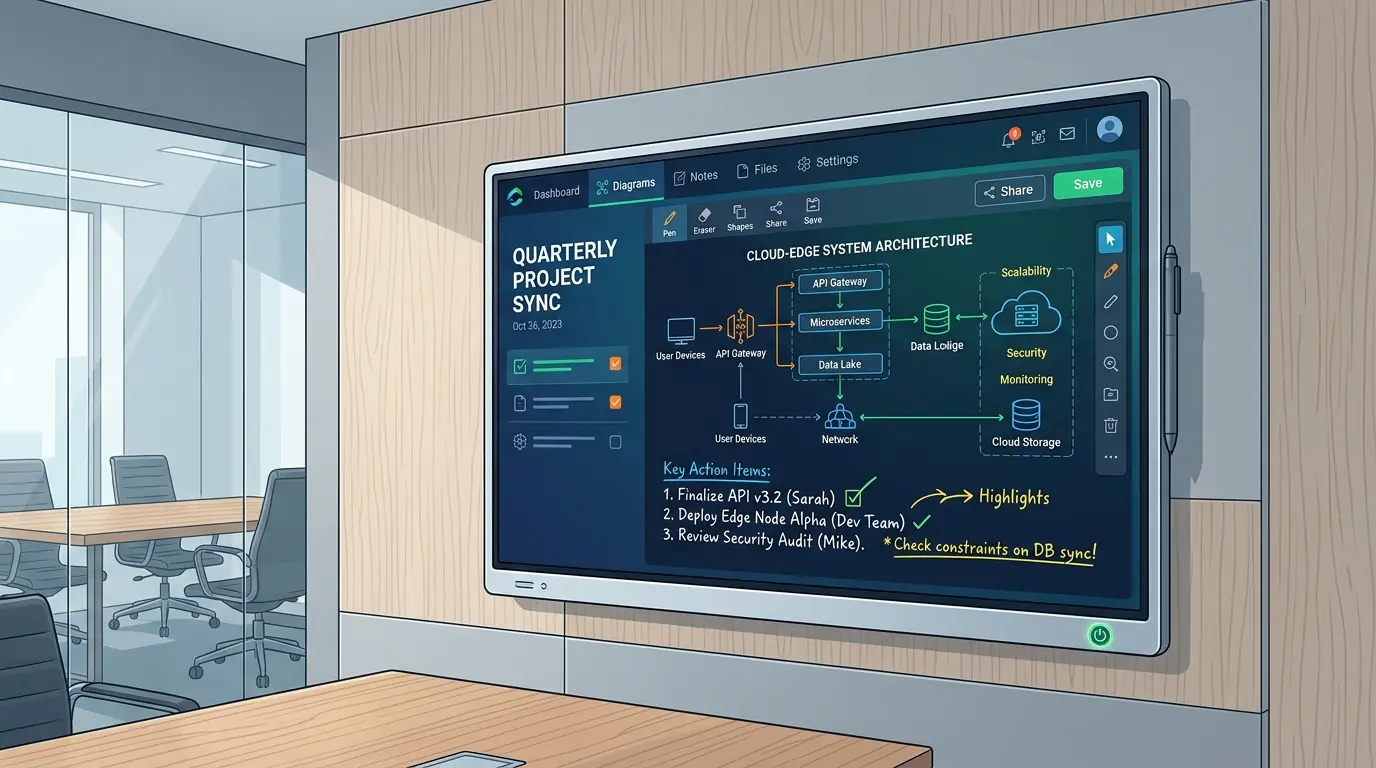
Modern boardrooms, training academies, and educational centres demand low-latency, intuitive software running directly on Interactive Flat Panels (IFP) and digital whiteboards. Tailored generative models embedded within touch-canvas operating environments transform group collaboration. Natural handwriting recognition, real-time diagram synthesis, automated meeting transcriptions, and instant action-item extractions turn physical displays into dynamic enterprise hubs. Grounding AI models in custom hardware unlocks powerful operational leverage for hybrid workforces.
Navigating Enterprise AI Transformation
Founders and technology executives evaluating enterprise transformation must balance algorithmic capability against practical systems readiness. Transitioning from legacy infrastructure requires a methodical technical audit to assess data quality, evaluate infrastructure costs, and implement strict governance frameworks. Before allocating capital, enterprise leaders benefit from structured IT consulting services and empirical readiness assessments. Evaluating computational requirements, integration points, and return profiles early ensures downstream deployments deliver sustainable performance.
Strategic Horizon: Capitalising on Custom Model Deployment
Harnessing the strategic benefits of generative AI development establishes permanent market differentiation. Moving beyond standard web subscriptions allows enterprises to transform dark operational data into automated, sovereign business execution engines. As models become integral to institutional scalability, building purpose-built software architectures secures data sovereignty, controls long-term run-rates, and unlocks compound productivity gains. Forward-looking organisations recognise that proprietary model architectures are the foundation of modern enterprise value. Let’s make the next big thing together!