Unlock Growth: Expert Cloud Consulting Services for Digital Transformation
Many organizations grapple with the limitations of legacy IT systems, hindering agility and stifling innovation in a rapidly evolving market. This often translates to inefficient operations, missed opportunities, and a struggle to maintain a competitive edge. Embracing digital transformation is no longer optional; it’s imperative for sustained growth. Our expert cloud consulting services for digital transformation are designed to navigate this complexity, providing a clear roadmap to modernize your infrastructure. We empower businesses to leverage cloud capabilities for enhanced operational efficiency, greater scalability, and a robust foundation for future innovation. This strategic approach ensures your enterprise remains agile and competitive.
Navigating the Digital Maze: Common Challenges for Modern Businesses
For founders, CXOs, and decision-makers, the digital landscape often feels less like an opportunity and more like a complex maze. The promise of efficiency and growth is frequently overshadowed by pressing digital transformation challenges. A major pain point is the crippling effect of legacy infrastructure – outdated systems that hinder innovation, complicate integration, and inflate operational costs. This often leads to a severe lack of true scalability, preventing businesses from seizing new market opportunities efficiently. Furthermore, fragmented information trapped in data silos obstructs holistic decision-making and a unified customer view. The constant struggle to achieve business agility and adapt swiftly to evolving market demands becomes an uphill battle. Traditional IT approaches, often focused on reactive fixes or siloed departmental solutions, only exacerbate these operational bottlenecks. What’s truly needed is a proactive, strategic shift towards integrated, future-proof solutions that empower growth rather than merely patching problems.
Strategic Cloud Consulting: Your Blueprint for Digital Evolution
To navigate the complexities of today’s digital landscape, businesses require more than just technology; they need a clear vision and expert execution. This is precisely where comprehensive cloud consulting services for digital transformation become indispensable. By embracing a strategic cloud adoption strategy, organizations can effectively overcome persistent operational challenges. Such a strategic shift empowers businesses with unparalleled scalability, ensuring resources can flex precisely with demand without costly overprovisioning. It significantly enhances operational efficiency through automation and streamlined workflows, freeing up valuable internal resources. Furthermore, cloud environments inherently foster innovation by providing on-demand access to cutting-edge tools and services, accelerating development cycles. Crucially, it leads to a tangible reduction in infrastructure costs, transforming capital expenditure into predictable operational expenses. Colladome excels in providing tailored strategic guidance, meticulously crafting cloud strategies that align perfectly with each client’s unique business needs and long-term growth objectives. Our approach focuses on achieving measurable business outcomes, transforming your IT modernization journey into a competitive advantage.
Key Pillars of Successful Cloud-Driven Digital Transformation
1. Strategic Cloud Migration for Foundational Agility
Problem: Many businesses struggle with outdated, on-premise infrastructure that limits agility, scalability, and innovation. As a result, high maintenance costs and slow deployment cycles can make it difficult to respond to changing market demands.
Solution: Businesses can develop and execute a comprehensive cloud migration strategy. First, this process involves assessing existing workloads and data to identify the most suitable cloud environment, whether public, private, or hybrid. Furthermore, organizations can use phased migration, re-platforming, or refactoring to support cloud-native capabilities.
Outcome: As a result, businesses can improve operational flexibility, reduce infrastructure overhead, and establish a scalable foundation for future digital initiatives. Additionally, this approach supports faster responses to evolving market requirements.
2. Continuous Cloud Optimization for Cost Efficiency
Problem: After migration, many organizations face rising cloud costs due to inefficient resource provisioning, limited visibility, and underutilized services. Consequently, these challenges can reduce the expected ROI of cloud investments.
Solution: Organizations can implement continuous cloud optimization practices. For example, this includes applying FinOps principles, rightsizing instances, leveraging reserved instances, and automating resource scaling. As a result, resources can align more closely with actual demand, helping reduce unnecessary expenditure.
Outcome: Furthermore, continuous optimization can improve performance efficiency and maximize return on investment. This allows businesses to redirect available budgets toward strategic innovation instead of spending excessively on underutilized resources.
3. Robust Data Security and Governance in Cloud Environments
Problem: As data moves to the cloud, organizations face complex compliance requirements, potential data breaches, and challenges in maintaining consistent data privacy standards. Without proper safeguards, these risks can lead to reputational damage and regulatory penalties.
Solution: To address these challenges, businesses should establish a comprehensive framework for data security in cloud environments. This framework may include strong encryption protocols, identity and access management (IAM), regular security audits, and compliance with applicable industry standards, such as GDPR or HIPAA.
Outcome: Consequently, effective security and governance practices help protect sensitive information against evolving threats. In addition, they support regulatory compliance and stakeholder trust, creating a more secure foundation for digital operations.
4. Driving Innovation with Cloud-Native Technologies and AI
Problem: Many businesses struggle to prototype and deploy innovative solutions quickly. Furthermore, traditional IT infrastructure and lengthy development cycles can limit experimentation and delay opportunities for product differentiation.
Solution: Organizations can promote innovation with cloud platforms by leveraging serverless computing, microservices architectures, and advanced AI/ML capabilities. By integrating these technologies, businesses can support faster experimentation and more efficient deployment processes.
Outcome: As a result, this approach can shorten time-to-market for new products and services. Moreover, intelligent features can enhance customer experiences and create opportunities for new revenue streams, supporting business growth.
5. Business Process Re-engineering with Cloud Agility
Problem: Outdated, manual, or siloed business processes can create operational bottlenecks and reduce efficiency. In addition, limited cross-functional collaboration may prevent organizations from realizing the full potential of digital transformation.
Solution: Businesses can undertake strategic business process re-engineering. For example, cloud-native tools and platforms can help automate workflows, integrate disparate systems, and enable real-time data exchange across departments. This approach supports a more responsive operational model.
Outcome: Ultimately, process re-engineering can streamline operations, improve productivity, and strengthen organizational agility. As a result, businesses can respond more effectively to market changes and deliver greater value to customers.
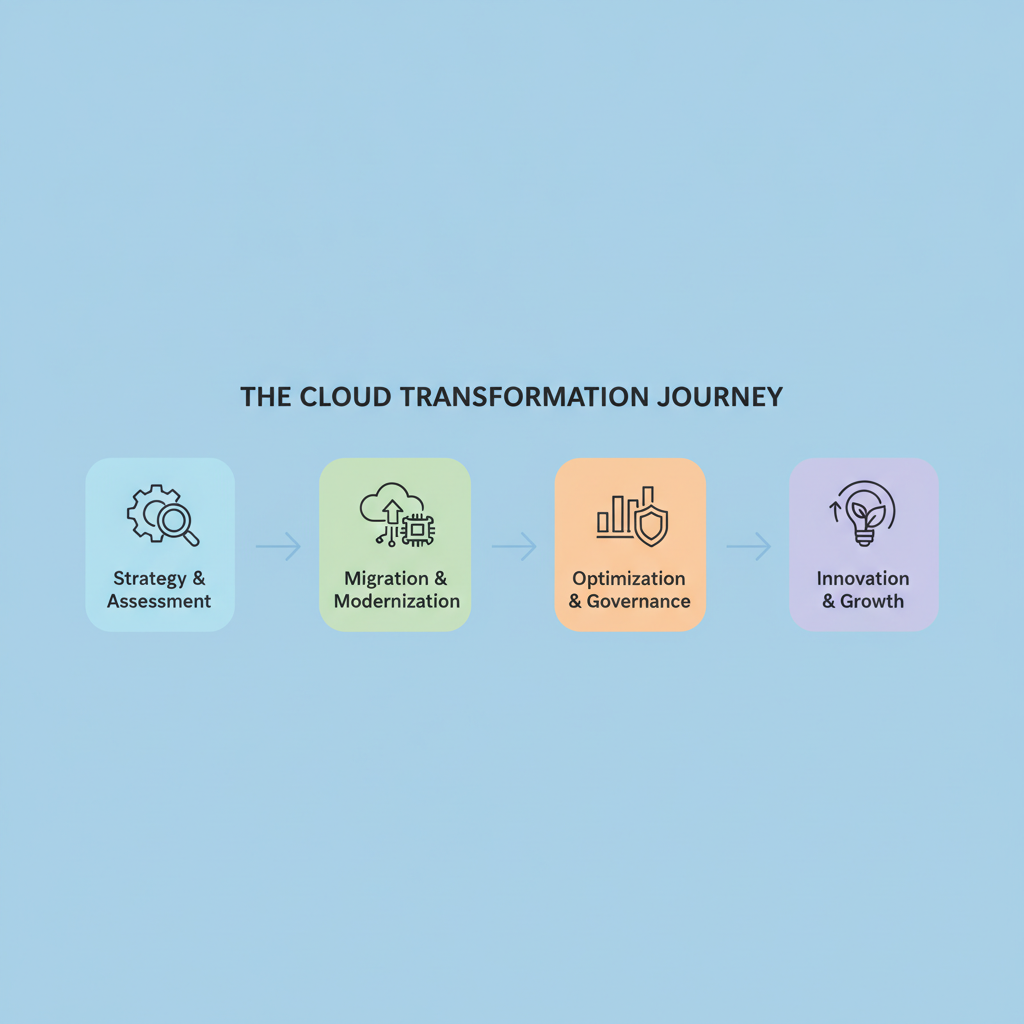
Strategic Cloud Roadmap & Assessment
-
Business Needs & Cloud Strategy Development
Expert cloud consulting services for digital transformation begin with a deep dive into your unique business needs, current IT landscape, and specific objectives. This initial discovery phase ensures the resulting cloud strategy development is perfectly aligned to drive tangible revenue growth and secure a competitive advantage.
-
Cloud Readiness & Infrastructure Assessment
A thorough evaluation of your existing infrastructure, applications, and team capabilities is crucial for successful cloud adoption. This assessment identifies potential challenges and opportunities for infrastructure modernization, minimizing risks and paving the way for improved operational efficiency post-migration.
-
Tailored Cloud Architecture & Vendor Selection
Crafting a customized cloud architecture involves selecting the optimal cloud service provider and technology stack. This critical step, guided by experienced IT consulting services, ensures your solution provides robust scalability solutions and inherent cost efficiency, establishing a strong foundation for future agility and growth.
-
Financial Planning & ROI Projection
Comprehensive financial planning, including forecasting Return on Investment (ROI) and optimizing cloud spend, is integral from the outset. This ensures that your investment in cloud consulting services for digital transformation delivers clear cost efficiency and a measurable financial return, directly impacting revenue growth and long-term profitability.
Seamless Cloud Migration & Modernization
-
Phased Migration & Data Transfer
Implementing a structured, phased approach to migrating applications and critical data migration is key to minimizing disruption. This meticulous planning ensures data integrity, maintains continuous operational efficiency, and accelerates your digital transformation journey without compromising business continuity.
-
Application Modernization & Cloud-Native Development
Re-platforming or re-architecting legacy applications for cloud-native performance enhances agility and supports modern SaaS development. Leveraging advanced software development services unlocks new capabilities, improves user experience, and provides a significant competitive advantage in the digital landscape.
-
Hybrid & Multi-Cloud Implementation
Strategies for leveraging multiple cloud environments or integrating on-premise resources with the cloud offer unparalleled flexibility and resilience. These hybrid cloud and multi-cloud solutions optimize resource utilization, enhancing business agility and ensuring seamless operations for complex enterprise infrastructures.
-
DevOps Integration for Accelerated Delivery
Implementing DevOps practices streamlines development and operations within the cloud environment, fostering faster deployment cycles and improved collaboration. This integration significantly boosts operational efficiency, accelerating the realization of digital transformation benefits and enhancing market responsiveness.
Cloud Optimization, Security & Governance
-
Performance & Cost Optimization
Continuous monitoring, dynamic resource scaling, and proactive cost management are vital to maximize cloud efficiency. This ensures sustainable cost efficiency, frees up budget for innovation, and directly contributes to improved revenue growth by optimizing operational expenditures and resource utilization.
-
Robust Cloud Security & Compliance
Implementing advanced cloud security measures, comprehensive compliance frameworks, and robust data protection strategies is paramount. Strong security safeguards sensitive information, mitigates risks, and ensures regulatory adherence, building customer trust and protecting your competitive advantage in a secure digital environment.
-
Cloud Governance & Policy Enforcement
Establishing clear policies and procedures for cloud resource management, access control, and risk mitigation is essential for effective cloud governance. This ensures controlled growth, prevents shadow IT, and maintains operational integrity, leading to enhanced agility, reduced operational overhead, and consistent service delivery.
-
Disaster Recovery & Business Continuity
Developing and implementing robust disaster recovery plans and business continuity strategies within the cloud is crucial. This ensures minimal downtime and rapid recovery from unforeseen events, protecting revenue streams, maintaining critical operational efficiency, and securing a resilient competitive advantage.
Leveraging Advanced Cloud Capabilities for Innovation
-
AI & Machine Learning Integration
Integrating advanced AI development services and machine learning capabilities into cloud environments unlocks predictive analytics, automation, and intelligent decision-making. This drives significant operational efficiency, creates new revenue streams, and provides a strong competitive advantage through continuous innovation and smart insights.
-
Serverless & Containerization Solutions
Adopting serverless computing and containerization (e.g., Kubernetes) offers enhanced scalability solutions and superior resource efficiency. These modern architectural patterns significantly reduce operational costs, improve deployment speed, and directly contribute to greater agility and optimized infrastructure management, accelerating digital transformation.
-
Data Analytics & Business Intelligence
Implementing robust cloud-based data analytics platforms transforms raw data into actionable business intelligence. This empowers data-driven decision-making, identifies market opportunities, and enhances customer understanding, leading to improved revenue growth and sustained competitive advantage through informed strategies.
-
Continuous Innovation & Future-Proofing
Ongoing support and leveraging new cloud services, including emerging technologies like Blockchain, ensures businesses remain at the forefront of innovation. This adaptability allows for quick responses to market changes, maintaining a sustained competitive advantage through a future-proofed approach to digital transformation and technology adoption.
Feature/Aspect |
Traditional IT Approach |
Cloud Consulting for Digital Transformation |
|---|---|---|
Scalability |
Limited by physical infrastructure; scaling up requires significant capital expenditure and lead time for hardware procurement and setup. Scaling down is often not possible, leading to wasted resources. | Offers elastic scalability, allowing resources to be scaled up or down instantly based on demand, ensuring optimal performance and resource utilization. Essential for handling fluctuating workloads and business growth. |
Cost Efficiency |
High upfront capital expenditure for hardware, software licenses, and data centers. Ongoing operational costs include maintenance, power, cooling, and staffing. Often leads to over-provisioning. | Shifts from CapEx to OpEx with a pay-as-you-go model. Reduces upfront costs and only pays for consumed resources, leading to significant long-term savings. Optimized resource allocation through cloud and DevOps services. |
Innovation Pace |
Slow innovation cycles due to lengthy procurement processes, manual setup, and reliance on existing, often rigid, infrastructure. Experimentation is costly and time-consuming. | Accelerates innovation through access to cutting-edge technologies (AI, ML, IoT) as managed services. Enables rapid prototyping, testing, and deployment of new applications and services, crucial for AI-driven digital transformation. |
Security & Compliance |
Responsibility lies entirely with the organization, requiring substantial investment in security infrastructure, staff, and continuous monitoring. Compliance can be complex and expensive to maintain. | Leverages cloud providers’ robust, multi-layered security infrastructure and compliance certifications (e.g., ISO, HIPAA, GDPR). Shared responsibility model allows businesses to focus on application-level security, enhancing overall posture and meeting regulatory requirements, especially for data privacy in digital transformation. |
Operational Agility |
Limited agility due to manual provisioning, complex infrastructure management, and rigid processes. Responding to market changes or new business requirements is slow and cumbersome. | Boosts agility with automated infrastructure provisioning, continuous integration/delivery (CI/CD), and flexible service deployment. Enables rapid adaptation to market dynamics and supports an agile development methodology. |
Maintenance Burden |
High internal burden for hardware maintenance, software patching, upgrades, and disaster recovery planning. Requires dedicated IT staff and significant operational overhead. | Reduces maintenance burden as cloud providers manage the underlying infrastructure, patching, and updates. Frees up internal IT teams to focus on strategic initiatives and custom software development. |
Global Reach |
Expanding globally requires establishing new data centers or complex network infrastructure in different regions, which is capital-intensive and time-consuming. | Offers instant global presence by deploying applications and data in multiple geographic regions with ease. Improves latency, resilience, and compliance with local data residency laws, critical for modern web development trends and international business. |
Realizing Potential: Industry Applications of Cloud Consulting
Cloud consulting services are pivotal for businesses aiming for digital transformation across various sectors. Because each industry has unique challenges, Colladome provides industry-specific cloud solutions tailored to specific business requirements. The following business transformation use cases demonstrate how cloud consulting supports innovation and operational efficiency.
1. E-Commerce: Scalable Infrastructure and AI Personalization
A rapidly growing e-commerce business faced challenges with its monolithic architecture. As a result, slow load times during peak seasons affected performance, while integrating new features for an enhanced customer experience became difficult.
To address these challenges, Colladome’s cloud consulting team designed and executed a migration to scalable, serverless cloud infrastructure using microservices. Furthermore, this tailored solution stabilized performance and enabled seamless integration of AI-powered personalization.
Consequently, the business experienced improved website speed and an enhanced customer experience. These improvements supported higher conversion rates and boosted operational efficiency. Additionally, the improved digital experience created opportunities for stronger customer engagement and business growth.
2. Manufacturing: IoT-Enabled Cloud Integration
A traditional manufacturing firm struggled with outdated legacy systems and inefficient production lines. Initially, the company faced limited real-time visibility into operations and high maintenance costs.
To overcome these challenges, our cloud consulting experts implemented an IoT-enabled cloud platform for real-time machine monitoring and predictive maintenance. In addition, the solution integrated factory-floor data with a cloud-based ERP system, improving inventory and supply chain management.
As a result, the firm achieved reductions in operational costs and faster product development cycles. Moreover, data-driven decision-making supported improved data security and contributed to a competitive advantage.
3. Healthcare: Secure Data Management and AI Analytics
Similarly, a healthcare provider faced challenges with fragmented patient data across disparate systems. Consequently, limited data coordination affected care delivery and created potential compliance risks.
To address these issues, Colladome deployed a secure, HIPAA-compliant cloud environment for electronic medical records (EMR). Furthermore, the team integrated AI-driven analytics to support predictive diagnostics and improve access to relevant information.
As a result, the comprehensive solution streamlined data access, strengthened patient privacy, and supported telehealth services. Additionally, the implementation aimed to improve data security and assist healthcare professionals with faster, more informed diagnostic decisions. These capabilities contributed to an enhanced patient experience and supported digital healthcare innovation.
4. Strategic Cloud Consulting for Digital Transformation
As businesses continue to navigate modern digital landscapes, strategic technology integration has become increasingly important. Organizations exploring comprehensive digital transformation often need expert guidance to unlock the potential of cloud and AI technologies.
Furthermore, decision-makers evaluating cloud adoption or seeking IT consulting services for digital transformation can benefit from a well-planned strategy. By developing a clear roadmap, businesses can align technology investments with their operational goals and future growth plans.
5. Explore Colladome’s Cloud and AI Expertise
In addition, a strategic partnership can simplify the digital transformation journey by providing tailored insights and supporting innovation. Colladome’s expertise in AI development services and custom software solutions helps businesses explore technology solutions aligned with their specific requirements.
Ultimately, organizations can evaluate these opportunities to strengthen their digital capabilities, improve operational efficiency, and adapt to evolving market demands. Explore the possibilities with Colladome and discover how expert guidance can help transform your technology vision into reality.
Accelerate Your Digital Future with Expert Cloud Consulting
In essence, expert cloud consulting services for digital transformation are not merely an IT upgrade. Instead, they represent a strategic imperative for businesses navigating modern markets.
By leveraging the cloud, businesses can unlock greater agility, scalability, and resilience. Furthermore, cloud adoption supports operational optimization, automation, and continuous innovation, helping organizations improve efficiency and pursue sustainable growth.
Cloud technologies also empower organizations to harness advanced solutions such as AI and machine learning. As a result, businesses can transform raw data into actionable insights and create more personalized customer experiences.
Although the digital transformation journey can be complex, tailored cloud solutions provide a structured pathway toward long-term business goals and competitive advantage.
For Founders, CXOs, and Business Owners seeking to modernize their operations, expert guidance can help align technology investments with strategic objectives. Therefore, exploring Colladome’s tailored cloud solutions or scheduling a consultation can be the next step toward your digital transformation journey. Discover how technology can support tangible business outcomes and future growth.