Cloud Consulting vs. In-House IT: Navigating Your Strategic Technology Future
Founders, business owners, and CXOs often grapple with a pivotal decision: how to best structure their technology backbone to fuel sustainable growth and innovation. The debate between cloud consulting vs in-house IT is at the heart of this challenge. This isn’t merely an operational choice; it’s a strategic imperative dictating your business’s agility and future trajectory. The right decision can unlock unparalleled efficiency, enhance scalability, and secure a formidable competitive advantage in today’s rapidly evolving digital landscape. Understanding which model aligns with your unique objectives and resource allocation is crucial for driving effective digital transformation and maintaining cutting-edge expertise.
The IT Dilemma: Why Strategic Technology Decisions Are Critical for Modern Businesses
For many SMEs, founders, and CXOs, navigating the complex landscape of modern technology feels like an uphill battle. The real pain point isn’t just adopting new tech, but making truly strategic technology decisions that deliver tangible value. Traditional in-house IT structures often struggle to keep pace, becoming bottlenecks rather than enablers. This leads to a critical gap where businesses fail to harness technology for innovation, scalability, and crucial cost-efficiency.
This challenge is compounded by rapid technological shifts and significant talent gaps, especially in specialized areas like AI development and custom software development. Decision-makers face immense pressure to reduce operational costs while simultaneously driving ambitious digital transformation initiatives. Without optimized approaches, businesses risk falling behind, unable to adapt to market demands or leverage cutting-edge solutions for competitive advantage.
Defining Your Path: Understanding Cloud Consulting and In-House IT Models
Managing technology infrastructure requires choosing between cloud consulting and in-house IT, both valid approaches to IT resource allocation and expertise. Each fundamentally addresses how a company acquires and deploys technical capabilities. A clear understanding of their distinct benefits is vital for strategic planning.
Cloud consulting provides specialized, scalable, and external expertise, perfect for projects like custom software development or AI transformation. In contrast, an in-house team offers direct control and deep institutional knowledge. The true “solution” lies not in choosing one over the other, but in making an informed strategic decision tailored to specific business goals and growth stages.
Strategic Considerations: Cloud Consulting vs. In-House IT for Business Growth
- Specialized Expertise & Innovation: Problem: Internal teams often lack niche skills for emerging tech like AI solutions or complex custom software development. Solution: Cloud consultants provide on-demand, specialized knowledge and expert guidance. Outcome: Accelerates innovation, delivers higher quality, future-proof solutions, crucial for digital transformation and competitive IT strategy.
- Scalability & Flexibility: Problem: In-house IT struggles to achieve rapid scalability with business growth or sudden project demands. Solution: Cloud consulting offers agile resource allocation and quick ramp-up/down, providing dedicated teams when needed. Outcome: Business adapts swiftly to market changes, optimizing resource utilization and enhancing operational efficiency without permanent overhead.
- Cost Efficiency & Predictability: Problem: High fixed costs and overheads associated with in-house IT (salaries, benefits, infrastructure) impact cost-effectiveness. Solution: Cloud consulting converts CapEx to OpEx, offering predictable project-based costs and access to expert guidance. Outcome: Improved budget management, clearer ROI on technology investments, and enhanced operational efficiency for SMEs.
- Focus on Core Business: Problem: Leadership gets bogged down in IT operational complexities, diverting from strategic goals and hindering digital transformation efforts. Solution: External cloud consulting offloads IT burden, allowing internal teams to focus on core competencies with expert guidance. Outcome: Enhanced strategic focus, driving overall business growth and market positioning through a streamlined IT strategy.
- Risk Management & Security: Problem: Keeping pace with evolving cybersecurity threats and compliance requires constant effort for in-house teams, impacting IT strategy. Solution: Cloud consultants bring up-to-date best practices, advanced security expertise, and ensure robust DevOps services. Outcome: Strengthened security posture, reduced risk, and improved compliance readiness, protecting business assets and fostering sustainable growth.
The Strategic Advantages of Cloud Consulting for Dynamic SMEs
Access to Specialized Expertise On-Demand
Engaging in cloud consulting provides immediate access to niche skills, such as advanced AI solutions or intricate custom software development, without the overhead of permanent hires. This accelerates project timelines and ensures high-quality, cutting-edge solutions, directly impacting innovation and market competitiveness. It’s a key differentiator in the cloud consulting vs in-house IT debate, offering unparalleled flexibility.
Enhanced Scalability and Agility
Cloud consulting offers unparalleled flexibility to scale IT resources up or down based on project demands or business growth. This inherent scalability allows businesses to respond swiftly to market changes and optimize resource allocation, leading to greater operational efficiency and robust cost control. This agility is crucial for dynamic SMEs pursuing rapid digital transformation.
Cost Optimization and Predictable Spending
Opting for cloud consulting often shifts IT expenditure from capital expense (CapEx) to operational expense (OpEx), providing more predictable costs. This model significantly reduces total cost of ownership by eliminating recruitment, training, and infrastructure maintenance costs, thereby improving financial forecasting and enabling better IT strategy. This cost optimization is a compelling advantage of cloud consulting vs in-house IT.
Strategic Focus on Core Business
Outsourcing complex IT initiatives to cloud consulting partners frees up internal leadership and resources. This empowers the business to concentrate on its core competencies, strategic planning, and market expansion, directly contributing to revenue growth and long-term vision. It allows a business to transcend day-to-day IT management and focus on impactful digital transformation initiatives.
Understanding the Strengths and Unique Value of In-House IT Teams
Deep Institutional Knowledge and Cultural Alignment
An in-house IT team possesses an intimate understanding of the company’s unique processes, legacy systems, and culture. This deep integration fosters strong internal collaboration and ensures IT solutions are perfectly aligned with specific business needs and values. This internal synergy is a critical component of a cohesive IT strategy, ensuring solutions resonate deeply with organizational goals.
Direct Control and Immediate Response
The benefit of having a dedicated, on-site in-house IT team for immediate problem-solving and direct oversight of IT operations is invaluable. This level of control is crucial for businesses with highly sensitive data, strict compliance requirements, or unique operational workflows requiring constant internal support, mitigating risk management concerns and enhancing operational efficiency.
Building Proprietary System Expertise
An in-house IT team can develop deep expertise in highly specialized or proprietary systems critical to the business. This fosters internal innovation and ensures that unique technological assets are managed and evolved by dedicated personnel, maintaining competitive advantage. It’s particularly vital for companies with complex custom software development needs that are integral to their market position.
Fostering Internal Talent Development
Investing in an in-house IT team contributes significantly to internal skill development and career growth within the organization. This can lead to a more stable workforce, reduced turnover in critical IT roles, and a stronger internal knowledge base over time. This continuous learning and development fortifies the company’s long-term IT strategy and resilience.
Making the Right Choice: Aligning IT Strategy with Business Goals
Assessing Your Current IT Landscape and Needs
Decision-makers must thoroughly evaluate their existing IT infrastructure, current challenges, and future technological requirements. A comprehensive audit is essential to identify gaps in expertise or capacity, especially concerning areas like custom software development or AI integration. This initial assessment is paramount in determining the optimal cloud consulting vs in-house IT approach.
Defining Future Growth and Innovation Needs
The choice between cloud consulting and in-house IT should be driven by the company’s long-term vision for growth, innovation, and digital transformation. Services in AI solutions and custom development can fit into either model to achieve strategic objectives and propel revenue growth.
Evaluating Budget, Resources, and Risk Tolerance
A comprehensive financial and resource assessment is critical, considering both upfront and ongoing costs, as well as the availability of internal talent. It’s vital to weigh potential risks, such as security concerns or vendor lock-in, against the benefits of each model. This cost optimization and risk management perspective is key in the cloud consulting vs in-house IT decision.
Considering a Hybrid Approach for Optimal Results
The best solution often isn’t purely ‘cloud consulting vs in-house IT‘ but a hybrid model. Combining the agility and specialized expertise of external consultants with the institutional knowledge of an internal team offers a balanced, robust IT strategy. This approach maximizes operational efficiency and scalability for maximum business impact.
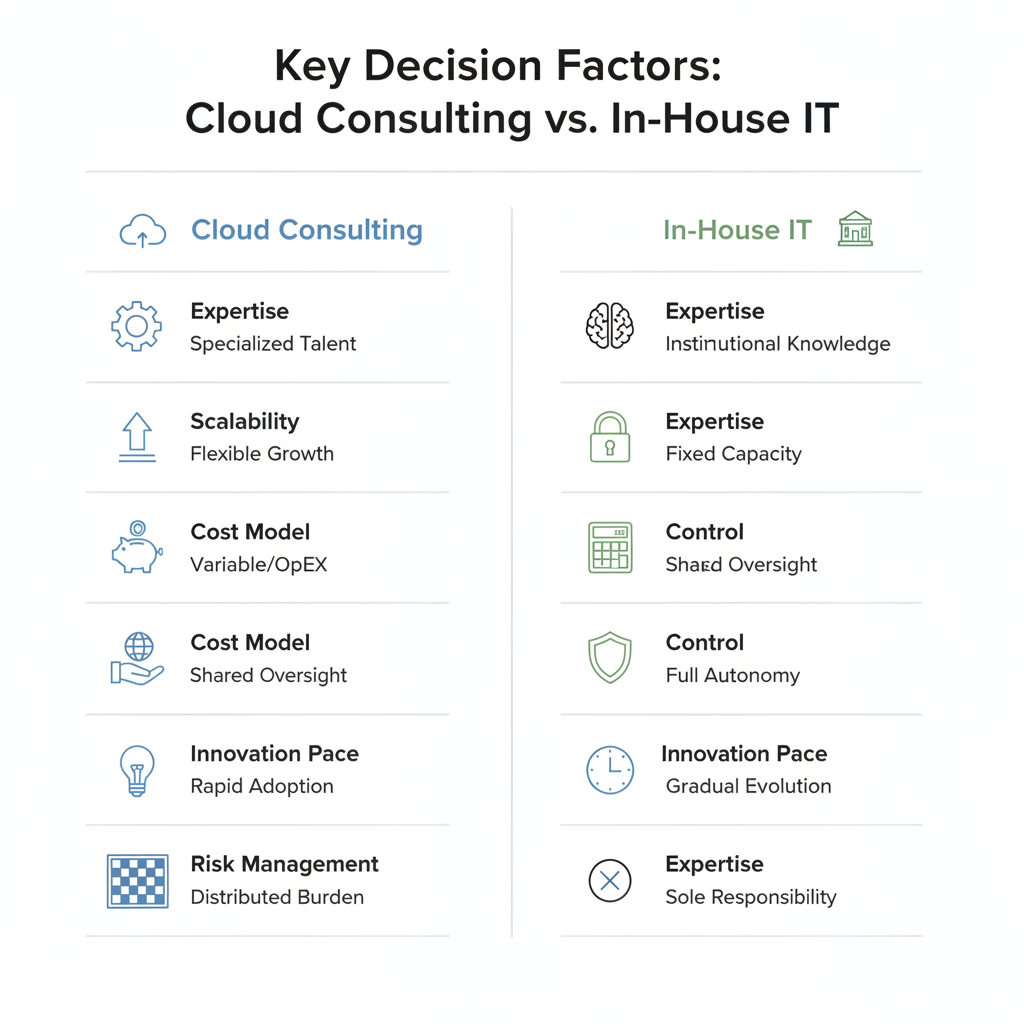
| Cloud Consulting vs. In-House IT: A Strategic Decision Matrix | ||
|---|---|---|
| Criteria | Cloud Consulting Model | In-House IT Model |
| Access to Expertise | Gain immediate access to a diverse pool of specialized experts (e.g., cloud architects, cybersecurity specialists, AI developers) on demand, without permanent hiring costs. IT consulting services offer broad, up-to-date knowledge. | Expertise is limited to the skills and experience of your hired staff. Requires continuous investment in training and recruitment to keep pace with evolving technology. |
| Scalability & Flexibility | Easily scale IT resources up or down based on business needs, project demands, or market fluctuations. Ideal for dynamic growth or seasonal changes. Cloud DevOps services enhance this agility. | Scaling requires significant lead time for hiring, training, and infrastructure investment, making it less agile and more rigid to adapt to rapid changes. |
| Cost Structure | Shifts IT costs from capital expenditure (CapEx) to operational expenditure (OpEx). Offers a predictable, pay-as-you-go model, avoiding large upfront infrastructure investments. | High upfront CapEx for hardware, software licenses, and recruitment. Ongoing OpEx includes salaries, benefits, office space, utilities, and maintenance. |
| Control & Oversight | Shared control with the consulting firm, clearly defined by Service Level Agreements (SLAs). Focuses on agreed-upon outcomes rather than day-to-day management. | Full, direct control over all IT infrastructure, systems, and personnel. Requires dedicated internal management and extensive oversight. |
| Innovation Pace | Consultants often bring cutting-edge knowledge and best practices, accelerating the adoption of new technologies and digital transformation strategies. | Innovation depends on internal R&D capabilities, budget for new tech, and continuous staff training. Can be slower without dedicated focus or resources. |
| Focus on Core Business | Frees up internal resources and management to concentrate on core business activities, strategic growth, and revenue generation, rather than IT operations. | Managing IT infrastructure, staff, and daily operations can divert significant time, attention, and resources away from primary business objectives. |
| Risk Management | Benefits from the consultant’s specialized expertise in cybersecurity, data privacy, and compliance, often with robust security protocols already in place. | Full responsibility for security, compliance, and disaster recovery. Requires substantial internal investment in tools, expertise, and processes to mitigate risks effectively. |
Real-World Impact: When Cloud Consulting or In-House IT Excels
A fast-growing hospitality chain needed to develop custom, AI-powered hotel management software to streamline operations and enhance guest experience. Lacking internal AI development expertise, they leveraged Colladome’s cloud consulting for rapid deployment of specialized skills. This allowed them to achieve innovation quickly, without significant upfront hiring, demonstrating the value of AI development services for transformative business operations within the hospitality industry.
A mid-sized manufacturing company, relying heavily on a highly customized ERP system and sensitive operational data, chose to maintain a dedicated in-house IT team. This ensured immediate support, deep system knowledge, and stringent security control, guaranteeing uninterrupted production and compliance. For future enhancements or complex integrations, Colladome offers expert ERP software development services to augment their internal capabilities.
A dynamic EdTech startup sought to integrate interactive whiteboard software and AI-driven learning analytics into their platform. They maintained a small in-house team for daily IT support but partnered with Colladome’s cloud consulting experts for the specialized AI and custom software development. This hybrid approach optimized both cost and innovation, allowing the startup to scale strategically within the education industry.
Navigating Your IT Future: A Strategic Partnership for Growth
Businesses exploring the complex strategic decision between cloud consulting and in-house IT face many considerations. Decision-makers evaluating the optimal path for their organization’s IT future require clear, unbiased insights. Colladome understands these challenges, positioning ourselves as a trusted, expert partner ready to provide tailored guidance to navigate this crucial landscape.
We specialize in crafting custom software solutions that align with your unique needs. Whether you’re seeking advanced AI consulting, bespoke hotel management software, or specialized software development, our team provides expertise to support your growth objectives. We empower you with informed choices, fostering innovation and efficiency.
Empowering Your Business with the Right IT Strategy
Navigating the choice between cloud consulting vs in-house IT is a pivotal strategic decision for any modern enterprise. This discussion underscores that the optimal path is not universal, but rather a bespoke IT strategy, deeply aligned with your specific business goals, available resources, and long-term growth aspirations. It’s about empowering your organization for seamless operations and robust digital transformation.
Making an informed decision is crucial for ensuring long-term operational efficiency, fostering innovation, and securing a competitive advantage. Whether you require tailored custom software solutions or specialized AI consulting, Colladome is here to help. Founders and CXOs, we invite you to discuss your unique challenges and vision with our experts to explore how tailored solutions can empower your business for the future. Contact us today to start the conversation.