
The Operational Cost of Distribution Friction: Why Off-the-Shelf Tools Break at Scale
Multi-property operators frequently encounter critical infrastructure bottlenecks when relying on generic third-party aggregators. Legacy aggregators cause multi-channel overbooking, rate parity violations, and severe synchronization latency spanning 15 to 20 minutes. These delays expose hotel portfolios to overbooking risks and punitive distribution commissions during sudden demand surges.
Packaged SaaS tools enforce rigid API payload caps and isolated data silos. These limitations create PMS integration bottlenecks, preventing bespoke room types, regional tax calculations, and localized corporate packages from broadcasting accurately. Off-the-shelf platforms also mask direct consumer contact details, which increases reliance on external intermediaries.
When scaling operators deploy unique revenue logic across diverse regions, vendor lock-in restricts technical evolution. According to distribution analyses by Hospitality Net, unoptimised distribution and delayed synchronization directly cause revenue leakage across major OTA partnerships. To resolve this friction, enterprise groups require custom architectural control.
Bespoke Channel Manager Architecture: Real-Time Synchronization as an Asset
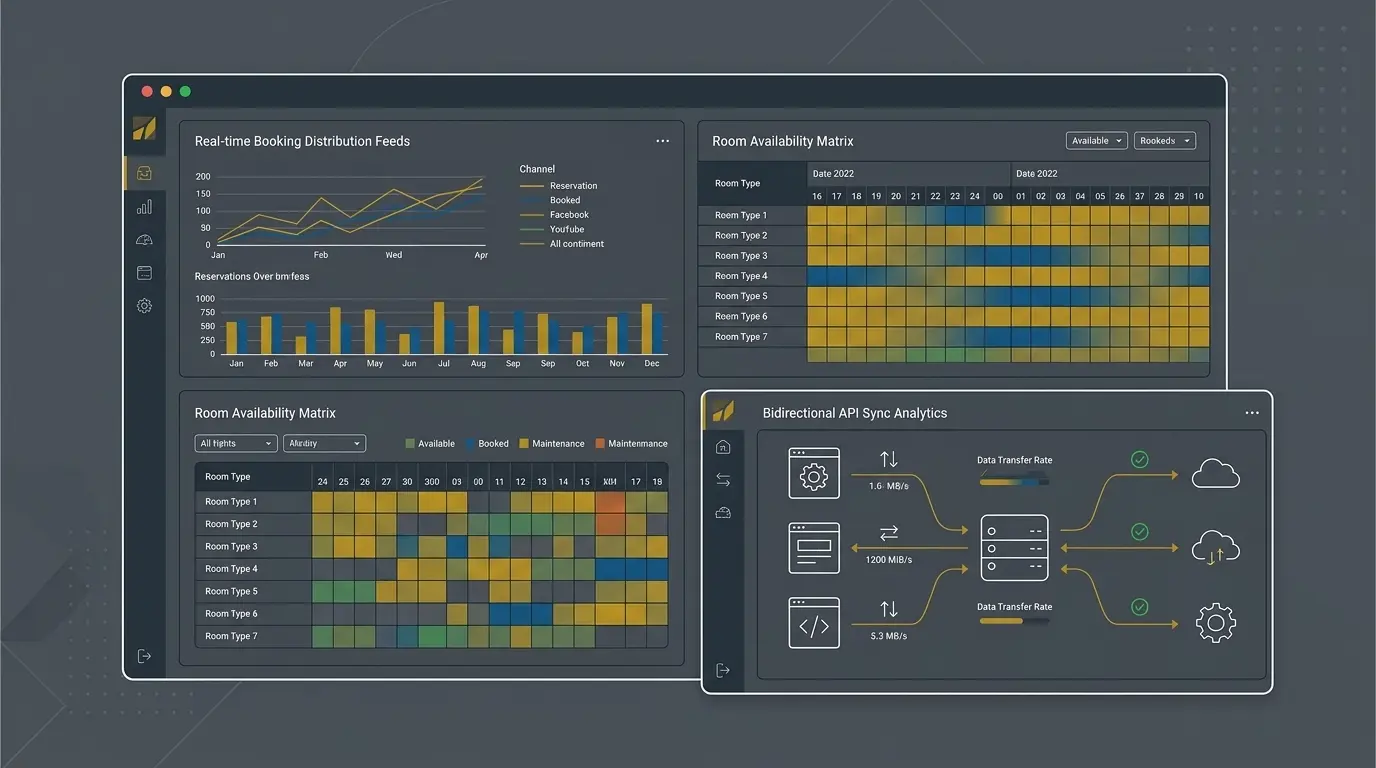
A custom enterprise web application transforms distribution from an overhead expense into a defensive operational asset. Investing in dedicated hotel channel manager software development deploys low-latency microservices that connect directly to major OTA partner APIs, executing real-time ARI (Availability, Rates, and Inventory) push-and-pull transactions within sub-second thresholds.
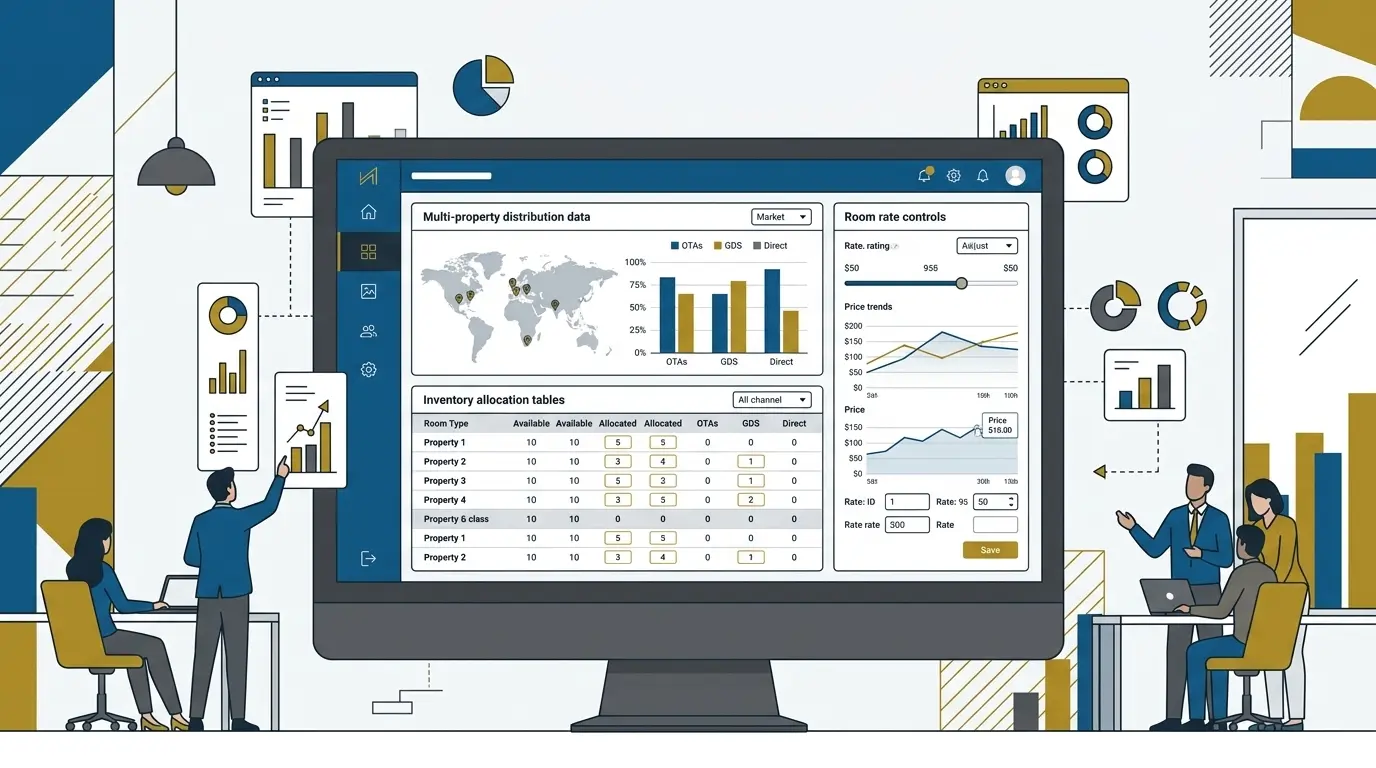
This bespoke design centralises inventory distribution across every connected sales channel through an automated, pooled inventory model. Operating a proprietary engine removes per-booking transaction commissions and protects proprietary guest booking records. While operators often review generic tools like Cloudbeds alternatives, high-volume hospitality portfolios achieve superior capital efficiency through proprietary systems engineered specifically for their operational profile.
Key Phases in Custom Hotel Channel Manager Development
- Bidirectional OTA API Integration Engine
Problem: One-way or delayed data feeds cause rate disparities and conflicting reservation records between channels.
Solution: Engineers construct high-throughput REST and XML connectors certified under modern Open Travel Alliance standards, pairing them with reactive webhook listeners for instant payload processing.
Outcome: Real-time rate synchronization and instant booking intake occur in less than 500 milliseconds, eliminating multi-channel inventory drift. - Dynamic Rate Parity & Rule Automation Module
Problem: Disparate pricing adjustments across fragmented regional OTAs trigger contractual rate parity penalties and margin decay.
Solution: Teams implement an automated pricing rules engine that recalculates derived rates, currency shifts, and length-of-stay restrictions across all connected endpoints.
Outcome: Hoteliers maintain compliant pricing across global channels automatically, protecting property margins without manual audit overhead. - Unified Inventory Pooling & Conflict Handling Architecture
Problem: Concurrent reservations for the final available suite create double-booking errors across disparate regional channels.
Solution: The core pipeline leverages distributed locking mechanisms and atomic database transactions within a unified pooling layer, reserving availability before confirmations post.
Outcome: Zero overbooking incidents occur even during peak promotional windows, maintaining brand reputation and platform reliability. - Enterprise PMS & Booking Engine Gateway
Problem: Disconnected property management systems cause administrative bottlenecks, requiring repetitive manual record entries.
Solution: Developers build an event-driven integration layer linking internal operations directly to a hotel front desk software development framework and enterprise PMS.
Outcome: Centralised reservation dispatch flows directly into front-desk scheduling systems without requiring human intervention.
Core Architectural Modules of an Enterprise Channel Manager
Bidirectional OTA Synchronization Engine
The synchronization engine coordinates inbound and outbound HTTP webhooks and RESTful endpoints connecting directly to channels like Expedia, Booking.com, and Agoda. By processing payload changes asynchronously through worker nodes, the system broadcasts availability, rate modifications, and stay restrictions globally in sub-second cycles without thread contention.
Centralized Inventory Pooling and Room Mapping
A resilient distribution layer relies on atomic database transactions to execute unified inventory pooling. When a guest reserves a room on any channel, distributed locks temporarily isolate that room class. The platform debits availability across all partner endpoints simultaneously, stopping simultaneous double bookings during intense traffic bursts.
Dynamic Pricing and Rate Parity Controllers
Programmatic revenue rule engines calculate rates on the fly based on primary rate schedules, occupancy thresholds, and seasonal multipliers. The controller recalculates derived pricing rules, automatically distributes updates, and prevents rate parity contract violations across all partner networks through structured, centralized governance.
Enterprise Engineering and Security Considerations
PCI-DSS Compliant Payment Tokenization
Securing guest financial data requires robust tokenization protocols that bypass raw credit card storage on internal servers. Integrations pass financial payloads directly through PCI-DSS Level 1 certified payment gateways. This architecture issues scoped, encrypted tokens, substantially shrinking regulatory liabilities while enabling automated guarantee processing.
Fault-Tolerant Microservices and Fallback Queues
Distributed message queues built with Apache Kafka or RabbitMQ buffer outgoing API payloads during external partner downtime. If an OTA rate update endpoint fails or throttles traffic, exponential backoff algorithms queue and retry messages systematically. This prevents dropped transactions and safeguards data integrity.
Role-Based Access Control and Operational Auditing
Multi-property operations require granular user administration. Role-Based Access Control (RBAC) protocols govern administrative permissions across revenue directors, regional managers, and property staff. Comprehensive, immutable audit logging records every rate override and configuration adjustment to maintain operational compliance across all business units.
Business Outcomes of Bespoke Channel Infrastructure
Elimination of Recurring Third-Party Commissions
Transitioning away from subscription aggregators delivers major financial benefits. Replacing per-booking SaaS transaction fees and recurring integration charges with an owned software asset preserves operating margins. Enterprises recover significant capital as transaction volumes expand across their portfolio.
Complete Control Over Distribution Data
Proprietary infrastructure captures complete, unmasked customer booking behaviors, direct channel metrics, and historical lead-time patterns. Eliminating aggregator obfuscation enables leadership teams to leverage hospitality CRM software solutions for hyper-targeted guest retention initiatives and data-backed yield modeling.
Scalability Across Multi-Property Portfolios
Custom engineering lets operators launch new properties, room tiers, and localized marketing campaigns without waiting for third-party roadmap updates. System architects simply register new inventory nodes within their custom distribution engine, scaling operations seamlessly without vendor-imposed licensing penalties.
| Operational Parameter | Off-the-Shelf SaaS Channel Manager | Custom Developed Channel Manager Engine | Strategic Business Impact | Breakeven / Horizon |
|---|---|---|---|---|
| API Flexibility & Custom Mapping | Standardized, rigid payload templates with fixed schemas | Fully bespoke schema definitions mapping to proprietary PMS rules | Removes integration constraints for unique enterprise operations | Immediate upon core architecture launch |
| Recurring Operational Cost | Per-room monthly licensing plus per-reservation variable fees | Zero recurring transaction fees; baseline cloud hosting overhead | Improves gross margins as property reservation volumes increase | 14 to 20 months across mid-market portfolios |
| Inventory Sync Speed & Scalability | Batched updates with common latencies between 5 and 20 minutes | Sub-second event-driven triggers via Webhooks and Apache Kafka | Eliminates revenue-draining double-bookings and rate discrepancies | Continuous operational protection |
| Data Governance & Security Control | Third-party vendor data custody with aggregated analytics | Full internal ownership, tokenized storage, and strict RBAC controls | Secures proprietary guest booking intelligence and ensures compliance | Day-one regulatory risk elimination |
| Custom Workflow & ERP Integration | Restricted to pre-built, generic marketplace plugins | Deep, native integration with bespoke ERPs, POS, and front-desk tools | Enables complete cross-departmental operational automation | Delivered during system onboarding |
Enterprise Applications: Removing Distribution Constraints Across Portfolios
Multi-Property Boutique Hotel Chains: Boutique operators managing distinct boutique room tiers across urban markets require agile, rapid distribution. In one implementation, a portfolio integrated custom channel software directly with an event-driven custom hotel management software core. This architecture synchronized unique package combinations across global distribution nodes while routing regional settlement workflows through native payment gateways, maintaining real-time rate adjustments with zero booking conflicts.
Hybrid Serviced Apartment Networks: Blended hospitality providers often manage both extended-stay corporate leases and short-term leisure reservations. Standard channel aggregators fail to reconcile distinct cancellation schedules, cleaning cycles, and tiered length-of-stay discounts. A tailored channel platform applies custom minimum-night logic across corporate travel portals and leisure OTAs simultaneously, giving asset managers unified portfolio reporting and total inventory clarity.
Evaluating the Build vs. Buy Equation for Hospitality Infrastructure
Choosing between commercial subscriptions and proprietary channel engineering requires assessing current transaction volumes and operational complexity. Operators constrained by third-party feature delays, sync discrepancies, or mounting per-room licensing costs often find standard tools unsustainable. Custom hotel channel manager software development provides long-term operational autonomy. Leaders exploring this transition should audit existing sync latencies and evaluate lifetime SaaS spending against the capital value of an owned distribution asset.
Future-Proofing Hospitality Operations Through Custom Engineering
Executing an enterprise distribution roadmap requires robust technical foundations. Bespoke channel management software eliminates aggregator overhead, guarantees inventory accuracy, and secures complete digital independence. Operating a custom distribution pipeline protects transaction margins, secures critical booking intelligence, and scales properties without vendor limitations. Let us make the next big thing together!