
The Operational Deadlock: Fragmented Inventories and System Silos
Legacy hospitality software architectures create costly friction for growing accommodation brands. When hoteliers manage independent software tools without direct architectural cohesion, operational vulnerabilities multiply across the property. Disconnected systems directly cause double bookings, manual rate-updating errors, OTA rate-parity violations, and fragmented guest folios. Off-the-shelf software packages and unverified third-party connectors fail modern hotel operators by lacking low-latency, two-way synchronisation and unified enterprise reporting. For hospitality decision-makers across India and global markets, this technological friction creates recurring guest friction, inflates front-office overhead, and triggers preventable commission leakage across digital channels.
Architectural Harmony: Delineating Core Operations from Global Distribution
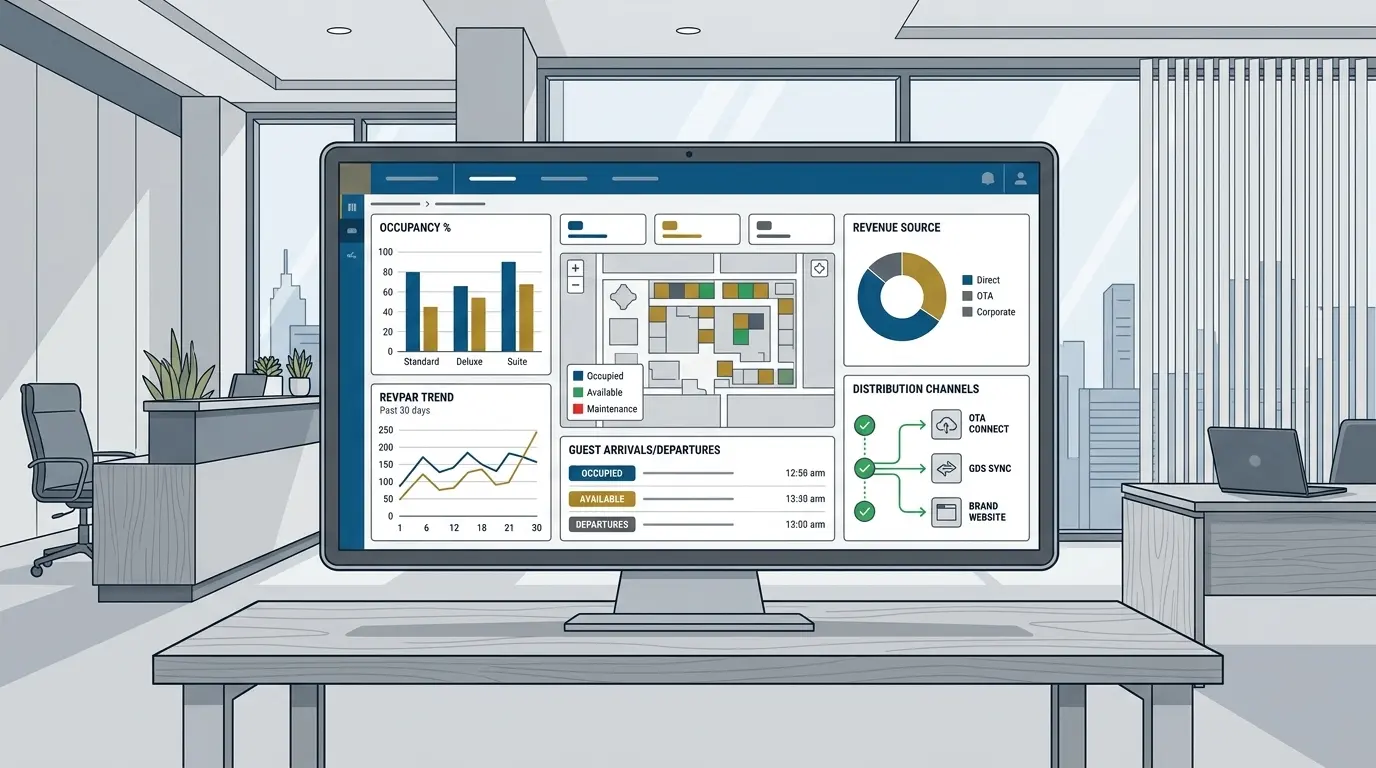
Resolving the hotel PMS vs channel manager equation requires treating these systems not as interchangeable alternatives, but as complementary architectural layers. A Property Management System (PMS) functions as the central operational engine of the hotel enterprise. It automates room status, front-desk check-ins, guest billing folios, housekeeping schedules, and enterprise resource planning. In contrast, a channel manager operates as the outward-facing distribution pipeline. It manages bi-directional API connections to Online Travel Agencies (OTAs), Global Distribution Systems (GDS), and metasearch aggregators like Phocuswright-monitored booking engines. Harmonising these systems removes manual operational constraints and creates an end-to-end foundation for revenue execution.
Operational Transformation: Three Pillars of Integrated Hospitality Systems
- Real-Time Inventory Parity
Constraint Removed (Problem): Disjointed channel updates trigger simultaneous bookings for identical rooms, causing double bookings and financial penalties.
Architectural Action (Solution): Implement automated two-way XML and REST API handoffs between the core operational database and online travel agents.
Strategic Business Impact (Outcome): Complete elimination of manual inventory reconciliation, protection of direct booking margins, and zero cancellation clawbacks. - Centralised Guest Profile Management
Constraint Removed (Problem): Disparate guest transaction histories across third-party OTAs fragment folio accuracy and eliminate upselling context.
Architectural Action (Solution): Route all reservation payloads directly into the PMS Central Reservation System (CRS) to establish unified guest identities.
Strategic Business Impact (Outcome): Enhanced lifetime guest value through personalised check-in experiences, loyalty rewards, and targeted post-stay direct booking incentives. - Automated Revenue and Rate Strategies
Constraint Removed (Problem): Static pricing grids lag behind market demand fluctuations, depressing average daily rates (ADR) during peak booking windows.
Architectural Action (Solution): Deploy dynamic pricing algorithms within modern hotel automation software that push automated rate adjustments through the channel manager.
Strategic Business Impact (Outcome): Maximised Revenue Per Available Room (RevPAR) through instant multi-channel yield adjustments matching live local market demand.
Deconstructing the Hotel Property Management System (PMS)
Core Front-Office and Reservation Orchestration
The hotel PMS serves as the transactional system of record for day-to-day guest operations. It processes walk-in reservations, executes frictionless digital check-ins, and manages room allocations in real time. By centralising room availability and guest billing into a unified ledger, the PMS eliminates front-desk bottlenecks and reduces front-office administrative overhead.
Back-of-House and Housekeeping Automation
Operational efficiency depends directly on rapid back-of-house room turnover cycles. Enterprise PMS platforms integrate automated housekeeping modules that update room cleaning statuses instantly via staff mobile devices. This real-time visibility prevents premature check-in attempts, cuts turnaround latency, and lowers overall labour expenses across housekeeping departments.
Financial Accounting, Billing, and Folio Accuracy
Comprehensive enterprise accounting requires automated tracking of multi-currency billing, state-level taxes, and incidental charges across points of sale. Modern PMS engines automate folio aggregation across on-property dining, spa facilities, and room amenities. This direct ledger integration prevents checkout billing discrepancies, mitigates revenue leakage, and simplifies monthly auditing for enterprise controllers.
Evaluating Channel Manager Capabilities and Distribution Reach
Two-Way Real-Time Rate and Availability Sync
A robust channel manager maintains rapid bi-directional data exchanges with external channels, including Booking.com, Expedia, and Agoda. The moment a guest books a room or cancels a reservation, the engine updates central inventory across all distribution endpoints within seconds. This rapid programmatic synchronisation prevents costly double bookings and protects platform rankings.
Channel Performance Analytics and Margin Protection
Unmonitored third-party distribution often erodes operational margins through compounding intermediary commissions. Channel managers deliver detailed booking analytics that isolate high-yield direct channels from expensive, low-margin OTAs. Equipped with transparent cost-per-acquisition data, commercial heads can selectively throttle expensive portals and allocate greater inventory to profitable direct engines.
Rate Parity Enforcement Across Global Networks
Third-party travel agents heavily penalise properties that fail to maintain pricing consistency across external platforms. Channel managers enforce algorithmic rate parity rules, deploying identical room rates and promotion structures across every connected network simultaneously. This automated enforcement safeguards hotel search visibility and protects brand integrity against contracted partner penalties.
Strategic Architectural Patterns: Unified ERP vs Best-of-Breed Stack
All-in-One Hotel Management Platforms
Packaged, all-in-one software suites provide entry-level convenience for boutique properties with straightforward operational requirements. These unified solutions bundle basic front-desk management with rudimentary distribution feeds. However, growing enterprises often encounter functional constraints, rigid data models, and high subscription costs as their multi-property operational complexity expands.
Modular Custom Enterprise Integrations
Growing hotel operators frequently outgrow commercial software boundaries, necessitating tailored infrastructure. Developing custom hotel management software allows operators to bridge proprietary front-office systems with specialized channel distributors. This modular engineering eliminates vendor lock-in, matches bespoke operational workflows, and integrates seamlessly with specialized enterprise ERP systems.
Data Governance and Single-Source Truth
Maintaining a single source of operational truth across hospitality software layers prevents destructive data inconsistencies. Fragmented guest profiles and conflicting inventory records undermine automated operations. Establishing disciplined data governance frameworks through centralized API endpoints ensures clean transaction logging, accurate reporting, and secure handling of guest personal data.
Strategic Feature Matrix: Hotel PMS vs Channel Manager
| Functional Domain | Property Management System (PMS) | Channel Manager | Primary Business Outcome | Strategic Priority for SMEs |
|---|---|---|---|---|
| Core Primary Focus | Internal property workflows, front-desk tasks, and guest lifecycle handling. | External inventory transmission across OTAs, metasearch, and GDS networks. | Synchronised internal staff actions and external market distribution reach. | High: Eliminates administrative fragmentation and double-entry overhead. |
| Inventory Scope | Physical room allocations, housekeeping status, and maintenance records. | Virtual room availability, pooled channel allocations, and restriction flags. | Protected inventory accuracy across both physical and digital operations. | Critical: Prevents costly overbooking occurrences across active booking feeds. |
| Pricing Execution | Base room pricing schedules, add-on amenity rates, and folio taxes. | Dynamic price adjustments, channel-specific rate rules, and parity enforcement. | Agile yield execution responding directly to shifting live market demand. | High: Maximises seasonal RevPAR performance across competitive channels. |
| Guest Profiles | Comprehensive lifetime folio records, preference tags, and direct history. | Transient transactional metadata limited to specific channel bookings. | Actionable guest intelligence for personalised retention and loyalty. | Moderate: Unlocks sustained margin growth through direct re-engagement. |
| API Connectivity | On-premise hardware, digital key locks, IFP smart boards, and POS. | External OTA interfaces, metasearch engines, and central reservation feeds. | Seamless data interoperability linking physical operations to cloud APIs. | High: Enables automated operations between physical hardware and cloud systems. |
| Revenue Metric | Reduces operational labour overhead and expands lifetime guest value. | Accelerates RevPAR growth and minimises unbooked room vacancy rates. | Sustained hotel profitability paired with lean operational cost profiles. | Critical: Defends enterprise operating margins against rising platform fees. |
Real-World Scenarios: How Modern Operators Deploy Both Solutions
Hospitality groups apply distinct architectural models based on asset scale and operational scope. Consider a 45-room boutique heritage property in Rajasthan. This enterprise relies on a lightweight cloud PMS to coordinate on-site arrivals, housekeeping tasks, and restaurant billing, while employing a dedicated channel manager to distribute inventory across global OTAs. This configuration maximises international visibility without burdening on-site staff with manual room allocations.
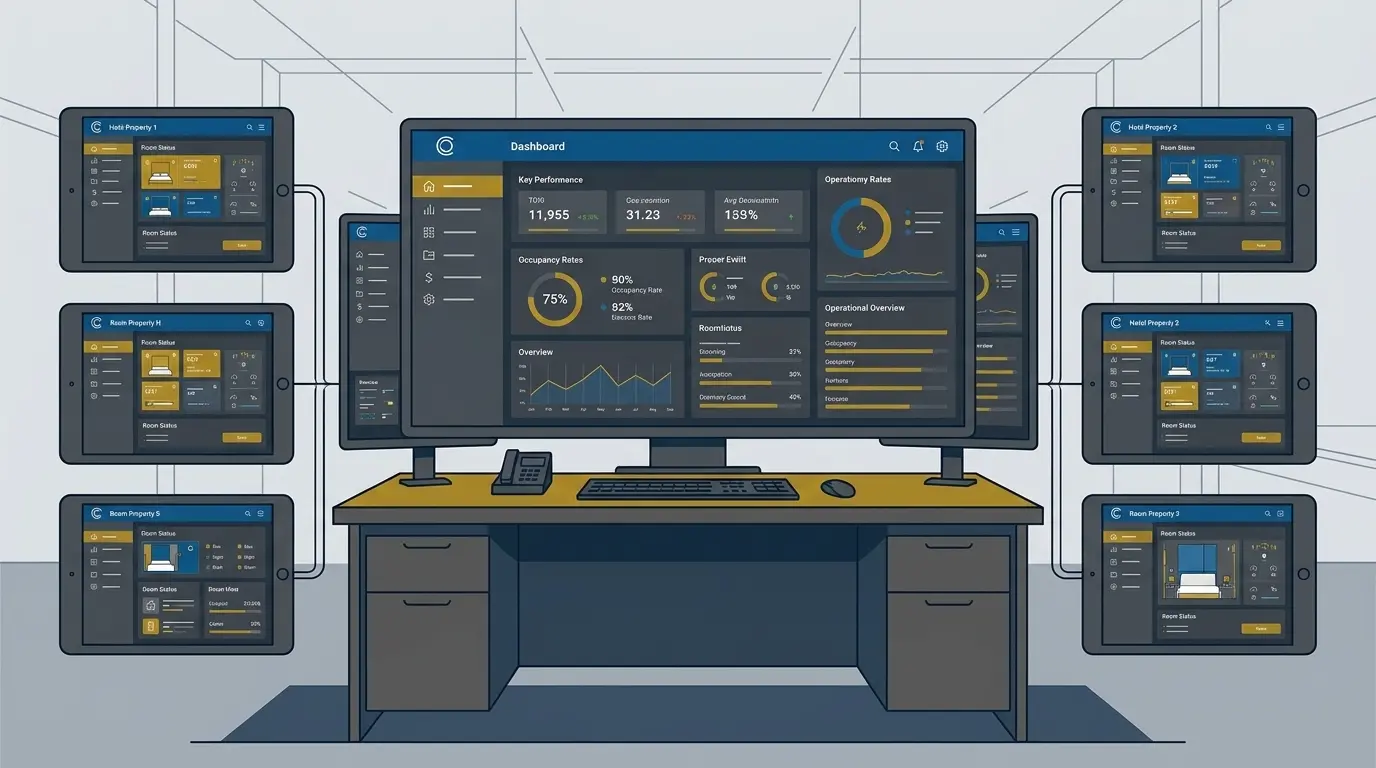
Conversely, a regional hospitality group operating five urban properties requires an integrated enterprise approach. Rather than relying on rigid commercial SaaS subscriptions, the operator deploys multiproperty hotel automation software development to link centralized accounting, smart hardware door locks, and housekeeping logistics. A dedicated channel management engine handles bulk distribution across hundreds of online travel agents, ensuring synchronized room availability across all properties while cutting per-room software subscription costs.
Navigating Tech Stack Decisions for Hospitality Growth
Hospitality executives must evaluate whether commercial software suites or tailored enterprise integrations best support long-term expansion goals. Off-the-shelf software tools often impose restrictive feature roadmaps, inflexible user licensing, and escalating seat fees that strain growing budgets. When commercial tools limit operational velocity, decision-makers turn to custom engineering to integrate proprietary PMS cores with enterprise-grade distribution gateways. Conducting a technical architecture audit allows executives to identify data bottlenecks, assess API capabilities, and build a unified software roadmap that scales alongside property portfolios.
Conclusion: Unifying Management and Distribution for Enterprise Scale
Navigating the hotel PMS vs channel manager choice is never an either/or architectural decision. Sustainable commercial performance requires harmonising internal property operations with rapid external distribution. By replacing manual room reconciliation with unified, automated software pipelines, hospitality enterprises eliminate operational bottlenecks, protect direct margins, and elevate guest service delivery. Colladome partners with ambitious founders, CXOs, and operations heads to architect resilient custom enterprise web applications, bespoke hotel management systems, and advanced automation platforms built for scale. Let’s make the next big thing together!