
Mobile app development for startups is the process of turning a new business idea into a small, testable app, launching it to real users and then growing it based on what they do. The smart path is idea, validation, MVP, launch and iteration. In short, build less at first and learn faster.
Key takeaways
- Startups should launch a minimum viable product (MVP) that solves one core problem well, not a full app.
- The journey has six stages: validate, scope, design, build, test and launch, then measure and improve.
- Cross-platform frameworks such as Flutter suit most startup MVPs because one codebase covers Android and iOS.
- Cost and timeline depend on features, platforms, integrations and the team, so a written scope matters more than a price list.
- A good development partner challenges your scope, shows live apps and gives you full ownership of the code.
This guide explains each stage in plain words. It also covers MVP features, tech choices, budget drivers, common mistakes and how to pick a partner. In addition, it shows how Colladome helps founders in India, the UAE, the USA and the UK go from idea to launch.
What Is Mobile App Development for Startups?
Mobile app development for startups means building an app under tight time, money and certainty limits. Unlike an enterprise project, the goal is not a complete product. Instead, the goal is to prove that people want the product, then improve it quickly. Speed of learning matters more than the number of features.
A large company already knows its users. A startup, however, is still guessing. As a result, every early build is an experiment. The app should answer one question: will people use this, and will they come back?
That is why startup builds follow a different rhythm. Teams ship small releases, watch the data and change direction when needed. So the process, not the first version, is what creates a successful product.
Why Should Startups Build an MVP First?
Startups should build an MVP first because it tests the riskiest idea with the least money and time. An MVP is the smallest version of the app that still delivers real value. It lets founders collect real user feedback before they spend heavily on features nobody may need.
Many founders want to launch with every feature they have imagined. However, that approach delays launch and burns runway. It also hides what users actually value. A focused MVP, on the other hand, gives clear signals within weeks of release.
This idea is central to mobile app development for startups. For example, Y Combinator’s essential startup advice tells founders to launch now and talk to users. In other words, the market is the best product manager you will ever have.
MVP vs Prototype vs Full Product: What Is the Difference?
A prototype shows how the app could look and flow, but it does not work with real data. An MVP is a working app with only the core features. A full product adds scale, extra features and polish. Each stage answers a different question, so startups usually move through all three in order.
| Stage | What it is | Main question it answers | Who uses it |
|---|---|---|---|
| Prototype | Clickable design screens with no real back end | Is the idea clear and easy to use? | Founders, early testers, investors |
| MVP | A working app with one core user journey | Will real people use it and return? | First real users |
| Full product | A scaled app with more features, roles and integrations | Can it grow and earn reliably? | A growing user base |
Skipping the prototype often leads to expensive rework later. Likewise, skipping the MVP means building a full product on untested guesses. Our product design and ideation services help founders turn an idea into a tested prototype before any code is written.
What Are the Stages of Startup App Development?
Mobile app development for startups usually has six stages: validate the problem, define the MVP scope, design the experience, build the app, test it, and launch and measure. Each stage reduces a specific risk. Skipping one rarely saves time, because the gaps show up later as rework, delays or low adoption.
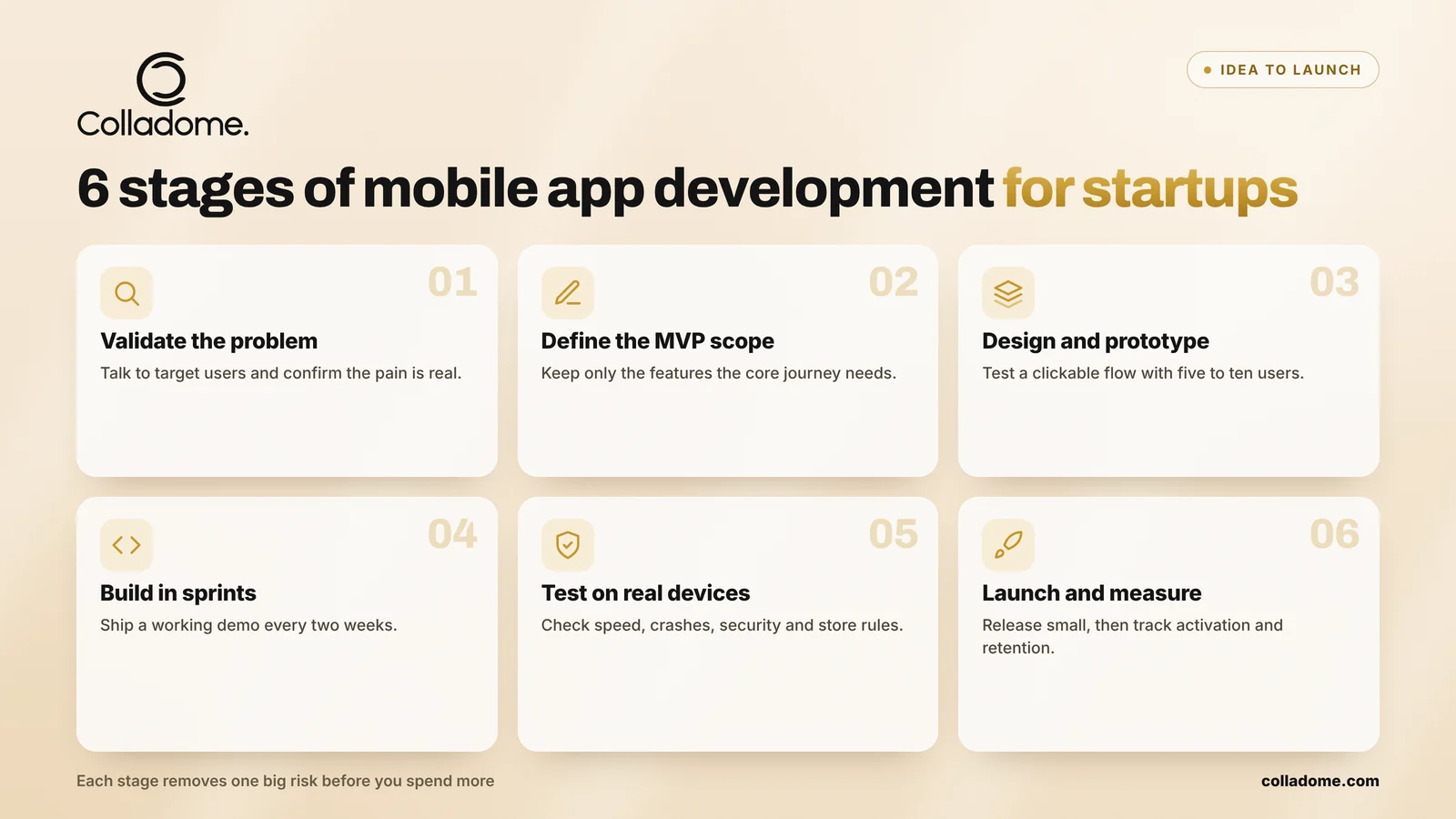
- Validate the problem. Talk to potential users first. Confirm that the problem is real and painful enough to solve.
- Define the MVP scope. List every feature, then keep only those needed for the core journey.
- Design the experience. Create wireframes and a clickable prototype. Then test it with five to ten target users.
- Build in short sprints. Develop the app in two-week cycles with a working demo at the end of each one.
- Test on real devices. Check speed, crashes, security and store rules before release.
- Launch and measure. Release to a small group first. Next, track sign-ups, activation and retention.
Which Features Belong in a Startup MVP?
A startup MVP should include only the features needed for one complete user journey, plus basic sign-up, analytics and support. Everything else can wait. A good test is simple: if removing a feature still lets users get the main value, that feature belongs in a later release.
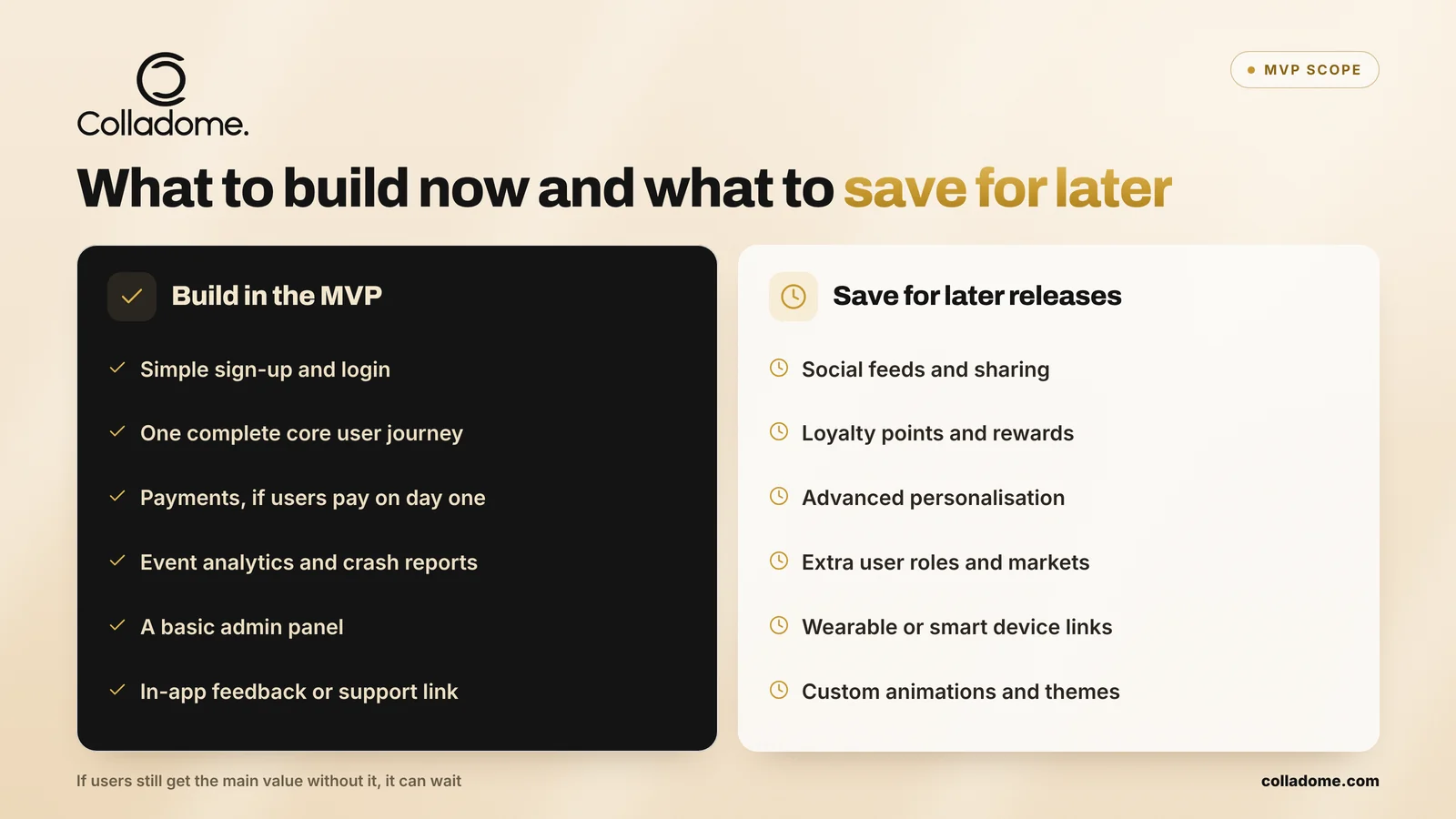
For instance, a fitness startup may only need workout plans, progress tracking and reminders in version one. Social feeds, wearables and coaching chat can follow later. Similarly, a marketplace MVP may start with one city and one category.
Do not skip analytics, though. Without event tracking, you cannot learn from your launch. Also plan a simple admin panel, so your team can manage users and content without a developer.
Native vs Cross-Platform vs No-Code: Which Should Startups Choose?
In mobile app development for startups, cross-platform is usually the best choice for an MVP. Frameworks such as Flutter and React Native build Android and iOS apps from one codebase, which saves time and budget. Native development suits apps with heavy device features, while no-code tools suit very early experiments that may be rebuilt later.
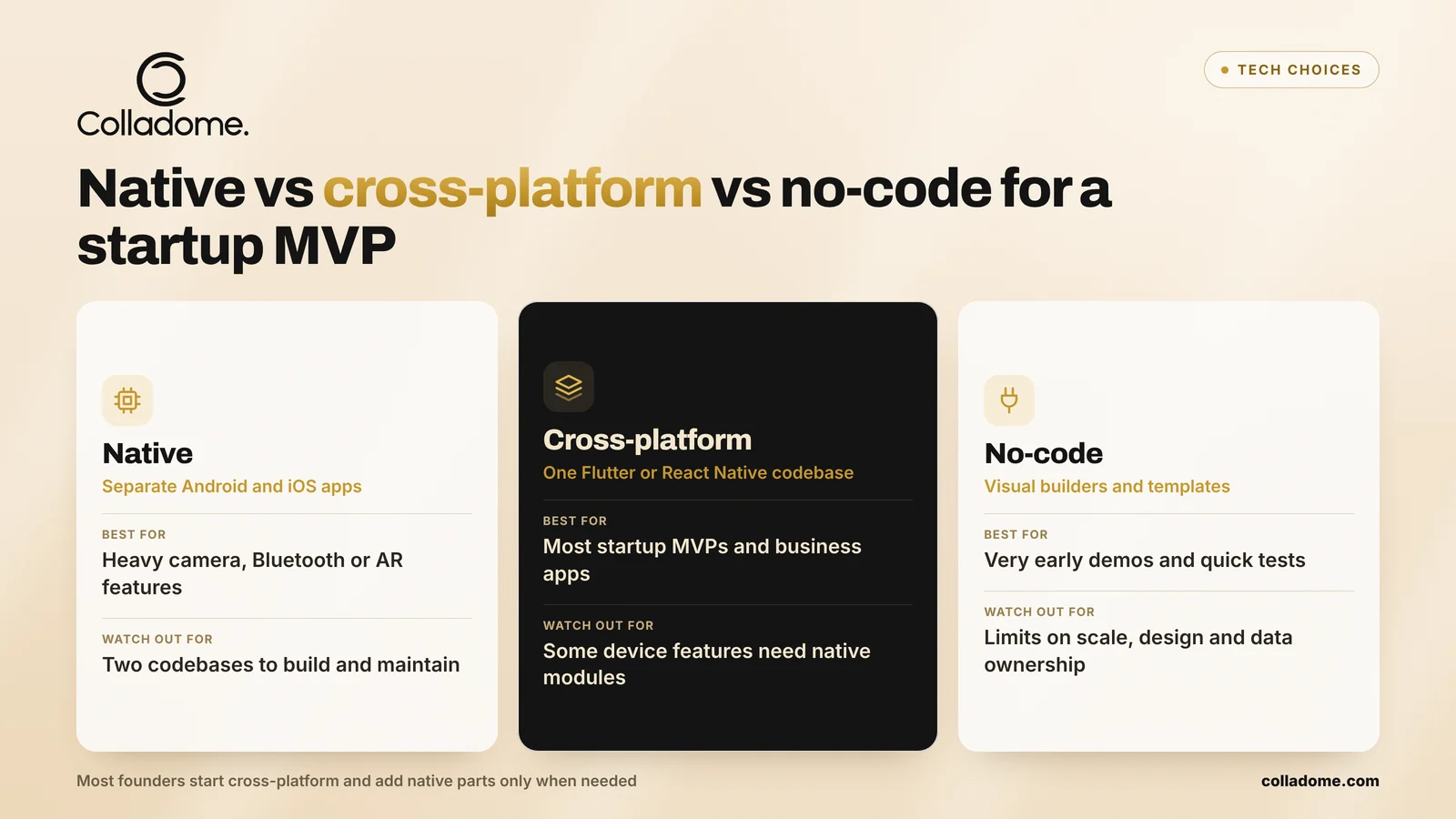
The right choice depends on your product. For example, an app that relies on advanced camera, Bluetooth or AR features may need native code. A booking, learning or ecommerce app, by contrast, usually runs very well on a cross-platform stack. You can learn more in our guide to Flutter app development.
No-code tools are fast for demos. However, they can limit performance, design freedom and data ownership as you grow. So if you start with no-code, plan for a rebuild once you find traction.
How Much Does Mobile App Development for Startups Cost?
The cost of mobile app development for startups depends on feature count, the number of platforms, integrations, design depth and the team’s location and model. There is no fixed price. A lean MVP with one core journey costs far less than a marketplace with several user roles and payments.
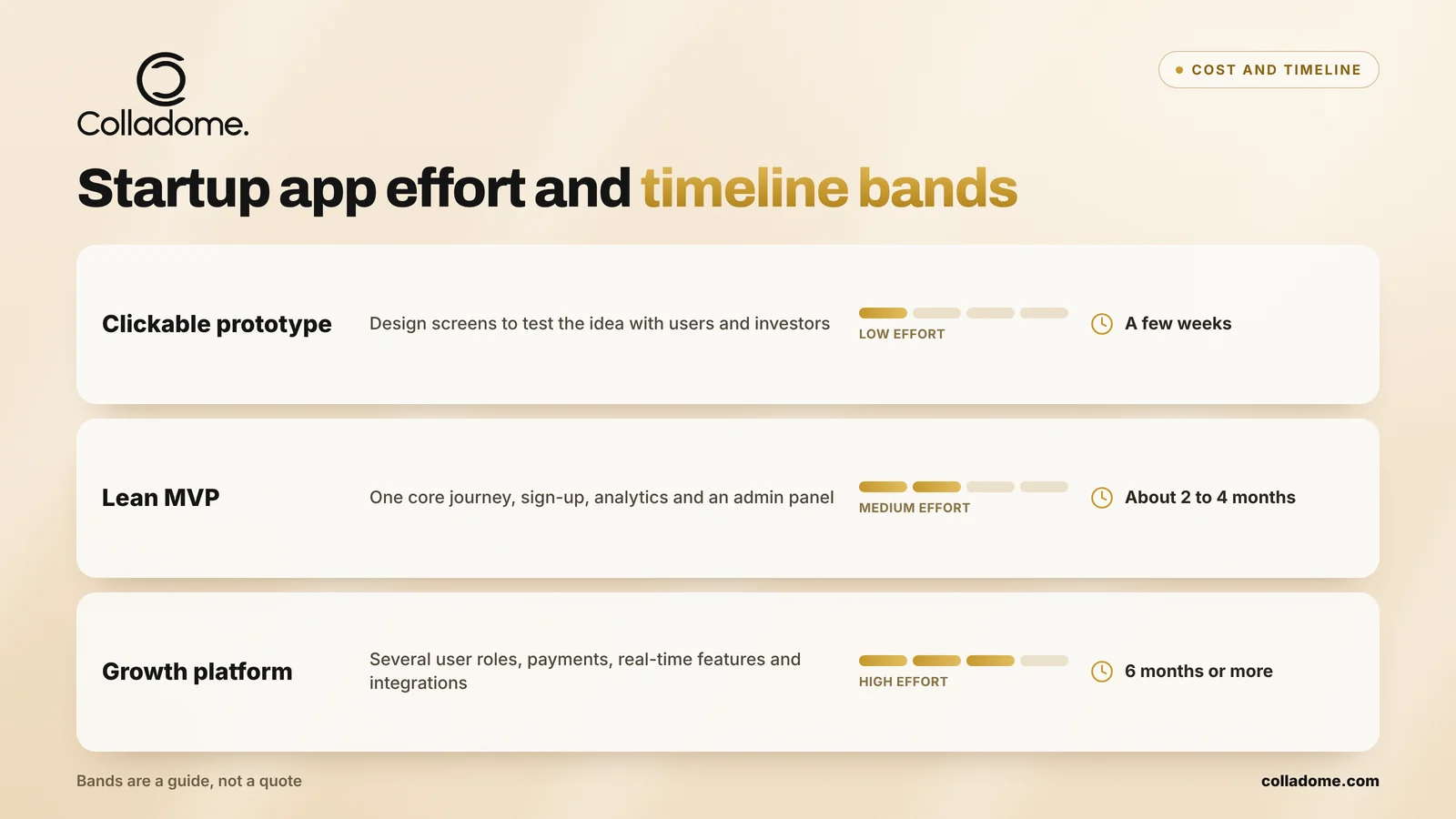
The main cost drivers are easy to list:
- Features and user roles. Each role, such as customer, vendor and admin, adds screens and logic.
- Platforms. One cross-platform codebase usually costs less than two native apps.
- Integrations. Payments, maps, chat and third-party APIs all add effort.
- Design depth. Custom animations and illustrations take longer than a clean standard UI.
- Team model. Fixed price, time and materials and dedicated teams each price risk differently.
For a deeper breakdown, read our guide on the cost of mobile app development. Want a clear estimate for your idea? Talk to the Colladome team and get a written scope for your MVP.
How Long Does It Take to Build a Startup App?
A focused startup MVP often takes about two to four months from approved scope to store launch. A prototype can take a few weeks. A complex platform with several roles, payments and real-time features can take six months or more. Clear decisions and fast feedback shorten every phase.
Delays rarely come from coding alone. Instead, they come from changing scope, slow approvals and late content. So agree on the MVP list before development starts. Then protect it.
Also plan time for app store review. Apple and Google both review apps before release, and a rejection can add days. Therefore, build store guidelines into your testing checklist from the start.
What Mistakes Should Startups Avoid in App Development?
The most common mistakes in mobile app development for startups are building too many features, skipping user research, choosing a partner on price alone and launching without analytics. Each one wastes runway. Avoiding them does not need a bigger budget. It needs discipline about scope and a habit of testing with real users early.
- Building for everyone. Start with one clear user group and one main problem.
- Ignoring retention. Downloads mean little if users do not come back.
- No code ownership. Make sure you own the source code, store accounts and cloud accounts.
- Skipping QA. Crashes in the first week can sink your ratings. Our QA testing services catch these issues before launch.
- No plan after launch. Budget for at least a few months of updates and fixes.
How to Choose a Mobile App Development Partner for Your Startup
Choose a partner that has launched live apps, asks hard questions about your users, works in short sprints and gives you full code ownership. The best partner acts like a product team, not just a coding shop. They should push back on extra features and help you protect your runway.
Use this short checklist when you compare companies:
- Ask for live apps on the App Store or Google Play, not just screenshots.
- Check that they have product, design, development and QA people in-house.
- Ask how they define and freeze an MVP scope.
- Confirm the contract gives you the code, designs and accounts.
- Ask what support looks like after launch.
If you are comparing local options, our guide to choosing a mobile app development company in Jaipur covers more checks. Founders who need early technical direction can also read about software consulting services for startups.
How Colladome Can Help
Colladome helps founders plan, design, build and grow mobile apps from the first idea to a scaled product. We are a custom software, AI and digital solutions company with 500+ projects delivered across 25+ industries. Our offices are in Jaipur, Hyderabad, Dubai and Portland, USA, and we are ISO 9001 and CMMI Level 3 certified.
Our mobile app development services cover discovery, UI and UX, Android, iOS and cross-platform builds, QA and post-launch support. For example, we built the Goalfi financial education app and the Dooper healthcare app, each with its own product challenges. Moreover, if your startup sells products, our guide to ecommerce app development explains the features shoppers expect.
Ready to turn your idea into a launch-ready MVP? Contact Colladome today for a free consultation and a clear, written plan for your startup app.
Frequently Asked Questions
What is the best way to develop a mobile app for a startup?
The best way is to validate the problem first, then build a lean MVP with one core user journey. Test a clickable prototype with real users, build in short sprints, launch to a small group and improve the app based on activation and retention data rather than guesses.
How much does it cost to build an app for a startup?
There is no fixed price. The cost depends on features, user roles, platforms, integrations, design depth and the team model. A lean MVP costs far less than a multi-role platform. A written scope is the best way to get a reliable estimate, as explained in our guide to the cost of mobile app development.
How long does it take to build a startup MVP app?
A focused startup MVP usually takes about two to four months from an approved scope to store launch. A clickable prototype can take a few weeks. Complex platforms with payments, real-time features and several user roles often take six months or more. Fast decisions and a frozen scope keep timelines short.
Should a startup build a native or cross-platform app?
Most startups should build a cross-platform app first. Flutter or React Native creates Android and iOS apps from one codebase, which saves time and budget. Native apps make sense when the product depends on advanced camera, Bluetooth or AR features. Read our Flutter app development guide to compare options.
What features should a startup app MVP include?
An MVP should include only what one complete user journey needs: simple sign-up, the core feature, payments if users pay on day one, analytics and crash reports, and a basic admin panel. Social feeds, rewards, advanced personalisation and extra roles can wait for later releases once you see real usage.
Is it better to hire freelancers or an app development company for a startup?
An app development company is usually safer for a startup MVP. You get product, design, development and QA in one team, plus continuity if someone leaves. Freelancers can work for small, well-defined tasks. Whichever you choose, insist on full code ownership and a written scope before work starts.
Can a startup app be built without a technical co-founder?
Yes. Many founders work with an experienced development partner that acts as their product and technology team. The partner helps validate the idea, scope the MVP and choose the tech stack. Early software consulting for startups can also guide architecture and hiring decisions as the product grows.