
The Dual Dilemma: Operational Bottlenecks vs Direct Revenue Loss
Boutique hotel groups and growing hospitality SMEs regularly struggle with a core structural confusion: treating customer-facing reservation channels and on-property resource management as interchangeable software. When hoteliers mistake sales acquisition for operational orchestration, technical debt accumulates rapidly. Disjointed legacy modules force front-desk staff into manual cross-checking, triggering rate disparity across platforms, room overbookings, and inaccurate night audits.
This fragmentation exacts a steep commercial toll. Without a dedicated digital sales portal, accommodation businesses surrender up to 25% of gross reservation revenue to third-party Online Travel Agencies (OTAs). Concurrently, off-the-shelf middleware often fails to bridge data silos between guest folios and external booking streams, degrading the guest experience before arrival.
Architectural Clarity: Decoupling Operations from Acquisition Channels
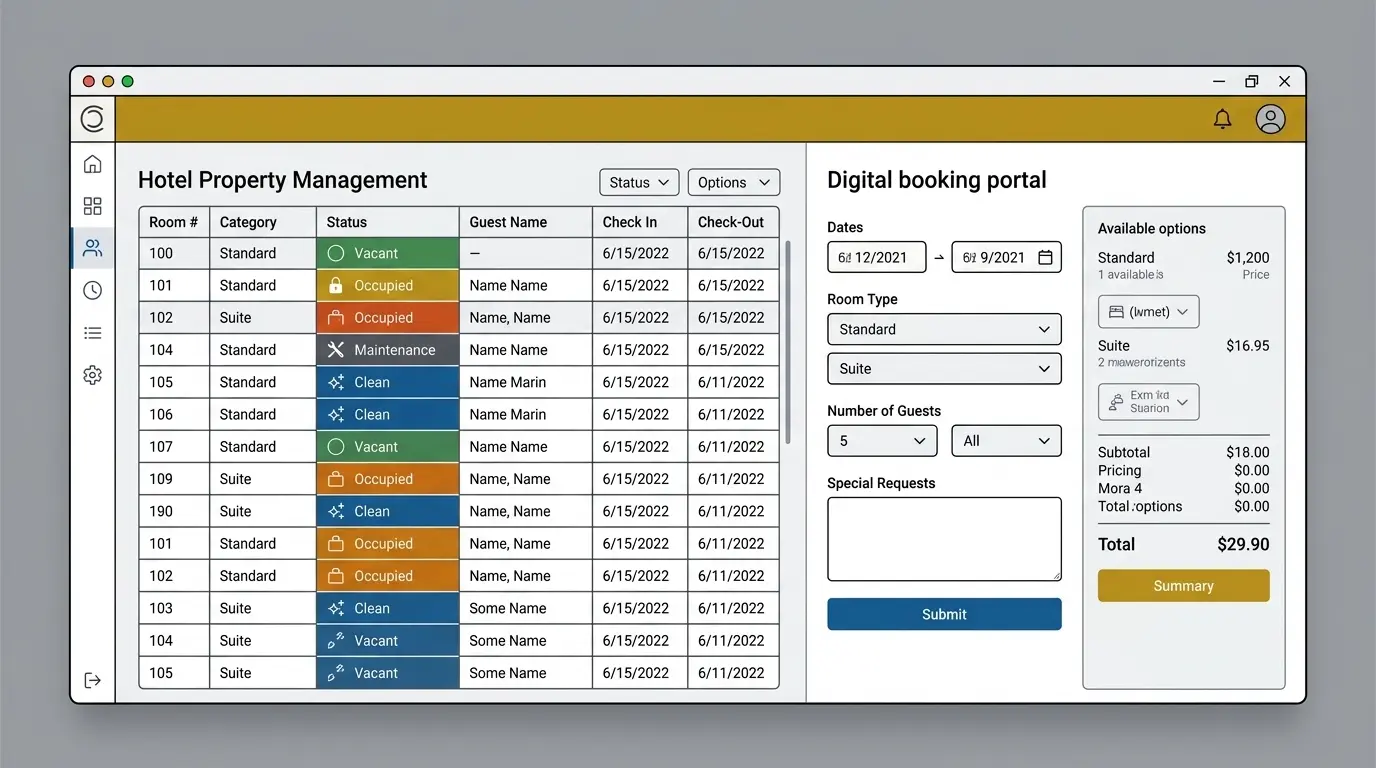
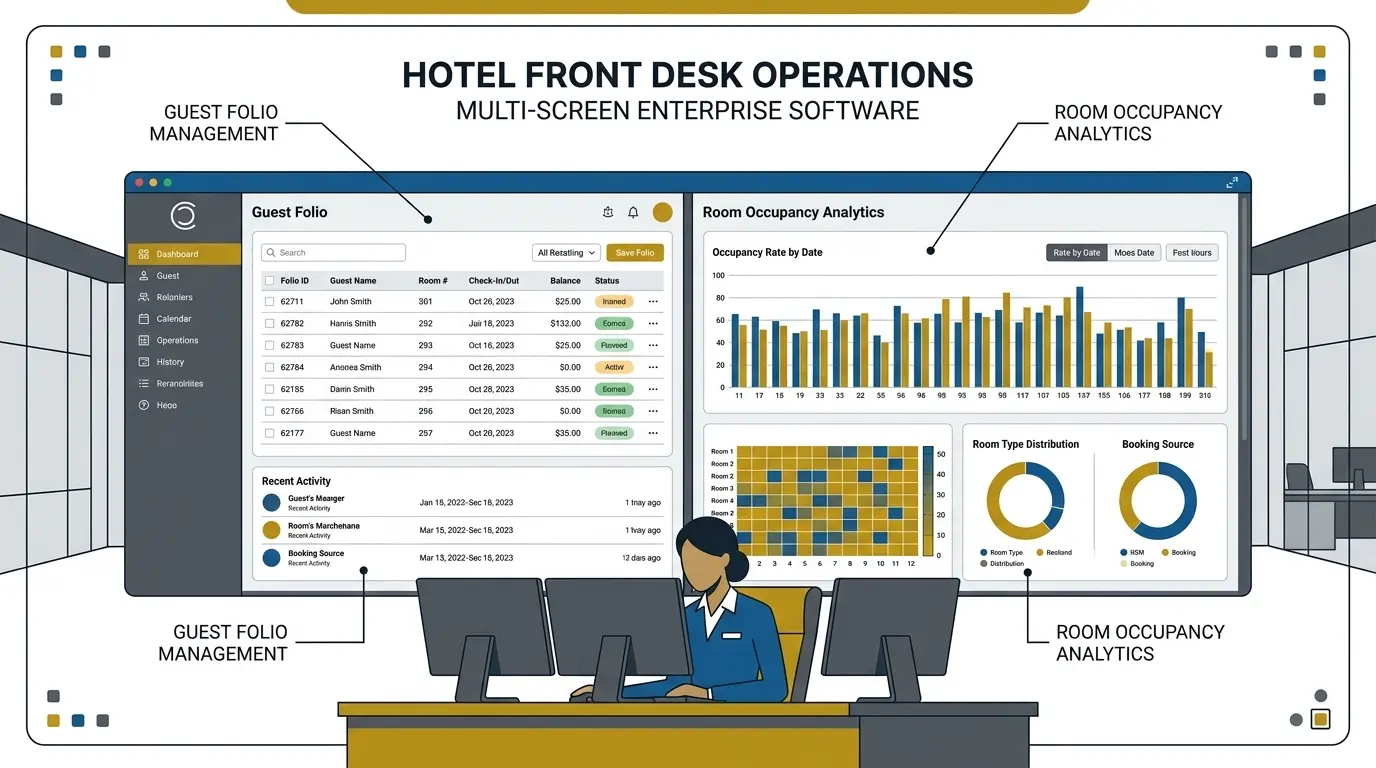
Modern hospitality technology requires decoupling enterprise operations from sales acquisition channels. A robust hotel PMS acts as the single operational source of truth. It manages room availability, coordinates automated housekeeping schedules, calculates food and beverage charges via point-of-sale integrations, and consolidates central ledgers. In contrast, an enterprise booking engine serves as a high-conversion transactional gateway designed to capture unmediated guest demand.
Achieving architectural synergy between both systems eliminates key business constraints for SMEs. When a custom hotel PMS communicates instantly with an unconstrained booking engine, live inventory updates across all touchpoints. Guests receive instant booking confirmations, while on-property managers gain clean folio data without manual intervention or commission leakages.
Strategic Implementation Matrix: Resolving Core Hospitality Challenges
- Challenge: Disparate inventory allocation causes recurring double-bookings across regional properties. | Architecture: Custom hotel management software development implementing bidirectional webhook synchronization. | Business Outcome: Zero room inventory sync latency and total rate parity across channels.
- Challenge: Fragmented guest profiles prevent personalized pre-arrival communication and post-stay marketing. | Architecture: Enterprise data consolidation routing direct reservations into centralized guest folios. | Business Outcome: Unified guest history capture and reduced front-desk administrative check-in times.
- Challenge: Heavy dependency on OTAs erodes profit margins on high-occupancy dates. | Architecture: High-performance hotel booking engine development natively integrated with property ledgers. | Business Outcome: Shift of reservation volume to direct web bookings, preserving 15–25% gross margins per room.
Core Functional Distinctions in Enterprise Hospitality Architecture
1. Core Operational Mission
The hotel PMS serves an internal, operational mandate. It coordinates back-office staff, assigns room keys, tracks maintenance tickets, and manages night audits. The booking engine fulfills an outward, commercial mandate, driving seamless digital self-service, room showcases, and instant payment validation for digital travellers.
2. Data Repository & Guest Folio Ownership
A PMS functions as a permanent enterprise database, capturing comprehensive stay histories, corporate billing profiles, and ancillary on-property spend. The booking engine handles short-lived checkout sessions, capturing payment tokens and guest contact data before passing the completed reservation payload downstream into the property ledger.
3. Channel Management and Inventory Feeds
While the PMS calculates physical room availability and manages internal capacity, the booking engine acts as a focused direct-sales channel. Enterprise setups often link the PMS to an integrated channel manager to balance external OTA feeds while reserving exclusive rates for the native booking engine.
Direct Financial and Operational Impact on Hotel Performance
1. Margin Preservation Against OTA Commissions
Direct web bookings completely eliminate third-party commission fees, which typically range between 15% and 25% per transaction according to industry benchmarks from Hospitality Net. A direct booking engine preserves gross profit margins, enabling operators to reinvest revenue into guest experiences and digital marketing.
2. Front-Desk Workload and Automated Housekeeping
A PMS eliminates manual administrative constraints. When a booking confirms, the PMS automatically updates room status boards and dispatches housekeeping tasks based on real-time check-outs. This systematic workflow eliminates front-desk data entry errors and accelerates room turnover times across multi-property portfolios.
3. Revenue Management and Dynamic Pricing Deployment
Modern revenue optimization algorithms analyze seasonal demand and room capacity within the PMS. The platform then pushes adjusted yield management pricing straight to the booking engine. This dynamic rate adjustment maximizes Revenue Per Available Room (RevPAR) across periods of peak and trough demand.
Integration Protocols, Custom Builds, and Architectural Synergy
1. Two-Way API Middleware and Latency Elimination
Enterprise reliability depends on asynchronous two-way APIs and webhooks. When guests book online, the transactional engine must debit the central inventory immediately. Sub-second synchronization prevents overbooking during sudden traffic surges, maintaining operational trust across independent properties.
2. Custom Engineering vs Off-The-Shelf SaaS Limits
Off-the-shelf subscriptions enforce rigid data schemas and recurring per-room fees. When evaluating build vs buy hotel management software, forward-thinking operators increasingly favor custom builds. Bespoke development removes feature bloat, guarantees data ownership, and scales effortlessly alongside proprietary business rules.
3. Unified Guest Journey and Lifetime Data Capture
A coordinated tech stack links discovery to long-term loyalty. When reservation engines feed directly into an internal PMS and hospitality CRM software, properties capture accurate guest preferences. This unified data loop unlocks automated post-stay retargeting and repeat direct bookings.
Architectural Decision Matrix: PMS vs Booking Engine
| Architectural Dimension | Hotel Property Management System (PMS) | Hotel Booking Engine | Strategic Business Advantage |
|---|---|---|---|
| Operational Scope | Internal resource allocation, front-desk workflows, housekeeping, folios. | External conversion interface, payment processing, room availability display. | Clear separation of guest acquisition from operational task fulfillment. |
| Primary Users | Front desk staff, general managers, housekeeping, finance auditors. | Prospective leisure guests, corporate travel bookers, group planners. | Specialized, distraction-free user experiences tailored to specific roles. |
| Data Handled | Master guest folios, internal invoices, room cleaning states, night audits. | Transient payment tokens, reservation dates, room rate calculations. | Guaranteed data security compliance and localized operational records. |
| Revenue Mechanism | Operational cost control, labor efficiency, asset maintenance scheduling. | Direct revenue capture, unmediated checkouts, zero OTA commission loss. | Preservation of gross operating margin paired with reduced administrative overhead. |
| Integration Requirement | Central enterprise database and operational backbone for the property. | API consumer integrating payment gateways and streaming data into the PMS. | Modular architecture supporting painless feature expansion and upgrades. |
Real-World Deployment Scenarios: Scaling Hospitality Infrastructure
Scenario A: Regional Resort Portfolio Facing Overbookings. A multi-property boutique resort group experienced recurring overbookings across its 180 keys due to asynchronous inventory sync. By deploying a centralized custom PMS paired with direct API booking nodes, the brand unified all room distributions. Live inventory feeds resolved manual reconciliation delays, dropping front-desk check-in latency by 40%.
Scenario B: Luxury Independent Hotel Eliminating Distribution Tolls. A high-end independent property surrendered more than ₹45,00,000 annually to third-party aggregator commissions. Building a bespoke, mobile-optimized booking engine tied straight to its back-office ledgers shifted 38% of total guest acquisition to native web traffic within twelve months, substantially lifting net RevPAR.
Evaluating Hospitality Architecture for Enterprise Scale
Transitioning from disparate software tools to an enterprise hospitality framework requires a thorough assessment of technical debt. Operations directors must evaluate integration limits, ongoing subscription overheads, and rate disparity risks within their current systems. When third-party platforms restrict custom workflows or guest profile ownership, bespoke engineering offers clear long-term value. Colladome provides specialized software engineering and technology consultations, helping hospitality brands architect unified, scalable property management systems and conversion engines tailored to their exact operational requirements.
Unifying Operations and Acquisition: The Strategic Imperative
Mastering modern hospitality distribution does not mean choosing between a hotel PMS vs booking engine. Sustainable business growth requires deploying both systems as interdependent, synchronized assets. The booking engine drives profitable guest acquisition, while the PMS ensures smooth operational fulfillment, staff coordination, and guest satisfaction.
By removing technological constraints through customized architecture, hotel operators protect their commercial margins and deliver exceptional guest experiences across every stay. Let’s make the next big thing together!